"The socialist state-owned enterprise has before it a historic opportunity to demonstrate that it can be agile, efficient, and competitive without abandoning its socialist nature. Business directors bear the responsibility of ensuring that this opportunity is not lost in the gap between rhetoric and practice."
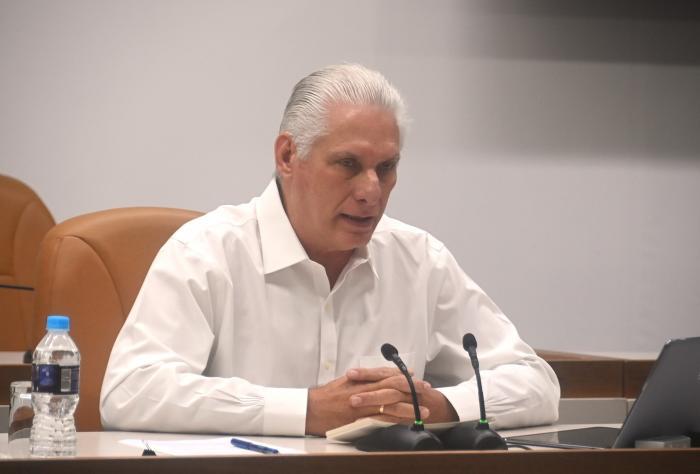
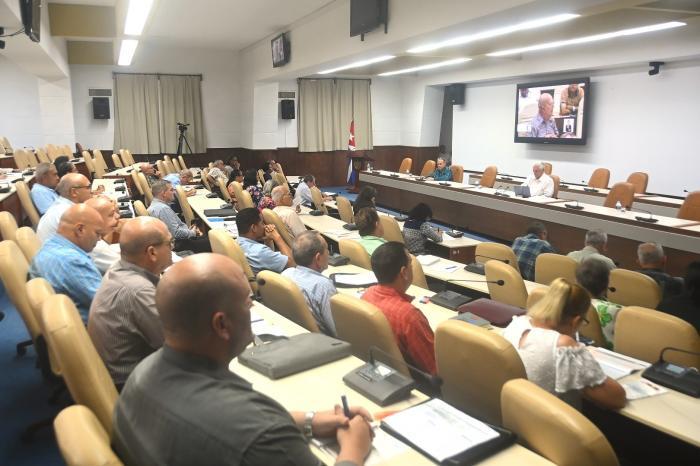
This statement was made by Miguel Díaz-Canel Bermúdez, First Secretary of the Central Committee of the Communist Party and President of the Republic, during a dialogue with over fifty executives who took part in a training exercise on the 176 Economic and Social Transformations. The exercise, held at the Higher School for State and Government Cadres, included the participation of presidents of business groups and governing boards.
As a follow-up to a seminar held in late September, the National Institute for State Business Assets (INAEE, in Spanish) reported on its tasks during the initial phase of implementing these transformations. The progress of this process was also evaluated across nearly a dozen business groups from various sectors.
During the meeting—moderated by Roberto Ricardo Marrero, president of the INAEE—President Miguel Díaz-Canel Bermúdez urged executives within the state business sector to commit to "management efficiency, worker participation, and delivering results for the people."
He noted that, by the end of October, the transformations were supported by a robust legal framework: the legal foundations for 171 of these measures had been established, and 215 specific regulations had been approved. All that remains is to finalize the procedures for five of them—the most controversial ones, he noted—though work has been underway on the legal regulations that will underpin them.
The working groups tasked with addressing the 23 thematic areas of the transformations have put forth an enormous effort; in just three months, 215 legal regulations have been produced, the leader reiterated, providing an extensive overview of this entire regulatory undertaking.
Nevertheless—the First Secretary of the Central Committee of the Communist Party added—what will ultimately determine the direction of these transformations "will be the attitude of the officials: their willingness to lead the change with proper preparation, social responsibility, the participation of the workers, and ideological firmness," while avoiding "the temptations of the market, as well as complacency and inertia."
WORKERS: THE DRIVING FORCE BEHIND THE TRANSFORMATIONS
During the exchange, the President of the Republic shared key perspectives on the role the country’s leadership assigns to the state-owned enterprise, the function of its managers, the concept of "active trust," the responsibilities—including social responsibility—that these enterprises must uphold, the participation of the workforce, and potential negative trends that must be avoided or addressed.
Reflecting on the outcomes of a seminar held as a training exercise regarding these transformations, he noted that it reaffirmed that "the socialist state-owned enterprise is neither a residual actor nor an appendage of the administrative apparatus; rather, it is the primary agent of the national economy and the fundamental link upon which the 176 Economic and Social Transformations rest."
He further asserted that this preeminence of the socialist state-owned enterprise "is not measured by the number of entities or the volume of assets, but by the quality of management applied to these processes and the enterprise's actual capacity to generate economic efficiency compared to other forms of ownership and management. In short, the socialist state-owned enterprise must drive efficiency across all processes."
Emphasizing that these transformations are a core task for every enterprise, Díaz-Canel highlighted another essential concept—one that cannot be overlooked—namely, that "the driving force behind these transformations, and the force that enables enterprises to undertake them, is the workforce."
Given the critical importance he places on the role of workers in the success of these transformations, the President dedicated a portion of the discussion to establishing guidelines for how corporate leadership should engage with its employees.
BUSINESS AUTONOMY IS NOT A BLANK CHECK
Regarding the premises behind these transformations, the Cuban President noted that they grant state-owned enterprises an unprecedented degree of autonomy in the administration and management of their resources. This includes the decentralization of authority to approve wholesale prices, greater flexibility in the allocation of post-tax profits, and the ability to establish salary systems independent of a standardized, one-size-fits-all scale for all enterprises.
He emphasized that many of the approved changes address long-standing requests—such as granting enterprises the autonomy to import and export goods without intermediaries, authorizing them to manage their own fuel supplies, allowing them to design their own organizational structures, and enabling the creation of subsidiaries and MSMEs (micro, small, and medium-sized enterprises), among other prerogatives.
Nevertheless, he cautioned, "it must be clear that this autonomy is not a blank check." Autonomy serves as a driving force for change, but that change must translate into increased production, higher revenues, the generation of foreign currency, better pricing, and more dynamic job creation. Ultimately, it should lead to "what we all desire: a tangible improvement in the people's quality of life and the well-being of our population, so that we may achieve the prosperity our people deserve as quickly as possible."
TRANSFORMATION IS NOT SYNONYMOUS WITH PRIVATIZATION
During a discussion with representatives of the Cuban business sector, the President examined two key elements that must be central to any analysis of these transformations: the concepts of ownership and management. He explained that there is some confusion surrounding these issues—even among committed revolutionaries and the general public—and that adversaries are actively attempting to propagate specific narratives designed to distort the true nature of this process.
"It must be clearly understood," he emphasized, "that transforming into a commercial entity—whether structured through shares or equity stakes—is not the same as privatization." "Here," he reaffirmed, "we will always protect state-owned enterprises from privatization."
Díaz-Canel explained that various types of business ties—such as international economic partnerships—can be established within the country. Any state-owned enterprise that can be saved—that does not have to go bankrupt—will be preserved; however, all such processes will be managed, and they will not lead toward privatization.
Through these transformations, he argued, "the goal is to separate ownership from management, attract capital, improve efficiency, and better utilize the capacities currently underused within state-owned enterprises—all while maintaining social ownership as an inviolable principle."
SCIENCE, INNOVATION, AND OTHER DEVELOPMENTS THAT GENERATE REVENUE
Addressing state-owned enterprise leaders, Díaz-Canel revisited four key areas that should guide ongoing transformations—areas that also form part of his 23 thematic pillars: the energy transition, the circular economy, science and innovation, and digital transformation—including process automation and artificial intelligence. He stated that "state-owned enterprises must be at the forefront of these initiatives and must embrace them to achieve the greatest possible impact."
Regarding the energy transition toward renewable sources, he emphasized that any enterprise failing to initiate or intensify efforts toward its own energy sovereignty will be unable to remain competitive or meet production requirements.
He noted that this has become a more essential business development strategy than ever, given the "energy blockade" imposed by the empire—a situation where it is impossible to predict when further fuel supplies might reach the country.
In the face of this energy blockade, he added, "we cannot sit idly by; we must pursue an energy transition." He further explained that this is not limited to photovoltaic systems; it also encompasses wind energy, biomass, biofuels, biogas, and more.
The president added that these transformations also require state-owned enterprises to adopt a circular economy model, making the most of everything that can be recycled or reused.
As for science and innovation, he reiterated his consistent advocacy for both, insisting that "the country will move forward only if it is capable of innovating. And to innovate, we must cultivate scientific thinking and harness our existing scientific potential—which is truly remarkable. Every day, we see the significant contributions made by our research and scientific teams." To this end—he clarified—"what we must seek is a more dynamic interconnection between the knowledge sector and the business sector, so that research results provide solutions to the specific problems we face."
He acknowledged that, in recent years, "the Government Management System based on Science and Innovation has improved this interrelation; there are now broader frameworks for engagement—addressing both the demands placed on science and innovation entities by businesses and those originating from the public administration. However," he noted, "certain capacities and potential remain underutilized."
Regarding the process of digital transformation and the global surge in artificial intelligence (AI) over the last three years—a field in which Cuba possesses over thirty years of experience—Díaz-Canel emphasized to state-sector business leaders that these tools can enhance the productivity and performance of all our production and service processes. "This," he warned, "is a new global industrial revolution; if we do not embrace it, we will inevitably fall behind."
Digital transformation and AI, he added, also offer an ideal solution to the demographic challenges we face. They represent "the only way to make our processes more productive and profitable, even as our economically active population shrinks and must support an increasingly large economically inactive population."
"Automating processes, undergoing digital transformation, and incorporating artificial intelligence"—this is the solution, the Head of State reaffirmed. He reiterated his directive that any new investment within the state-owned business sector must integrate renewable energy sources, digital transformation, and artificial intelligence; furthermore, existing operations must begin shifting their processes in this same direction—all while seeking answers through science and innovation.
THE ROLE OF BUSINESS DIRECTORS
"The success of these transformations depends, to a large extent, on the leadership capacity of our officials," stated the First Secretary of the Central Committee of the Communist Party and President of the Republic, while analyzing the role of business directors in the success of the 176 Economic and Social Transformations.
"Directors of state-owned enterprises are not merely passive executors of legal regulations. While legal regulations provide guarantees and legal certainty for these transformations, they do not, in themselves, bring them about. You—as business leaders—are the ones driving the process of change within each of your entities," Díaz-Canel defined.
"If you do not embrace this change, if you do not take ownership of this transformation, it will be very difficult for it to be carried out. This is, therefore, a significant responsibility—one that demands a deep level of commitment. You," he told them, "are officials of the Revolution; you are officials of the Party."
"And what legacy can we leave for future generations?" he asked. "It is the legacy of having the capacity to carry these transformations forward, ensuring the Revolution succeeds during one of the most difficult periods it has ever faced—a time when imperialism has attacked the Revolution with particular ferocity."
"We—all of us—must be able to tell our children and grandchildren: 'We saved the Revolution because we were creative, because we were courageous, because we did not give up, and because we did not bow to the designs of the empire.'"
"That is why it falls to you to exercise 'autonomy with responsibility'—not just in words, but by translating it into concrete decisions that unleash the productive forces within each of your organizations."
BUSINESS LEADERSHIP MUST BE BUILT
Regarding how to carry out the leadership that corresponds to the businessmen of the Cuban socialist state system, Díaz-Canel Bermúdez shared with them several fundamental elements:
"One, the preparation. There has to be a preparation of the paintings. Preparation is not only that of seminars, nor that of postgraduate courses, nor that of diploma courses, which are important vehicles of self-preparation."
"In this concept of preparation we must include the strengthening of the Governing Board and all the management teams of each business organization, because we are going to bold processes, we are even going to develop some concepts that had not been applied at other times."
The management teams of our state companies, he added, "require trained members, the proper functioning of these bodies and not an administrative formality that is a drag on innovation, development and that leads to bureaucracy."
Another element that cadres must possess and assume "is the change of mentality," said the Cuban President in an analysis of the relationships between the Central State Administration Agencies, the ministries and companies over the years.
They were relationships that were necessary at certain historical moments and allowed the Revolution to move forward, not without errors by organizations, ministries and companies, but now — Díaz-Canel stated — is also another historical moment, which is why we have these transformations.
Those relationships, he reiterated later, may have worked at one time, but they don't work now; Now we have to go to true autonomy. Now we have to find the currency and we have to export. And we have to find currency so that the company can have fuel - which is "no longer going to come through the canal" - to be able to buy inputs, raw materials.
The president also referred to the exchanges he has had in recent weeks with nearly twenty management teams from business systems and ministries, in which he has appreciated an adequate interpretation of the transformations.
"People are proposing and interpreting how to make good use of things." And now, where that is not the case, we must break with inertia, we must promote that change of mentality; That is why, he told them, I insist that you have to go to the base, to the entities of the municipalities, the provinces, where some still say that they have not received guidance.
But this attitude, he denounced, is being in the comfort zone. There is no need to wait for guidance. The Economic and Social Transformations are approved, 171 of them have all the content on how they can be implemented, and there are more than 215 legal regulations that ensure them.
In other words, he argued, if I am daring, if I have appropriated the change of mentality that is needed without anyone guiding me, I should already be analyzing what to do or interpreting how I am going to implement the transformations in my entity.
I know —the President of the Republic acknowledged— that the change of mentality may constitute the most cumbersome process, but life itself is going to lead us with tremendous speed to advance in this change of mentality.
In his reflections on what in his opinion should be the fundamental qualities that the directors of the Cuban socialist state business system must have, the First Secretary of the Central Committee of the Party also pointed out "the sense of belonging" of the businesswoman or businessman with his work group, the assumption that it is an intrinsic part of it.
"The main asset, the fundamental thing that we have in the company are the workers, who are the genuine representatives of the people. None of us knows more than all of us combined." "We must finish assuming in management," he said, "the concept of worker participation in decision-making."
Only in this way will we make fewer mistakes, Díaz-Canel explained, highlighting the importance of the company director maintaining a permanent exchange with the workers, as in those groups where, despite earning three or four thousand pesos, people remained in their factory, in their company. And they have done it, he stated, because in that group "there is a sense of belonging. And those workers know what needs to be done for that place to move forward."
"Give them participation, don't decide anything without consulting the workers," demanded the President. And so you will see - he warned them - how the transformations are enriched, how they are better understood, how the workers will defend them better and how a greater environment of cooperation, solidarity, defense, self-esteem is created.
What we are saying—Díaz-Canel pointed out—does not mean that workers have not participated in the country's processes; quite the opposite. What we are talking about is a more everyday, more daily participation, in the workplace, in the company, not just participation in the big moments.
As a fourth fundamental element to be assumed by businessmen and women in the state system, the Head of State referred to the concept of “social responsibility” and, within it, the intrinsic responsibility of the director, which is not exhausted in the economic balance, in the internal management of his company.
He thus referred to the possibilities that now exist for entities to allocate part of their profits not only to increasing salaries, but also to science and innovation, to solving problems of their groups, such as housing and food, among other stimuli aimed at retaining the workforce.
Part of these funds can also be used to support its retirees and young workers; contribute to the care of people in vulnerable situations who live in the communities where the company is located. But this, he clarified, cannot be “done by hitchhiking,” but rather it must be decided by the collective of workers and thus everyone will come out to defend it.
On another aspect of corporate social responsibility, Díaz-Canel recalled that this "is not a philanthropic addition, but is a constitutive part of the mandate of the socialist state company."
ENTERPRISES AT THE FOREFRONT OF THE TRANSFORMATION PROCESS
"The leadership of the Party, the Government, and the State have reaffirmed their full confidence in the capacity of the socialist state enterprise system to provide the country with what it needs," stated the First Secretary of the Central Committee of the Communist Party and President of the Republic during his discussion with the executives.
"However, this confidence comes with a requirement: directors must be at the forefront of the transformation process, rather than lagging behind in resistance. You are the ones who must break down any resistance that may exist toward these transformations," he noted, outlining the role the country expects enterprises to play in this process.
Regarding the socialist state enterprise, he conveyed the following expectation: "that they understand they are the protagonists of production and efficiency; and that the plan is executed efficiently—by reducing costs, improving quality, and increasing productivity."
"They should be generators of foreign currency—producing for export, supporting the development of tourism, and leveraging opportunities to export services abroad. They must be leaders in import substitution, capable of producing goods that the country currently has to purchase from elsewhere."
In analyzing the challenge posed by this philosophy—and advocating for the necessity of embracing it—the President explained that what is required is "a bit of boldness."
He pointed out that this is an approach already put into practice, citing the strategy used to confront the COVID-19 pandemic. This strategy enabled our scientists to develop five vaccine candidates—three of which became effective vaccines—with almost no funding, compared to the billions of dollars invested by developed nations that yielded no such results.
"Given the talent that exists within the country and our installed capacity—even when the technology might be considered obsolete, yet capable of being updated through innovation—this country is capable of producing anything," asserted Díaz-Canel Bermúdez. "When you see the talent that exists out there—what people achieve, what they set out to do, the dreams held by so many—it becomes clear that anything is possible here. But to achieve this, we must fully unleash our productive forces," he acknowledged.
Elaborating on the role the socialist state-owned enterprise is expected to play in this process of transformation, Díaz-Canel explained that it should also serve as a bridge to the non-state sector.
The socialist state-owned enterprise, he noted, must "learn to work with the non-state sector—with self-employed individuals, with non-state MSMEs, and with that private sector that complements us."
However, according to the leader’s analysis, this must be approached with intelligence and responsibility. It should be a mutually beneficial arrangement for both state and non-state economic actors—one that contributes to the enterprise’s development and fosters collaborative production, among other benefits, based on the contributions of each party.
After outlining further ideas regarding the role of state-owned enterprises in these transformations—such as serving as a "laboratory" where the boldest changes are tested before being applied elsewhere—the leader reiterated his core premise: if the socialist enterprise system "does not embrace these changes, the transformations will remain merely on paper."
"Transformations," he insisted, "are implemented in every plant, every factory, and every workplace; they are realized through every decision made by the management team and through the actions and contributions of every individual worker."
THE SOCIAL ROLE OF THE SOCIALIST STATE-OWNED ENTERPRISE
During the discussion, the First Secretary revisited the social mission of these entities, noting as a foundational principle that our enterprises "bear a social responsibility for which they must answer."
"A socialist state-owned enterprise—within the context of building socialism in Cuba," he defined, "is not merely an economic unit; it is a social unit. Within an enterprise, there are social relationships among workers and among collective groups. In these settings, we take on a social responsibility—a duty and an obligation—to the people."
"The state-owned enterprise represents the people’s property, utilizing that property for the benefit of the nation and the people themselves. Social transformation is measured by its impact on the lives of workers and their families—and, ultimately, by its impact on the entire population."
"An enterprise that focuses on production while neglecting its people is not truly undergoing transformation," he asserted. "On the contrary, it is depleting its most valuable capital: its workforce. We have no shortage of examples—both positive and negative—of this. It is precisely this reality that demands a shift in mindset. That is why," he added, "worker participation is so crucial."
Díaz-Canel explained that in an enterprise where workers actively participate, they cease to be mere labor and instead become agents of transformation. This, he noted, underscores "the vital importance of the relationship between management teams and the workforce in driving these transformations forward."
WARNINGS REGARDING NEGATIVE TRENDS
Díaz-Canel Bermúdez also analyzed negative trends that could potentially reverse the implementation and development of transformations within the socialist state-owned enterprise system.
He urged the need to confront "bureaucracy and stagnation. We must prevent managers from simply waiting for instructions or copying plans from the previous year... We must address inefficiency, financial losses, and the misuse of resources and energy." He called for the rejection of absenteeism and indiscipline, arguing that "those who do not work cannot share in the same results as those who do."
He also demanded transparency at all times regarding the use and allocation of the company’s assets. Such allocations—he insisted—must be decided collectively, avoiding any signs of cronyism, clientelism, or favoritism, all of which only serve to breed corruption.
He urged the need to "confront the 'comfort zone'—the habit of producing very little while complaining about everything." He warned against becoming disconnected from the workforce; management that fails to engage directly with production processes or get to know its people will not succeed in implementing changes.
Díaz-Canel firmly denounced what he termed "management by complaint"—the tendency to attribute problems to the macroeconomy, the embargo, or other external factors, rather than examining internal management practices.
COMMITMENTS TO BE ASSUMED BY BUSINESS MANAGEMENTS
In the summary of his words, the First Secretary of the Central Committee of the Party and President of the Republic asked the directors of the state business system to endorse the commitments derived from the seminar in which they had participated.
The first thing, he told them, is to "assume autonomy as a responsibility and not as an excuse for not doing things. Seek own solutions in coordination with other economic actors.
"And maintain political and ideological firmness in the face of market distortions, without confusing autonomy with abandonment of socialist principles, and evaluating by concrete results and not by formal compliance."
He urged them to turn each company into a collective learning space with workers; to increase productivity and efficiency, because the cost of production remains high in many companies; and to reject the formation of prices based on expenses, because with these we may be hiding inefficiency, and the people pay for the inefficiency.