

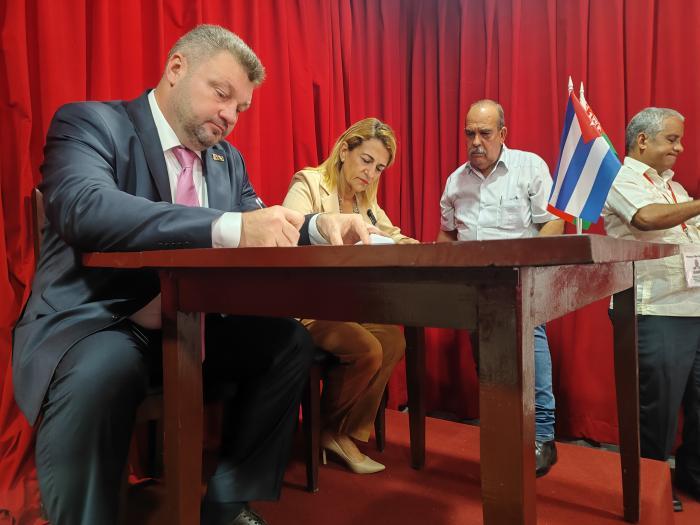
The Government of the Republic of Belarus has delivered a donation to the Cuban Ministry of Public Health consisting of 30 tons of powdered milk and nearly four tons of medicines. The contribution is intended to support medical care in hospital facilities, specifically at the University Pediatric Hospital and the William Soler Pediatric Cardiology Center.
Dr. Tania Margarita Cruz Hernández, First Deputy Minister of Public Health, expressed the gratitude of the Ministry and the Cuban people for this gesture of solidarity. She noted that it represents not only a significant material contribution but also a symbol of hope and humanity amidst the difficult circumstances currently facing the country.
During the handover ceremony—which was also attended by Carlos Luis Jorge Méndez, First Deputy Minister of Foreign Trade and Foreign Investment—the Deputy Minister explained that restrictions stemming from the United States’ economic, commercial, financial, and technological blockade—exacerbated by measures taken by the current U.S. administration and an "energy siege"—have limited access to the fuel, technology, and resources essential for the operation of hospital facilities.
These challenges hinder the proper storage of medicines, the use of high-tech medical equipment, the performance of surgeries, and the provision of emergency care.
In this context, she highlighted the value of the donation in sustaining medical care at the beneficiary pediatric institutions. The medicines, supplies, and food will assist in the treatment of patients and help address the needs of the health services.
Cruz Hernández noted that Cuba and Belarus share a long history of friendship and excellent relations, which include cooperation agreements in the healthcare sector between institutions and regulatory agencies in both countries. For his part, Vitali Barchuk, Ambassador of the Republic of Belarus to Cuba, explained that, given the complex situation facing the island—and in keeping with the tradition of assisting the Cuban people—his government decided to send this humanitarian shipment.
The diplomat stated that the aid would help improve the health and well-being of the population, particularly children, who represent one of the most vulnerable segments of society.
He noted that the shipments delivered to Cuba in recent years demonstrate the strong bonds of friendship between the two nations, built upon mutual respect and support within international forums. "For Belarus, remaining on the sidelines during such a difficult situation is not an option," he remarked.
In this regard, Dr. Eugenio Selman-Houssein Sosa, director of the William Soler Pediatric Cardiology Center, highlighted both the material and moral value of the donation—especially at a time when Cuba is grappling with the constraints imposed by an intensified economic and energy blockade.
He noted that this contribution provides significant support to the patients and staff at both institutions, while strengthening the country’s capacity to continue confronting these challenges.
Dr. Alena Fontane Valdés, director of the William Soler University Pediatric Hospital, expressed her gratitude for the humanitarian aid, emphasizing that it will benefit many children through both the provision of medicines and food supplies.
The donation, he stated, will contribute in different ways to the treatment of patients and constitutes an example of the continuity of exchange and cooperation between both nations.


