On Friday, the President of the Republic of Cuba, Miguel Díaz-Canel Bermúdez, expressed his deep admiration and respect for the work being done by the leadership, scientific experts, and staff of the Pedro Kourí Institute of Tropical Medicine (IPK).
The meeting between the President and the Institute’s team was defined by a sense of pride in the vast expertise and profound dedication demonstrated by this iconic institution—an organization whose mission is to improve the quality of life for the Cuban population and for the global community.
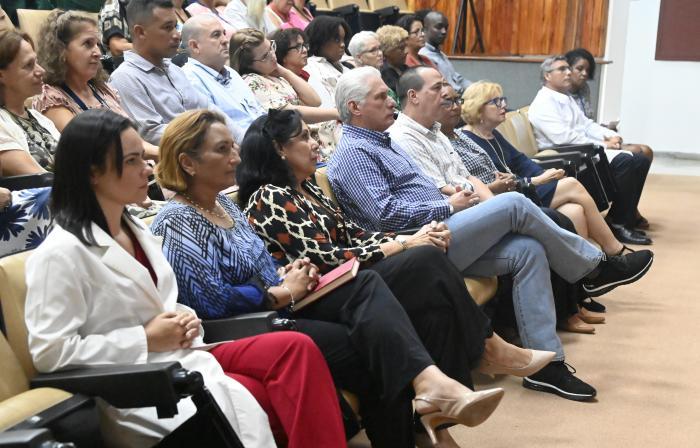
After listening to an expert presentation by Vivian Kourí Cardellá—a physician, microbiologist, Doctor of Sciences, and director of the IPK—the head of state highlighted how the Institute’s team has provided vital support during such "difficult times." Díaz-Canel remarked that he would never forget the COVID-19 pandemic, noting that the country had to confront it "amidst an extremely complex situation." It was during that period, he said, that the support of "centers like this one, and the institutions within the BioCubaFarma group," proved essential.
These entities, the President recalled, "were what carried us through; and I believe that, thanks to that effort and that innovation, our country became one of those that managed the disease most effectively." Reflecting on the response during those difficult days, the head of state remarked that "this heroism—everything that was done here regarding clinical trials, the initial research that began at the IPK back when COVID-19 was not yet known in the country—is what strengthened all of our protocols."
Before expressing his gratitude and admiration, the First Secretary of the Central Committee of the Communist Party of Cuba spoke with those present about the frequent visits that the country’s leadership has been making to healthcare facilities. He explained the reasons for this:
"This is one of the sectors that has been most severely targeted and impacted by the tightening of the blockade—particularly the energy blockade—and we are well aware of the conditions under which work is being carried out in centers like this one."
The dignitary reflected on the harmful impact that this imperial blockade has had on the Cuban population, and subsequently acknowledged that—were it not for the ongoing efforts—if it were not for the fact that, day after day—despite a lack of transport, no electricity at home, and enduring difficult, sleepless nights—the professionals at the IPK still arrive at the center "to conduct research, provide care, and deliver high-quality education"—what would the state of health indicators be? the head of state reasoned.
He then emphasized: "What would be the true magnitude of the impact—considering the cumulative problems and the constant, systematic adversity—which is the most painful aspect of it all?"
Elsewhere in his remarks, Díaz-Canel Bermúdez stated, "This year, we have set out to advance the digital transformation of our society, as well as the development of artificial intelligence." In this regard, he noted, "We have seen that there is a program currently underway and making progress."
Over the last two years, he pointed out, significant strides have been made. "And now, given these ongoing transformations, we have incorporated into these discussions the question of how the healthcare system can leverage such changes to foster further development—ultimately enabling it to contribute even more to the nation's health."
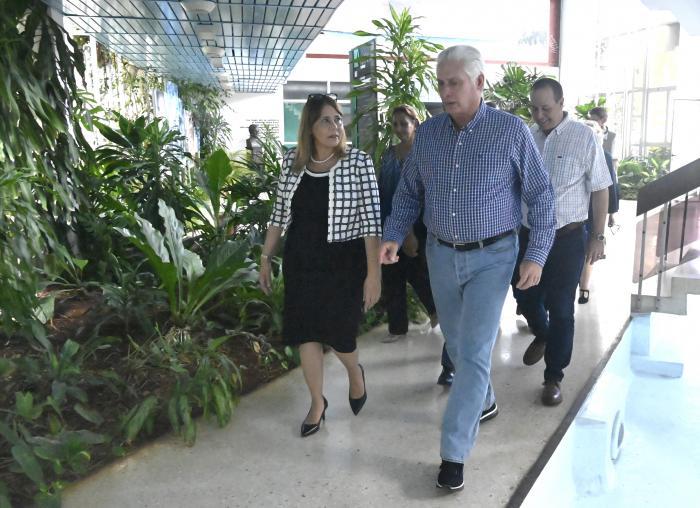
Following the discussion, the president—accompanied by the Minister of Public Health, José Ángel Portal Miranda, and other sector officials—toured the IPK facilities, specifically the laboratories where vital research is conducted to safeguard life.
THE SAGA OF AN INSTITUTION OF EXCELLENCE
This Friday afternoon, while presenting an overview of the Institute’s characteristics and missions, Dr. Vivian Kourí Cardellá concluded with a highly symbolic detail: on October 29, 1993—a particularly difficult year for Cuba—Fidel inaugurated what is known today as the IPK. At that moment, he said to the staff: "I urge you not to view the Pedro Kourí Institute, which we are inaugurating today, merely as a Cuban institution, but rather as an institution belonging to all of humanity."
At the end of the visit, the director of the IPK spoke with the press team from the Office of the President of the Republic of Cuba, reflecting on the significance of "an institution that will soon turn 90"—given that it originated in 1937 and has since passed through various stages of development.
Vivian Kourí brought up the period spanning from 1937 to the revolutionary victory in 1959; she then mentioned a second phase, marked by the year 1979, which saw the emergence of the acronym "IPK"—a name given to an institution whose objective was "to prevent the introduction of exotic diseases that had already been eliminated from the country following the triumph of the Revolution."
Regarding this, the executive described a "transitional phase" leading up to 1993, when the Institute’s current facility was inaugurated. Vivian Kourí Cardellá defined the IPK: its fundamental mission is to provide specialized medical care, conduct research, and offer training in the field of infectious diseases; "therefore, we are the reference center for infectious diseases."
She explained that they operate a hospital, "but we also house national reference laboratories—facilities that perform high-tech diagnostics. In other words, we go beyond the routine diagnostics found in a typical hospital, offering more specialized diagnostic services."
On the subject of training, the scientist noted that they educate both Cubans and individuals from other parts of the world: "We offer master’s and doctoral programs, and we train undergraduate students—both from the medical sciences field and from the University of Havana. Essentially, we are an institution with a global reach, extending beyond the scope of public health alone."
When discussing key milestones, the Doctor of Sciences highlighted how the institution has addressed various epidemics: "In this regard, the IPK has played a central role. One could say that the IPK’s primary function is to provide protection against the entry of emerging or re-emerging exotic diseases."
This mission, she explained, is carried out "not only through laboratory work but also through clinical protocols, the care of patients suffering from these conditions, and scientific research—since the findings generated here lead to further results and studies that have a significant global impact." Among other achievements, the director of the IPK noted, for instance, that international guidelines on dengue incorporate criteria developed by Cuba, because "we are experts in that field." Drawing on its own expertise, the island has also made significant contributions regarding Oropouche virus, COVID-19, and chikungunya.
"Have you fulfilled Fidel’s request to become an institution for humanity?" the reporters asked. The doctor of sciences replied without hesitation: "I believe so. The IPK has held that vision since its inception, and we continue to work along those lines. In other words, our work is not limited to Cuba."
"We work for Cuba, first and foremost, but we also work for all of humanity; I believe we have lived up to that, and we will strive to continue doing so."
Vivian Kourí Cardellá emphasized: "We take great pride in the IPK. Despite the difficult situation in the country, we make every effort to sustain our scientific work—attracting young people, ensuring they feel welcome here, and immediately integrating them into training programs and doctoral studies. We cherish this institution deeply, and we hope to continue on this path."