

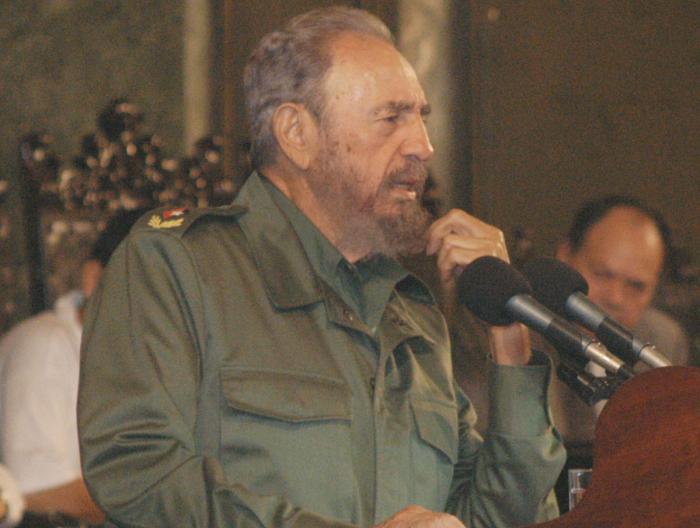
We are talking about life, because when we speak of universities, we are speaking of life," Fidel said on November 17th, 2005, before an audience in the Great Hall of the University of Havana.
It was neither a brief nor a rushed speech. Its transcript exceeds 33,600 words. He covered a great deal. It was not a simple address; it may well be the most extensive public accounting by a statesman so far this century.
His method—moving from the general to the particular—sought to answer a grand question: what kind of world is this? Within that inquiry lay others: what kind of country is this? What kind of university is this? And what kind of people are we becoming? His words unfolded in a spiral, weaving back and forth between the broadest scope and the immediate reality.
Nearly twenty-five years had passed since the collapse of the USSR and the most arduous years of the "Special Period." Cuba—defying all predictions from both friends and adversaries—remained standing, in the same geographical location, still facing existential threats and powerful enemies.
And so, in a speech addressed to university students, Fidel set out to speak, fundamentally, about life.
He spoke of the life of the sun; the temperature of the Earth; the fragility of our species and its millennia-long struggle to avoid extinction; the wars already underway and those looming on the horizon; and the natural disasters that pushed the very existence of millions of humble people to the brink—people who received far less "investment" than advertising or the military-industrial complex.
From the life of the Revolution; of the inequality that had grown in the country in the shadow of the 90s; of the necessary offensive against everything that was wrong; of social workers at the apex of that regenerative force; of our doctors already then nestled in the Kashmir mountain range and in the jungles of Guatemala.
And he said more... about shame and ideas as weapons against nuclear bombs; research for the cure of cancer; the cost of sugar, rice, oil, electricity and education; of I, of us and of them.
He also took the time to exclaim: "Go to hell or wherever you want to go, idiots, you're not going to scare anyone here!", in reference to the horde on duty led by Bush Jr.
How was it possible, in the same speech, to encompass the most specific aspects of the Homeland along with the most general aspects of humanity? Well, from Martí's point of view, equating the essence of both concepts.
And starting from there, that Homeland is humanity, that it had to be repeated every day, he spoke without dogmatism about the diversity of social background of those who made the Revolution, who many times, he pointed out, acted against the interests of their class.
He criticized Stalinism and the Latin American communists of that time who, with great discipline, assumed the order of certain alliances, in order to confront fascism. So it was that in Cuba they allied themselves with Batista, who was "a fascist of a different kind, a criminal and a looter of the public treasury," he recalled.
He immediately stressed that, even so, those communists "were the most disciplined, most honest and most self-sacrificing citizens of this country."
And he continued speaking about unity, about the example of ecumenism that liberation theology had bequeathed, and in the midst of that vital need to unite, the ethical concept that the end does not justify the means along with sacred respect for the other:
"When the USSR collapsed, many people were left alone, including us, the Cuban revolutionaries. But we knew what we had to do and what we had to do, what our options were. There were other revolutionary movements in many places waging their struggle. I'm not going to say which ones, I'm not going to say who; but these were very serious revolutionary movements. They asked us whether or not they negotiated in the face of that desperate situation, whether they continued fighting or not, or whether they negotiated with the opposing forces seeking peace, when one knew what that peace led to.
"I told them: "You can't ask our opinion, it's you who would go to fight, it's you who would go to die, it's not us. We know what we will do and what we are willing to do; but only you can decide that." There was the most extreme manifestation of respect for other movements and not the attempt to impose on the basis of our knowledge and experiences and the enormous respect they felt for our Revolution to know the weight of our points of view. At that moment we could not think about the advantages or disadvantages for Cuba of the decisions they made: "You decide," and thus each one of them, in decisive moments, decided their line.
Having said that, he returned more than once to what was perhaps the most memorable idea from that day: "Are revolutions destined to collapse, or can human beings cause them to collapse? Can people—can society—prevent revolutions from collapsing, or not?" He immediately added another question: “Do you believe that this revolutionary, socialist process could collapse, or not?” (Exclamations of: "No!") "Have you ever thought about this? Have you given it any deep thought?"
He continued, noting that we were militarily invulnerable—a fact well understood by our adversaries—while simultaneously pointing to various instances of theft within the country that he was aware of. He spoke of the prevailing public sentiments he encountered daily, the plight of single mothers and elderly people living alone, and—in contrast—the universal access to education, including university programs established in neighborhoods and even within prisons. He highlighted how corruption was siphoning off the very funds that could otherwise be used to strengthen the culture and well-being of the people.
"Well, things like this have been happening. And, generally speaking, we are aware of it all. Many have said: 'The Revolution can’t handle this; no, this is impossible; no, there's no way to fix this.' But the people will fix this—the Revolution will fix this—and in a decisive way. Is it merely an ethical issue? Yes, first and foremost, it is an ethical issue; but, beyond that, it is a vital economic issue," he said.
Rarely have such harsh points been raised in public—with such depth, responsibility, and force. And yet, they were not expressed with any desire to destroy or to hold anything back.
Quite the contrary: the intent was to bring people together, to propel everything forward—despite any hardships—against the global, white-collar murderer and against local scoundrels (for whom, he asserted, there are ways to hold them to account and shame them).
"It is entirely right to fight for this, and for this we must dedicate all our energy, all our efforts, all our time… so that we may say—in the voice of millions, or hundreds of millions, or billions—'It is worth having been born! It is worth having lived!'" he concluded.


