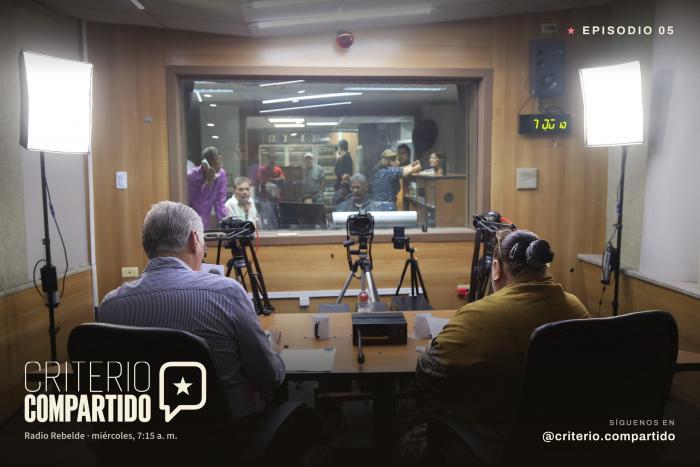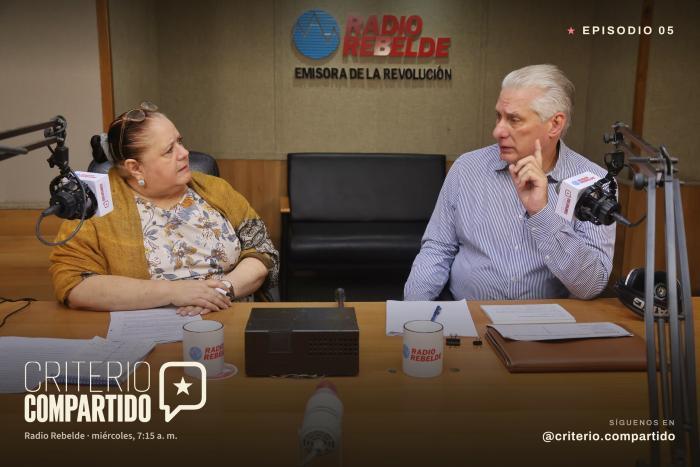
The strengthening of attention to the population, citizen participation and the responsibility of public servants focused on the fifth broadcast of the Shared Views program, in which the First Secretary of the Central Committee of the Party and president of the Republic, Miguel Díaz-Canel Bermúdez, examined the results of the follow-up to the concerns received in previous spaces.
The president highlighted the importance of maintaining direct communication with citizens and taking advantage of their approaches to improve the functioning of institutions and public management mechanisms.
Díaz-Canel explained that, although initially the program was conceived to exchange opinions on various issues of daily life, the concerns expressed by the population have led to dedicating its broadcasts to specific topics, including water supply, care for vulnerable people and the operation of public services.
In that sense, he considered that space has become a driver of solutions and an experience that can contribute to transforming the relationship between state institutions and citizens.
"The main responsibility of an institution is to listen to the people and not just listen. It is listening, but then organizing, planning, acting and controlling," he stated.
During the meeting it was reported that the 46 cases registered in the previous broadcast were visited by representatives of the corresponding institutions, of these, 41 were complaints and five were opinions, including some expressions of gratitude.
According to the report presented, 29 complaints were found to be valid, five were partially valid, and seven were groundless; meanwhile, 20 issues had been resolved, while another 13 remained pending as they required material resources.
The president noted that 45 of the 46 individuals visited expressed appreciation for the attention they received—though some indicated they would not be satisfied until a definitive solution is reached—and he further specified that 27 cases from previous instances remain under follow-up.
Díaz-Canel acknowledged that certain solutions depend on resources that are currently unavailable, but he emphasized the need to provide timely explanations for each situation and to keep the individuals involved informed about the steps being taken.
He also highlighted that following up on these concerns makes it possible to identify not only potential solutions but also the underlying causes that previously prevented them from being addressed.
ADDRESSING THE PUBLIC’S CONCERNS AS AN INSTITUTIONAL RESPONSIBILITY
The leader described the exchange with the citizenry as a democratic exercise and a form of popular oversight, in which the concerns raised serve as an opportunity to evaluate and improve the performance of government bodies and entities.
"The concern of a Cuban citizen—or of representatives from a community—is, above all, a barometer for the sensibilities of our people," he stated, noting that such issues also serve as an early warning sign for institutions.
In his remarks, he emphasized that the public’s right to lodge complaints must be matched by an obligation on the part of government bodies to provide responses—even when material constraints make it impossible to resolve a problem immediately.
The President urged a distinction to be made between economic limitations and management shortcomings, pointing out that there are already successful examples of how citizen concerns are handled—practices that should be extended to other areas.
He also criticized bureaucratic responses to certain complaints and announced that he would convene a meeting with the national leadership of associations involved in social services, with the aim of strengthening institutional coordination and assessing the needs that have been identified.
In this regard, he explained that some challenges require better coordination between existing structures and social programs, as well as more active participation from the associations themselves in seeking solutions.
During the program, the First Deputy Minister of Justice, Yailet Peña, addressed the guarantees recognized in Law 167, of the System for Attention to People's Complaints and Petitions, in force since March 13th, 2025.
Peña recalled that this legislation establishes a general period of 30 calendar days to respond to claims and recognizes legal mechanisms that allow citizens to demand compliance with their rights, including the possibility of going to court when appropriate.
In another moment in space, Joel Queipo Ruiz, first secretary of the Party in Holguín, shared the experiences developed in that territory to improve care for the population.
He explained that since 2024 they have been working with university institutions and computer centers on tools to monitor the situation of different services and as part of these initiatives, in April 2025 the QR Code program emerged, aimed at strengthening communication with communities and the management of their approaches.
Díaz-Canel valued the extension of similar experiences to other provinces and highlighted that their importance lies in ensuring that municipal institutions function more effectively and closer to citizens.
In the final part of his speech, he returned to the need for the problems to find answers from the responsible structures, without waiting for them to reach the highest levels of the country.
"That the cadres who are below do not wait for the problem to reach the highest leadership of the country," he expressed, insisting that each minister, governor, mayor, director and institutional leader must listen, decide, manage and respond within the scope of their powers.
The president reiterated that attention to the population must constitute a permanent practice of the institutions and contribute to the strengthening of popular participation, administrative responsibility and the quality of public service.