

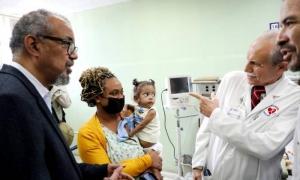
On Monday, at the organization’s headquarters, Cuba’s Minister of Public Health, Dr. José Angel Portal Miranda, met with Tedros Adhanom Ghebreyesus, Director-General of the World Health Organization (WHO). They discussed the status of the National Health System, the challenges facing the sector, and international cooperation.
Portal Miranda provided an overview of the national healthcare system and an update on its current situation. He reported on the implementation of the 176 Economic and Social Transformations and reaffirmed Cuba’s commitment to the 2030 Agenda, free healthcare, and universal coverage.
He highlighted the collaboration with the WHO and PAHO regarding technical advice, working groups, international projects, and scientific endeavors. He expressed gratitude for the support received following the damage caused by Hurricane Melissa and in light of the complex energy situation, and reaffirmed Cuba’s commitment to continue contributing to the work of both organizations.
For his part, Tedros Adhanom acknowledged the resilience of the healthcare system, while noting the challenges it faces as a result of the blockade, fuel shortages, power outages, and issues with water supply.
The head of the international organization inquired about how the WHO and the United Nations could assist in the implementation of these transformations, and urged Cuba to outline its needs and request the necessary support.
“You have our support—both from the WHO and the United Nations,” he assured.
He recognized Cuba’s contribution to other nations through the training and deployment of tens of thousands of doctors.
The WHO Director-General noted that sanctions against Cuba have been in place since the 1960s and acknowledged the challenges involved in maintaining a healthcare system under such conditions. He further commended the country for upholding its commitment to the health of other nations, even during a period of significant internal hardship.
For his part, Dr. Mario Cruz Peñate, representative of the PAHO/WHO in Cuba, pointed out that cooperation should strengthen existing capacities and address urgent needs through the mobilization of resources and donations.
Cruz Peñate explained that such cooperation should also help sustain the country’s capabilities and leverage its potential for responding to difficult situations. In this regard, he highlighted the importance of addressing the immediate needs of the population while simultaneously supporting long-term development processes.
He agreed that health does not depend solely on hospitals, but rather requires action from all sectors; therefore, he noted that identifying social and economic impacts allows for better prioritization of resources and helps align international support with national responses.
During the discussion, Santiago Dueñas, Vice President of BioCubaFarma, presented an overview of the state of the Cuban biotechnology sector, ongoing research projects, and international cooperation efforts.


