

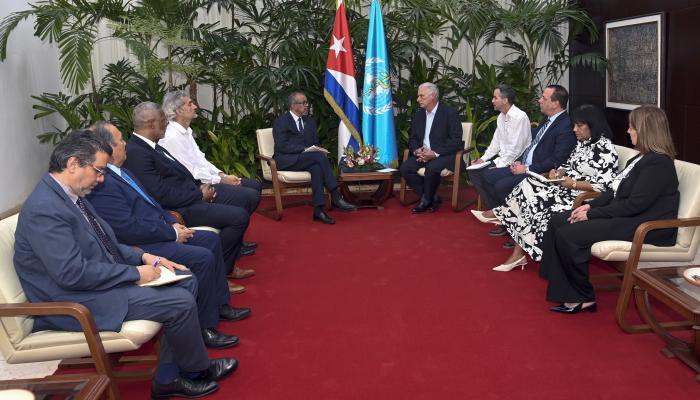
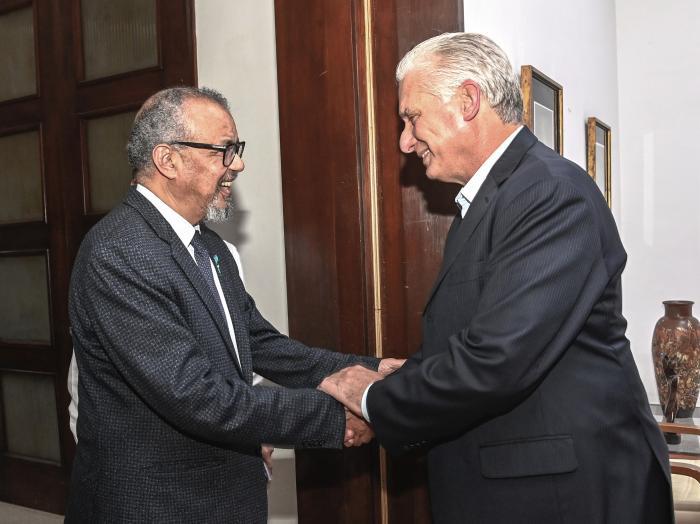
President of the Republic of Cuba, Miguel Díaz-Canel Bermúdez, expressed his gratitude for the visit to the largest of the Antilles as he welcomed Dr. Tedros Adhanom Ghebreyesus, Director-General of the World Health Organization (WHO), on Monday afternoon.
Addressing the health expert and the other members of the delegation—who are in Cuba for an official visit—the Head of State highlighted the significance of their arrival, noting that it comes "at such a difficult time for our people." He pointed to the "intensification of the blockade, the energy siege also imposed by the United States government, and a policy of 'maximum pressure' that has a profound impact on the daily lives of Cuban families."
The First Secretary of the Central Committee of the Communist Party of Cuba noted that this imperial policy affects "all aspects of economic and social life, with a particularly significant impact on the healthcare system."
The leader shared figures illustrating the damage caused by the blockade. He stated that "there are more than 100,000 people on waiting lists for surgical procedures that we are fully capable of performing." He explained that the primary obstacles to providing this care are "the energy situation" and a shortage of medical supplies and medications.
He further pointed out that many of the 100,000 individuals awaiting surgery are children. He added that "there are more than 34,000 pregnant women who are currently not receiving the full level of care and monitoring" that they require.
"We have affected more than 67 percent of the basic medication schedule," said the president, who also said that there are more than 10,000 patients with effects on their radiology treatments. He also made reference to patients in need of hemodialysis treatments; and the childhood vaccination program, "which is an efficient, robust program," which will continue, but is outdated.
Díaz-Canel Bermúdez denounced that "our Health indicators have deteriorated"; among them, that of infant mortality, which was four and is at 9.9 so far this year.
The Head of State commented to the Director General of the WHO: "I know that you have been aware of this situation, since you have already visited Health centers and have had an exchange with colleagues from the Ministry of Public Health. But what I can assure you is that, regardless of that situation, no blackout, no blockade extinguishes our hope. "
The Cuban President explained to the visitor "that every day our doctors, our nurses, after having suffered blackouts and barely having transportation to get around, arrive at their health centers to provide medical assistance." And then he wanted to express his gratitude for the statements that the Director-General made in March 2026, "recognizing the effects that the energy siege had on Cuban health."
Likewise, the Head of State wanted to thank the "support of the extra cooperation and the mobilization of funds that the WHO has given to our country to overcome this situation." And he confirmed that Cuba, as a member of the World Health Organization, "maintains its commitments" to the entity.
"We are fully willing," he stressed, "to work with the WHO, to find new forms of cooperation, for joint research and for the modest contribution that Cuba can give to any regional or global situation, in relation to health."
For his part, Dr. Tedros Adhanom Ghebreyesus told Díaz-Canel that "it is a pleasure to greet you again"; and brought up the first time they both saw each other: it was in April 2018.
"Thank you very much for receiving us, for your time. We have received really very good information from my colleague, the Minister of Health, " commented Tedros, who emphasized that the data received allowed him and his colleagues "to understand what challenges the country is facing. "
The Director-General of the WHO said that they were able to visit the William Soler Pediatric Hospital and the Center for Genetic Engineering and Biotechnology (CIGB). "The progress they have made is impressive," he said. And he added that, although there are still "many challenges", there are achievements "in many aspects."
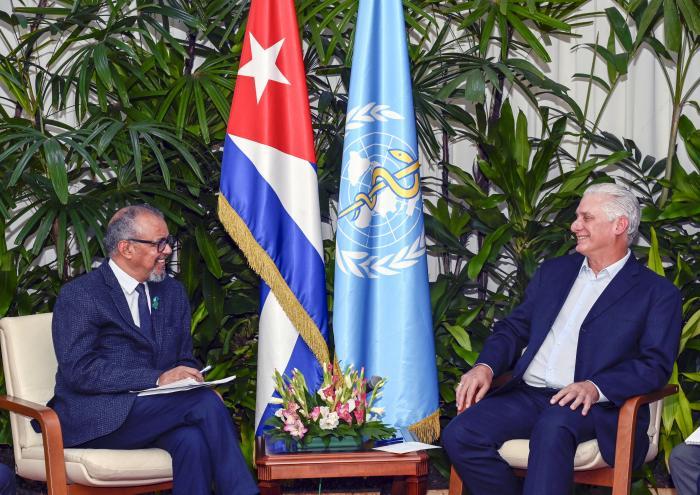
Dr. Tedros expressed that in these hours "we have essentially talked about the impact of the blockade." He also made reference to the impact figures that the Cuban President had commented on, and later said: "In March 2026, as you said, we issued a Declaration, because we were really very concerned about the incidence and impact that this whole situation would have."
On the margins of the WHO Assembly – the manager stated – the decision was made to provide support to the largest of the Antilles.
On the afternoon of this Monday, on the Cuban side, the Minister of Public Health, José Angel Portal Miranda, was also present; the vice minister of the Foreign Ministry, Anayansi Rodríguez Camejo; as well as Mayda Mauri Pérez, president of the BioCubaFarma Business Group.


