

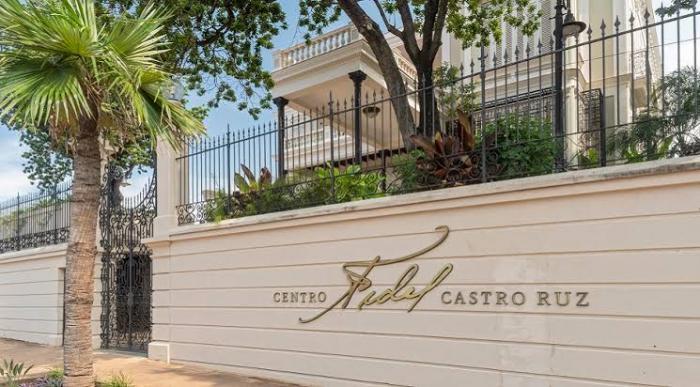
In the year of the Commander-in-Chief's Centennial, the Fidel Castro Ruz Center reaches five years of existence, convinced of its mission and usefulness, that of studying, researching and disseminating the thoughts of the Leader of the Cuban Revolution.
To learn about its interior details, researcher Sissi Abay Díaz, deputy director of the Fidel Castro Ruz Center, spoke with Granma, and based on the importance of both commemorations, she let us know that, for the Center, whose reason for existing is precisely to pay tribute to Fidel every day, these dates have become special days.
"For an entire year—since August 13th, 2025—we have been carrying out activities in anticipation of the Commander’s centenary. It has been an exceptionally busy year, unfolding amidst a complex economic situation; yet, Fidel's significance to our people and to the history of Cuba is such that no circumstance should be allowed to overshadow it."
"Furthermore, we mark ten years since his physical passing, as well as the work our institution has accomplished over the past five years. In light of these anniversaries, we have developed a special program—featuring workshops, lectures, and activities for children—that expands upon our usual scope while introducing new dimensions."
"Of particular importance is the 1rst International Colloquium, 'Fidel: Legacy and Future'—an event we have moved forward with despite the current national context, and which has brought together more than 1,500 delegates from every continent."
"Today, we have a clear understanding of what research is being conducted on Fidel—and by whom—both across the continent and globally; this is of vital importance for an institution of our scale and responsibility. During the colloquium, we were able to present the Selected Works of Fidel Castro Ruz—a colossal undertaking by the Center that will now pave the way for the preparation of his Complete Works."
Regarding the Selected Works, it is explained that "assembling a 23-volume collection containing 690 documents was an extraordinary challenge. While it may sound simple, the sheer volume, the specific discursive style of Fidel, and the complex editorial demands involved—ensuring a consistent tone while maintaining absolute fidelity to Fidel’s original words, all while presenting the material in a new, annotated format—made it a formidable task. Yet, it has fostered invaluable professional and personal growth for us; it represents a qualitative leap in the caliber of our research and the development of our specialists."
Furthermore, the availability of these works within our country—to support and facilitate the study of Fidel’s thought throughout our educational system—will be fundamental to understanding the Commander-in-Chief, the era in which he lived, and the political, social, and economic evolution of our people. It will also provide a comprehensive grasp of Fidel's full stature, offering insight into the social and critical thought for which he is so widely recognized."
"It has been an extraordinary project that has been accompanying all the work of the institution, because although today we talk about that result, the Center did not stop its activities while working on it, and in the midst of all this, we have been receiving visitors from all over the world and from our country; developing activities, and participating in international events."
"It has been possible to have them physically thanks to the Socialist Republic of Vietnam and the people who love Fidel well. But it has undoubtedly been an achievement for us, a very great satisfaction to have fulfilled Fidel, in the year of his Centennial."
–In five years, we can well talk about what, broadly speaking, the institution has meant…
–An institution similar to the Center did not exist and does not exist in Cuba. From the founding purposes it was clearly established that it was not a place to worship Fidel. It is not a museum in its name. It is not a place to dedicate ourselves solely and exclusively to scientific or academic research on his figure and his contributions to historiography.
"It is a set of many things, and achieving, since its foundation, taking these precepts for granted has been a challenge for the entire team and for the people who have worked alongside us during this period. There is a new experience, a way of doing things that is created every day and this has been possible because we had documentation from the beginning that allowed us to adhere precisely to what we should be and everything we did not want to become."
"During this period we have been able to realize how much there was a need for a place that was capable of bringing together, of adding the efforts made in Cuba on Fidel's research, and focusing his personality on cultural activities, so that our children can get to know him better, and learn from his example and what he has meant to us."
–Is it a duty to study Fidel?
–I wouldn't say that it is a duty, I would say that it is essential to study Fidel. Everything we are, everything we will be as a nation and as a people is closely linked to his thoughts, his life and, above all, his work. A country that was built, rebuilt and reinvented itself at his hands, from January 1st, 1959, cannot renounce that historical experience, those teachings.
"Undoubtedly, few have known us as well as the Commander-in-Chief. And I believe that, even in the current context, the solutions, successes, and shortcomings of the Revolution over these nearly 70 years are fundamental to addressing the times we live in—not only times of crisis, but also times of prosperity, and times when we are called upon to continue creating new things and updating what already exists. For this, Fidel’s thought and his body of work are of extraordinary value."
"We also need to learn from and keep alive his teachings regarding the confrontation with imperialism, his contributions to Cuban military doctrine, and the concept of 'war of all the people.' In short, it is essential for Cuba to continue studying him; and for the world, too—which speaks so much today about critical thinking and challenging the superficial—it is highly valuable to engage with his ideas."
–Five years since the Center’s founding, what dreams do its leaders hope to see realized?
–We have many dreams, all of them, I believe, are achievable because they depend on us. One of the greatest strengths that the institution has had in these five years has been the group of its workers.
"When a new institution is created, a team is formed and governing documents, institutional designs are implemented... and in that the collective plays a fundamental role. And we have had very talented people, with Cubans and specialists trained by the Revolution, defenders of the thought and work of Fidel, professionals with all the effort to build a collective project, because the Fidel Castro Ruz Center is a project of collective creation."
"And the dream of continuing to be there, of continuing to provide quality services to our users, of designing more attractive activities, of establishing other links with our children, very close links with schools and the community, more than a dream, it is a principle of work and development of our institution."
"And yes, we would very much like to see our libraries filled, that young people go to read the Selected Works, or simply to investigate, that is, to delve deeper into Fidel, and that all those movements of solidarity with Cuba, all those friends, all those decent people from any part of the world who want to know Cuba from the history of the Revolution can do so."
"We are already committed to starting steps of fabulous research that will allow our people to get closer to the life of Fidel and we have the commitment with Army General Raúl Castro to carry out the Complete Works, as expressed in the prologue of the collection."
"We have indications from the First Secretary of the Party and President of the Republic, Díaz-Canel, given at the closing of the 1st International Colloquium Fidel: legacy and future, therefore, for us it is a working principle that what was expressed in that event can continue to be carried forward, and can lead to palpable results. We have the deep conviction that we are an institution that will last over time."


