

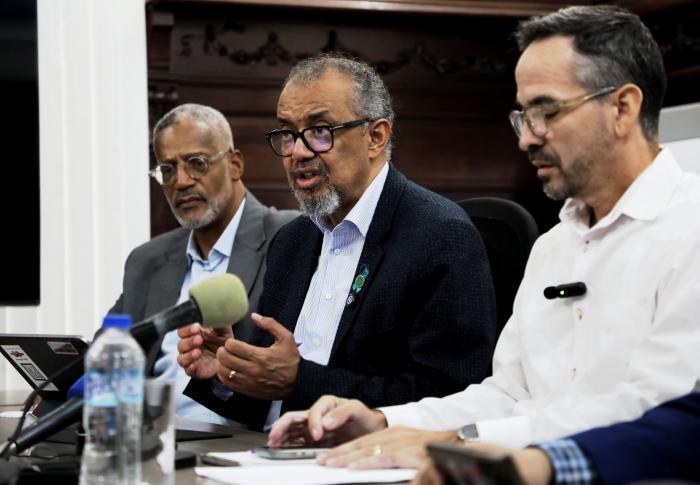
"The Cuban health system is going through a difficult and critical situation," said Tedros Adhanom Ghebreyesus, Director-General of the World Health Organization (WHO), during a press conference held in Cuba, as part of his working visit to the country.
At the beginning of his speech, he thanked the Cuban Government and people for their welcome, as well as the Minister of Public Health, José Angel Portal Miranda, and his team. He also recognized the representatives of the WHO and PAHO who participated in the visit program and the meetings held with the United Nations Resident Coordinator, the UN country team and members of the diplomatic corps accredited in Havana.
Tedros recalled that the Cuban health system has a long history, is based on primary health care, offers universal coverage and trains professionals for dozens of countries. He also recognized his career in research and biotechnology and considered that it is a system built over generations that must be protected.
As part of his visit, he said that he visited the William Soler Pediatric Hospital and its Cardiology Center, where he met a one-year-old girl who was waiting for open heart surgery, as well as other children awaiting surgical procedures.
He highlighted that "doctors know the needs of their patients, but they do not always have the medications, supplies, spare parts and reliable electricity supply they require to care for them."
Fuel shortages and energy problems, along with sanctions affecting the purchase of medicines and medical equipment, have put strong pressure on these services, he said.
In this context, he recalled the statements made by the United Nations High Commissioner for Human Rights, Volker Türk, who warned that the intensification of fuel restrictions and sanctions is causing direct harm to the Cuban population—especially the most vulnerable—and putting lives at risk. Tedros supported his call for the immediate lifting of these restrictions.
The WHO Director-General drew attention to the concerning trends in several health indicators. According to the data presented, overall mortality has risen, and life expectancy has declined for the first time since records began in 1950—dropping from 78.8 years in 2020 to 74.4 years in 2025.
Infant mortality, he added, has more than doubled, rising from approximately four deaths per 1,000 live births to 9.9 in 2025. Maternal mortality has also increased, from 37.4 per 1,000 births in 2019 to 44.1 in 2025.
Likewise, it mentioned a 50% increase in tuberculosis cases since 2019, along with outbreaks of Oropouche, dengue and chikungunya viruses. In particular, he expressed concern about the situation of children and noted that the pediatric cancer survival rate had dropped from 85 to 65% following the beginning of the energy blockade in January.
However, he recognized the work of the professionals who keep hospitals open and essential services operational, even when they must go to their jobs after entire nights without electricity.
During his tour of the Cardiology Center, he met Dr. Herminia Palenzuela—one of the center’s founders—who, at 80 years old, continues to train new generations of pediatric cardiologists. "People like her are the reason the system keeps functioning," he remarked.
Healthcare workers deserve far more than just admiration, Tedros stated, emphasizing that they require support. At the conclusion of his opening remarks, he once again expressed his gratitude to the minister, the healthcare staff, and the Cuban government and people for the hospitality he received.


