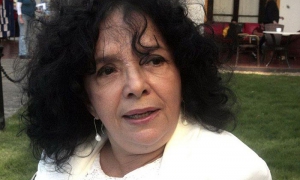
In her pictorial work, Flora, does justice to her name, attempting to unlock the secrets of nature. Flowers, trees, woods multiply, and move in the breeze or to the beat of a hurricane, since the air moves between the lines and colors of her artwork. Or, with her mastery, they may sway to the rhythm of water in the sea, rivers and lakes which irrigate fertile lands. These landscapes which reflect the essence of Eastern calligraphy (her surname is Fong), but touched with Caribbean color, bright tones and light, making her dreams almost real. Copying nature does not make sense to Flora Fong. She seeks immaterial expression via simple means, using only the indispensable, which at times gives the appearance of a sketch - very similar to the traditions of her ancestral Oriental painters. But she is Caribbean; she works, lives, creates, and is inspired here. Tropical tones, a way of feeling images and managing the language of materials acquire a special connotation in her work. She began 2014 with a February show in Camagüey, on the occasion of her native city’s 500th anniversary, exhibiting specially conceived paintings, along with a group of bronzes. Next, she was off to Shanghai, as a participant in a National Visual Arts Council collective exposition entitled Rodando se encuentran. Her most recent show Grabados en el tiempo, opened in the Eduardo Abela provincial visual arts center in San Antonio de los Baños, offering a unique opportunity to see a retrospective of her life and work, a return to her beginnings. Within Cuban painting, Flora Fong’s creations occupy a symbolic place. Harmoniously united within her work are a celebration of color; agile brush strokes; the three elements of life; nature; the country’s culture; the landscape with its violent atmosphere; the poetic domestic life of people; and the Chinese component, integrated within the nation’s fabric. All of these dimensions are part of a language which began with a dark spectrum, and increasingly moved toward surprising lightness and a powerful sun, in which colors explode in the shape of a hurricane sky, a piece of fruit ,or flower. From a metaphorical point of view, Flora has become her own creative modality, the trace of Asian calligraphy which reveals the strength of her ancestors, the pitch of every line, in which the mixture of her fragility and assertiveness appear, along with the choice of sensory and habitual values of our daily life, which allow her to present a different vision of the themes which have been assumed by many 20th century Cuban artists. In the early 1980’s, Flora Fong questioned herself aesthetically, and began to consider Chinese landscape painting, and seek to understand - from an Oriental point of view - the fascinating techniques used by Chinese and Japanese artists. She studied the Chinese language, because she wanted to know the history of calligraphy, of pictograms, and a way of approaching concepts which is so different from that of the West. Given her temperament, she needed to make the air, and the rain, felt in her work. And in fact, those who approach her pieces feel the atmosphere, the humidity, the heat. It can be said that her current painting has two basic cores, which are differentiated by the evidence of structure, on the one hand, and the disappearance of structure, on the other. In the first, the play between planes, their penetration and super-imposition, their transparency, facilitate the spectator’s ability to recognize internal tensions which mark each piece. While reflecting the other core element are pieces which could be called invertebrate, in which the artist appears to focus on the traditional practice of calligraphy, seeking textures and studying spaces between brush strokes. The sea, softly approaching coastlines and beaches emerge in her Bahías, in which intense shades of blue occupy her palette. Her more recent painting, predominately featuring islands and cays, is permeated with sharp contrasts and well defined shapes, revealing solid structures created with broad curved areas or triangles. In these marine landscapes, light and color become brighter. They are a continuation of what she has done before, but on another level, taking on new visual intentions, since Flora Fong studies, analyzes, and incorporates, in an organic fashion, whatever serves her purpose of transmitting messages from her life experience. Her sunflowers? The question opens a door, touching a sensitive spot, leading the artist to say she is not interested in painting any flower, and, in her response, conveys decisiveness and strength with her tone. "Studying a little of the spirituality of Chinese painting, and those hard-working artists, I saw in this flower (so strong and able to move with the sun) what I could represent, from a Western and Eastern point of view." In this retrospective of different stages, Flora incorporated the bronze sculptures, which she said continue to give her thoughts of conceptual renovation, looking toward future ideas, the beginnings of a theme. Commenting on this difficult work, she said smiling, "I got two hernias doing them," though she intends to continue along these lines, with renewed motivation. The beautiful collection of bronzes recreates the shapes which have accompanied her thus far, images extracted from her two-dimensional paintings, which now take on shape and come to life with another dimension. Flora smiles, she is happy to see her life, her effort, her work – that which is transformed while hanging on the wall, to become dreams recreated on different surfaces.

OFFICIAL VOICE OF THE COMMUNIST
PARTY OF CUBA CENTRAL COMMITTEE