HAVANA has played host to three important meetings focusing on the significance of culture as the indisputable means by which to promote the identity and integration of the peoples.
From September 17-19, the 6th Meeting of ALBA-TCP (the Bolivarian Alliance for the Peoples of Our America-People’s Trade Agreement) Culture Ministers, the 3rd Meeting of CELAC (Community of Latin American and Caribbean States) Ministers of Culture, and the UNESCO Regional Workshop, all took place at Havana’s Convention Centre.
ALBA-TCP AND CULTURAL DIVERSITY
The regional bloc known as ALBA currently includes Antigua and Barbuda, Bolivia, Cuba, Dominica, Ecuador, Granada, Nicaragua, Saint Vincent and the Grenadines, Saint Kitts and Nevis and Venezuela.
Culture ministers of these member countries approved a statement reaffirming their commitment to strengthen cultural integration in Latin America and the Caribbean, promote the active participation of communities in cultural processes, preserve cultural heritage and encourage the development of creative economies.
The document highlights “respect for cultural diversity within our multiethnic, multicultural and multilingual societies.”
Speaking during the event, Abel Prieto, advisor to the President of Cuba’s Councils of State and Ministers, emphasized “the need to create a decolonized public so that they might take an interest in traditions and contemporary creations, and form cores of cultural resistance. The hegemonic battle is being fought there, in series, videogames. Junk culture creates addicts who are then unable to appreciate authentic cultural processes.”
The official statement of the 6th Meeting also focuses on rejuvenating the ALBA Grand-National Culture Project, approved during the 6th ALBA Summit (Caracas, 2008), in which “Unifying processes are strengthened through culture, through the implementation of plans which facilitate the identification and development of the potential of member countries.”
Featured among the agreements approved is the holding this coming October of a Meeting of ALBA Coordinators, the opening of an ALBA Cultural Centre in La Paz; the Plurinational State of Bolivia’s selection to host the 7th Meeting in September 2016; and the confirmation of Cuba as ALBA Culture Coordinator.
CELAC APPROVES FIRST CULTURAL ACTION PLAN
The inauguration of the 3rd Meeting of CELAC Culture Ministers saw the participation of delegations from the bloc’s 33 member nations and was presided by the Cuban Culture Minister, Julián González; and Guillaume Long, minister of Culture and Heritage of Ecuador - current President pro tempore nation of the regional integration mechanism – as well as the Director-General of UNESCO, Irina Bokova.
A positive outcome of the meeting was the approval, for the first time, by sector ministers (18) and other government representatives, of a cultural action plan through 2020 focusing on four key areas, in which every country was assigned a specific function.
For example, Peru is responsible for addressing aspects of the first area which among its main objectives includes “Promoting the exercise of the cultural, individual and collective rights of our citizens (indigenous peoples, afro descendent communities and diasporas) and the social development of our peoples,” while Belize, Panama, Argentina, Bolivia, El Salvador and Mexico will cover points in the third area relating to the protection of cultural heritage, and hold a Regional Workshop on the Illegal Trafficking of Cultural Goods; draw up an inventory of tangible and intangible cultural heritage and create a computerized stolen cultural goods detection system.
The other two areas address diversity of cultural experiences; art and creativity; information exchanges and the creation of policies concerning cultural rights on the Internet; and the identification of emblematic sites in every nation with the potential to be classified CELAC Cultural Spaces.

The current CELAC action plan includes projects such as the Travelling Caribbean Film Showcase; Caribbean CapacityBuildingProgram; Virtual Museum of Latin America and the Caribbean; Caribbean Festival of Arts (CARIFESTA); Latin American and Caribbean Culture Website; and the Central American and Caribbean Cultural Promoter.
Over several busy days, Culture ministers discussed specific issues. Ecuadorian representative Guillaume Long commented on the need to create solutions “In order to combat the mass homogenization of the powerful cultural industries of the North. In order to achieve greater integration, in regards to culture, we need to work together from a common position, with CELAC acting as the spokesperson for Latin America and the Caribbean.” Meanwhile Minister of Youth, Sports and Culture of the Bahamas, Daniel Johnson, highlighted the importance of achieving cultural sovereignty through respect for diversity and the need to protect the cultural identity of all communities.
On the subject of identity, Argentine Minister, Teresa Parodi, noted: “The people create culture out of necessity and in these times we must reaffirm who we are. Our vast diversity is our raison d'être.”
The event was marked by Irina Bokova’s speech during which she stressed the importance of the event in order to “respond to violent attacks on culture, tackle extremism which destroys our common memory and pursue those who hold these views in their beliefs and traditions.”
The UNESCO Director-General stated that the meeting of CELAC Culture Ministers was “A unique opportunity to advocate for humanist values and the power of culture as a means of guaranteeing sustainable development.”
UNESCO WORK PLAN FOR CULTURE FOR LATIN AMERICA AND THE CARIBBEAN 2016-2021
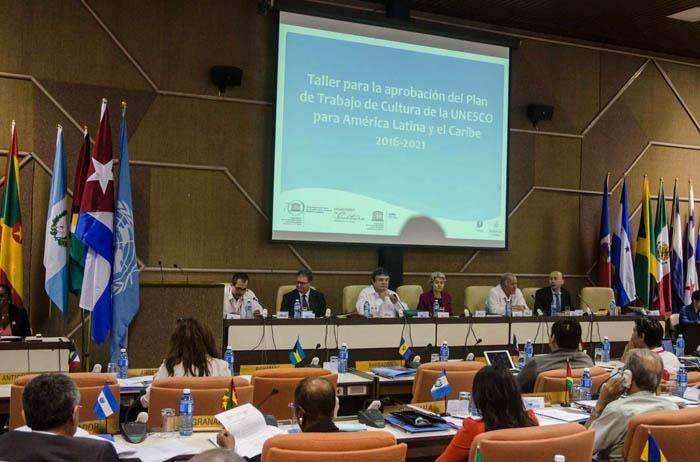
Taking place within the context of the ALBA-TCP and CELAC ministerial meetings, was a Workshop for the adoption of a Work Plan for Culture for Latin America and the Caribbean 2016-2021, which saw the participation of the organization’s Director-General, Irina Bokova, and was led by Alfredo Pérez de Armiñán, UNESCO assistant director-general for culture, and Fernando Brugman, officer in charge of the UNESCO Regional Office for Culture in Latin America and the Caribbean.
According to Bokova, the encounter was held at an opportune moment, given that the Sustainable Development Summit will be taking place from September 25-27 at the United Nations headquarters in New York; which aims to establish “A new development agenda with goals planned through 2030, which culture will without a doubt help to achieve,” she noted.
”Culture provides us with points of reference and supports our identity, it is a force for inclusion and social justice, and together we must promote this message especially now, when we are celebrating the 10th anniversary of the UNESCO convention on the protection of cultural diversity.”
The workshop agenda included topics related to the protection, conservation and safeguarding of tangible and intangible cultural heritage, the prevention of and fight against illegal trafficking in cultural goods and respect for diversity.
Bokova’s visit to Havana was the ideal occasion on which to celebrate 70 years of UNESCO in its Regional Office for Culture in Latin America and the Caribbean, based in Cuba, the first to be established outside of the organization’s headquarters in Paris.
EUSEBIO LEAL HONOURED
UNESCO’s Director-General made the most of her visit to the capital during which she honored Havana City Historian Eusebio Leal, with a medal commemorating the institution’s 70th anniversary.
Bokova described Leal as “a symbolic vector of knowledge, a bridge which connects countries through dialogue so that we might know each other better and resolve our differences, to protect our heritage.”
The ceremony took place in the Palaceof theSecondLieutenant, a restoration project which received support from UNESCO and financing from the European Union.
“The city, its buildings, the cultural expressions of its inhabitants constitute vectors of knowledge, symbolic experiences which we make our own and are the basis for creation, innovation and social cohesion; dialogue and conflict resolution…the management of these experiences, of this knowledge, to provide a better future for all, is not an easy task. Here this mission is being achieved thanks to the commitment, dedication and leadership of an extraordinary person. Thanks to him (Leal) and his magnificent team of professionals, this city, a legacy belonging to us all, is an example of the restoration and conservation of heritage.”
The Palaceof theSecondLieutenant, a typical example of 18th century Cuban baroque architecture with its main façade of beautiful arches, which faces thePlaza de Armas, currently houses the Interpretation Centre for Cultural Exchanges between Cuba and Europe, with rooms which depict Christopher Columbus’ voyage to the New World, Creole and foreign settlers’ impressions of America, the process of mapping the island of Cuba and a room dedicated to the history of the building and the restoration project.
The essence of these meetings of regional culture ministers is acutely reflected in the renovation of a historic building of cultural value, a vital component of the nation’s identity, which extends itself within regional and universal integration efforts.