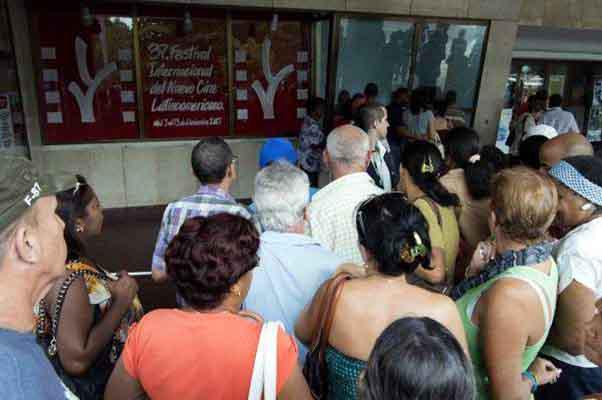
The scope of the 37th International Festival of New Latin American Cinema is very broad. Havana has something of great worth - an audience enthusiastic about film, which hasn’t lost its love of the cinema, as has happened elsewhere.
It is no longer a secret that Havana audiences have a passion for cinema, that they defend Cuban cinematography tooth and nail, while also applauding the best from the region - with this year’s festival having presented films of extraordinary quality - and follow closely the films from other countries screened each December.
ESPEJUELOS OSCUROS AND ITS FOUR STORIES
Awards and festivals are a means of obtaining financing, especially for novice filmmakers. This is the case of one of the Cuban films selected for the directorial debut category of the official competition: Espejuelos oscuros, by Jessica Rodríguez, who began as a director of well received documentaries (Tacones cercanos, 2008; El mundo de Raúl, 2010, and ¡Crac!, 2012).
The script that gave way to the film won the 2008 Cinergia Award (The Audiovisual Promotion Fund of Central America and Cuba), as well as a Special Mention in the category of Unpublished Screenplay during the 6th Cine Pobre International Film Festival in Gibara; the Best Unpublished Screenplay Award at the 10th IMAGO Film Festival in Havana and the 2009 Haciendo Cine Prize for Best Feature Film Project at the ICAIC Young Filmmakers Showcase.
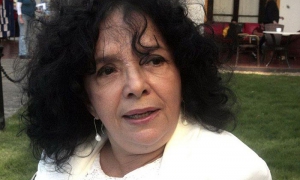
With this support, Rodríguez managed to finish Espejuelos oscuros, the story of Esperanza, a blind woman living in the Cuban countryside who, like Scheherazade of One Thousand and One Nights, begins to tell stories to Mario, a fugitive who enters her house, in order to keep herself safe. They are four stories of three different periods in Cuban history - the 1970s, the 1950s and the last war of independence in 1895. “These are stories of women who refuse to play the role that society has in store for them,” the director told this publication in the gardens of the Hotel Nacional.
Jessica Rodríguez played it safe with her two main characters, turning to none other than the great actors Laura de la Uz (who plays Esperanza, Marlene, Adela and Dulce) and Luis Alberto García (Mario, Inocencio, the Sergeant Acosta and Manuel). Each plays a range of distinct characters, with their own conflicts and at different periods.
Laura de la Uz herself told GI that playing characters from four stories in different eras “meant having to create different psychologies, physical aspects, means of expression, it was exhaustive work with each of these characters, especially the research regarding the era and also the physical characteristics of each of these characters. We undertook extensive read-throughs, as we had so few days of shooting too, so we began filming as prepared as possible.”
We asked the actor, one of the most sought after by directors, regarding what she looks for when deciding whether or not to accept a script. “Basically there are few scripts that one does not accept here in Cuba because the truth is that you don’t have many opportunities to work in film, although I am one of the privileged and grateful for that every day of my life. I have just had a very good run of movies with great characters, which is what one really seeks, no matter whether starring or supporting, that is not important to me. A good script, that's what matters.”
PAVEL GIROUD AIMS TO ENTERTAIN
The latest film by Pavel Giroud, El acompañante (The Companion), was very well received by the public. “I always aim to entertain. Making a serious film doesn’t mean making a boring one,” the director stated at the Chaplin Cinema, where the films entered for the official competition are being screened.
This time round, the director of La edad de la peseta (2007) went for drama, looking at the issue of HIV/AIDS, for which he spent a year researching the subject. “There are fabrications, but everything about the Los Cocos sanatorium is real.”
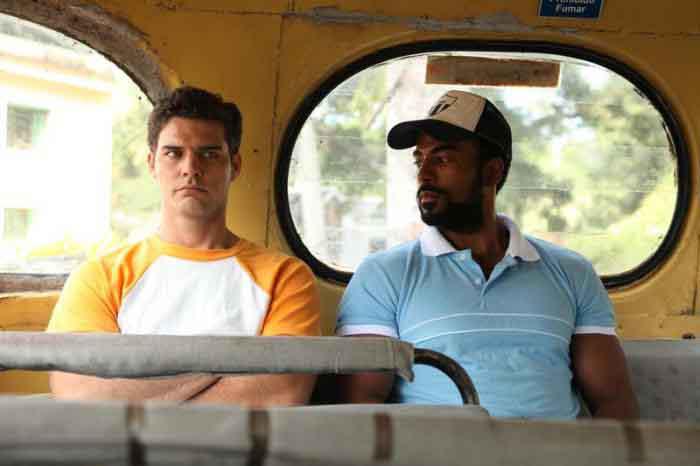
In terms of the protagonists, Giroud reported that he did not hold a casting, but rather directly contacted Yotuel Romero, a former member of the group Orishas (playing the companion) and Armando Miguel Gómez (the patient), one of the best current young actors in Cuban cinema.
Some doubts arise in the script; firstly with the title itself, referring to the companion when, in actual fact, the patient is the true protagonist of the film. On this issue Giroud said: “It is true, Danny (the patient) is more attractive, but he actually ends up being the companion of Horacio. There is a transposition of roles. I think that always happens. In a film like Fresa y chocolate, for example, the dramatic protagonist is David, but Diego, the character played by (Jorge) Perugorría, steals the show.”
The director argues that “the film changes from a specific point onwards. It starts with vignettes, a more stationary point of view, without music, rawer. As they begin to communicate there is another rhythm, other sounds, the companion is inverted.”
The fact is that El acompañante was well received by a full house at both the Yara and Chaplin cinemas.
FOREVER HEMINGWAY
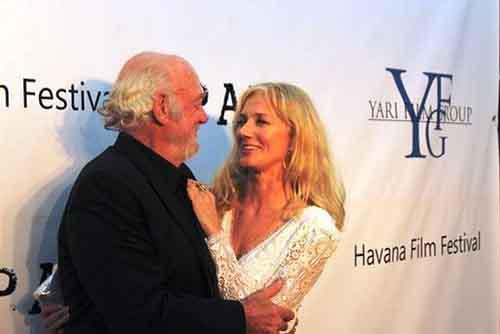
The La Rampa cinema hosted the premiere of Papa, the first U.S. film made in Cuba in the past six decades, from the experienced Iranian producer and U.S. national, Bob Yari, who makes his directorial debut with this film, which addresses the final days in the life of Nobel Prize for Literature winner Ernest Hemingway.
The premiere was attended by the director, along with the main actors, Adrian Sparks (Hemingway) and Joely Richardson (who plays his wife Mary) and Mariel Hemingway, granddaughter of the great writer.
During a press conference, Yari explained the significance of the title of the film, Papa, to the international guests attending, as for Cubans it is perfectly understandable, “It’s the nickname by which all those close to the writer, born in Illinois, knew him in Cuba.
Papa was filmed at the Finca Vigía, Heminway’s Havana residence, as well as other sites such as the Hotel Ambos Mundos, the Gran Teatro de La Habana and the Malecón. The plot centers on the relationship between the writer and journalist Denne Bart Petitclerc. “For me, it was vital the filming took place in Cuba, where everything in the script actually occurred, where all the places that the journalist had access to from Hemingway and his wife Mary’s lives are.”
Mariel Hemingway noted that “the film reveals something which is still unknown to many people in the Unites States, the deep connection that my grandfather had with Cuba. This island was a home for him for over 30 years and he considered Cubans his family.”
GALAS, A NEW CATEGORY
Within the film festival, a new category of Galas was included, during which a dozen productions from prominent directors from Latin America and elsewhere were screened.
Carol, by Todd Haynes, inaugurated this new category, and despite the subtitles appearing in English, received an ovation following the screening at the Yara. This was preceded by a great review and the Best Actress Award at the recent Cannes Film Festival for Rooney Mara, which was boosted by the presence of the superb actress Cate Blanchett (Oscar for Blue Jazmin).
The Galas section included films from various contemporary maestros such as Chilean Patricio Guzmán (El botón de nácar), Mexico’s Arturo Ripstein (La calle de la amargura), Canadians Atom Egoyan (Remember) and Deepa Mehta (Beeba Boys) and Fernando León de Aranoa (Un día perfecto) and Cesc Gay (Truman) of Spain.
Anyone would wish to have the gift of ubiquity over the ten days (December 3-13) of the International Festival of New Latin American Cinema, but there is another important necessary skill, the ability to make the best selection, with good documentation in hand of course.