“Dear friends,
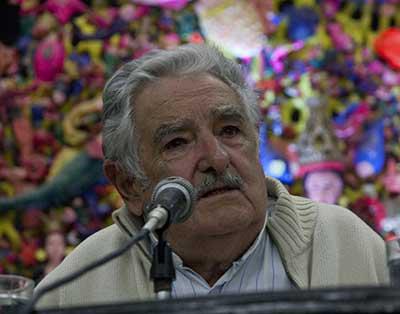
The years, thoughts, sayings, hardships have piled up. For me it is a welcome honor to be in this temple of culture, of the sculpture of writing, of painting, of feeling, of transforming it into nostalgia and sentiment; into poetry, into emotion that is transmitted over time, that interconnects human beings.
Because I am a compatriot who once fell in love and dreamed - as many of you here did - of changing the world. And so it was. Ah! But something we learned to transmit to new generations: that they commit the errors of their time, not ours.
Until the age of 22 I was passionate about literature. I even read the phone book...But, when I entered into this business of changing the world, the story changed: booklets jumped out, we had to find 38 and 45 and so on. And literature finished for us and the years and the hardships piled up. And we had to be terribly distanced from culture. And they didn’t treat us well in the years in prison, we were without books for many years.
I have not devoted the deserved respect and time to culture. For me, to be here is an undeserved honor, because this is a temple that symbolizes the most committed efforts of Latin American culture, to which we owe an old debt. And this was something built between the drumbeat of an old dream and a very old banner that tells us - in concise terms – that we have managed to found various countries in the last two hundred years, but the nation is still an outstanding debt.
This is the debt we owe to Martí, to Bolívar, to our history. But before it was for a dream, defense, an attitude of defense against the Empire. I am one of those who interpret the struggle for Latin American integration as (motivated by) fright. Why? The battles of our humanity, to be or not to be, now depend on what is in danger: the very existence of the species on this planet.
Life passes us by and we do not believe - we can not believe in these secular societies - that this world is a vale of tears to get to paradise.
And our life passes us by and we thirst for happiness, and we don’t want to confuse - at least many don’t - happiness with buying new things every day.
The feeling of happiness is linked to intimate, ancient, eternal things: time for the children, for the family, for a handful of friends. Free time that is not sold, that is not bought. We know perfectly well, by necessity, that in this world you have to work to attend to and address material needs; but life is not just work. Life is a struggle for freedom, and freedom is having the free time to devote to the things that move us.
Well, that’s why we turn to history. This is not the liturgy of remembering Martí solely as a tribute. We go to the trunk to seek out the intellectual tools that serve us in the struggle today...Our lessons are in the roots of our history. But the future is not nostalgia. The future is always a new world.
“Those of us who essentially call ourselves leftists, must turn to sources such as Martí…I do not know, nor do I have the authority to say, whether he was a pre-modernist or anything like that, I do not care. What matters to me is that he was a dreamer, a constructor and didn’t just write papers. He wrote papers to advance life and action.
And this singular man decided to throw in his lot with the poor, which speaks of an enormous social awareness. But, in turn, given the difficulties of his time, he knew that the struggle for independence is twofold.
He had the pragmatic greatness to see the circumstances and suggest a party for all, with all…He understood that he had to establish a tool, a revolutionary, inclusive party, to try and bring all possible social classes into the struggle.
And, perhaps with some foresight, he offered up his life as a way of endorsing his commitment. He was a knowledgeable figure for his time: writer, essayist, poet, in love “como pata de catre” - it’s a Uruguayan saying, I can’t help but speak in very rural language. He loved life and he appreciated it.
Martí represents a precise moment in history. He establishes the commitment of the intellectual with a living cause. On the one hand he is a thinker but, on the other, he puts his life at the service of his thoughts. And frankly, it is easy to think, it’s easy for those who are intellectually gifted to write novels that can be thrilling, but to do all that and risk your life, convinced of a cause, is not common.
This man is something that shakes your very soul. Here they call him the Apostle, for me he is a bridge between the old leaders of Latin American independence and the challenges of the future.
I do not believe that this is a second independence. But if this is the second, then we lack the third, and the third is ownership of the knowledge that makes us free. And the creation of a libertarian culture, not subject to capitalist values. The nature of ownership and its distribution do not matter, what matters is the behavior of the masses, the natural behavior of man, and we have an obligation to build a distinct, defiant culture.
The eternal problem of the forces for change is the struggle for unity, which means respecting diversity and learning to form columns with people who have their nuances, but not divide the forces of change because that is to weaken them against the right.
We must be clear regarding the main battle. For Martí the main battle was to achieve, on the one hand, independence from the colonial empire and, on the other, curbing North American ambitions which were manifest across this part of America, aware that if they succeeded they were fulfilling a service in favor of Latin America...Hence the diplomatic struggle and consular representations.
Of course for Cuba, Martí is much more than this. For Cuba, Martí is the symbol of the construction of the Republic. He is, as you call him, the Apostle. Because it seems as if he almost joyfully sought out death, as a means of endorsing what he thought and what he felt. He had given up everything, or almost everything, it remained to give up his life to be eternal.
I would like to point out the idea of balance that he bequeathed to us, because I believe that we are at the juncture of this lesson, of this struggle for balance.
The balance to ensure the independence of Latin American countries. If Cuba fell, or was annexed to the United States, all the Caribbean would be compromised. It was obvious, and the United States sure was enthusiastic. He realized that to break with the colonial empire and, at the same time, curb North American ambitions, was a cause for Latin America.
He sought internal diplomacy, he discovered the conspiracy between the Republic of Argentina and England and distrusted the policy of Brazil from the era of Don Pedro with an approximation toward the great Yankee market. He tried to get around the contradictions across all America, and never forgot Mexico, as appropriate.
But this idea of balance is not just a matter of political tactics, it is a vision of the world, a world of balance which I think is a modern message, and which must be analyzed in each historical circumstance, just how the struggle for balance and forces occurs, in a world that is totally unbalanced and that seems to belong to the insane, not the unbalanced.
With a civilization that rules over us and that, with great genius, we accumulate nonsense. Recently we cried out against climate change...We were yelling from Kyoto to here, to no avail. We are full of these contradictions...I could spend hours talking about these absurdities that we are committing as humanity. Fidel is right, in a speech somewhere, which years ago said: “What is at stake is human life.”
Because we have reached a stage of interdependence, of interrelation, where the world requires global, obligatory decisions, which must be made… we need global agreements because man has never had the strength he has today. He has never had the means he has today. Two million dollars per minute are spent worldwide on military budgets…To say there are no resources is to have no shame.
We must begin to ration, as the species responsible for the life of this ship called Earth. But this world has no direction, or rather, it is driven by capitalist accumulation. Not in favor of life.
Martí faced the challenge of the sharp rise of the United States, the independence of the colonies and the preservation of Latin America. Our challenge is the struggle for life above ground. I believe we are often not aware because we live in a society of marketing...They have us entertained. The Romans invented bread and circuses, here we have television and entertainment to stupefy us. A media civilization is the way to dominate us.
I do not advocate that man returns to the caves or lives under a palm leaf. I do not advocate poverty as an ideal life, I defend sobriety to the death. Living with little luggage, having time to live, remembering that human happiness is the relationship with other human beings. That man is not a commodity, he is not bought or sold.
I sincerely believe – to summarize - that our duty is to fight for a rebellious, libertarian, different, unconquerable culture. They will tell me that this is not possible, I think this human creature is the only animal able to reprogram his behavior, if he exercises willpower over himself.
Man has the ability to self-program himself andin the part thathas to do withthe constructionof the future.
I believe to the death that we must fight for liberation, a liberation of our very selves, from a culture that holds us back in the depths of our decisions. We must fight for human happiness and human happiness is not accumulating pieces of junk...Life passes us by, and these things I am saying are so basic, and as they are basic, they are forgotten. When you buy something with money, you're not buying it with money, you are buying it with the time of your life you had to spend to get that money.
But you cannot buy back time...Please do not waste the only miracle you have, the miracle of being alive.
Thank you.” (From La Ventana)