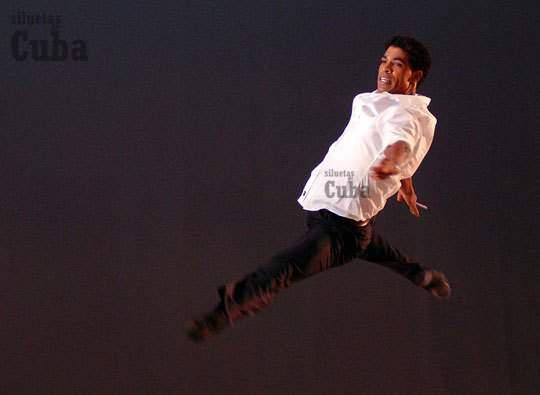
Charismatic, with a broad smile, iron technical virtuosity and elegance on stage, Carlos Acosta (Havana, 1973) speaks with poise and modesty about the founding of his own company, Acosta Danza, as the second phase of his extraordinary career.
For over two decades, he has been considered the best ballet dancer in the world and relentlessly compared to the legendary Nijinsky, but with his majestic art he has managed to silence these pleasing, if unnecessary, comparisons. He is a true god of dance, in his own right.
Acosta is currently very happy with the announcement of the first season of Acosta Danza in the Lorca Hall of the Gran Teatro de La Habana Alicia Alonso, “a company with which I want to give back to my country everything I have learned during my career, and which I envisage and hope is original, to launch Cuban talent, at this moment of building bridges.”
This artist without limits - he is also a choreographer, writer, actor – adds that he is a dancer undergoing “a transition, leaving behind the classical repertoire, because the body, which is our instrument, becomes tired, and I’m working toward contemporary (dance), freer, with less impact on the body.”
Naturally, in order to launch and establish Acosta Danza, he knows his presence on stage is essential. The programs for the season, one contemporary (April 8, 9, 10, 12 and 13) and one classic (April 16-17) show, were designed to this end.
In August 2015, Acosta called several auditions at the Fernando Alonso National School of Ballet and selected the 25 varied dancers who now make up the young company. “Half have a classical (or academic) background, and the other half contemporary. They must embrace all the demands, ballet, dance, folklore. I know that for this we need time, we are just beginning.”
The director of Acosta Danza wants to “explore many paths, for example contemporary movements, broken lines, over classical vocabulary. I seek an intermediate, from the classic at one end to the most abstract dance, to offer a new alternative, a freshness.”
He doesn’t refer only to technique. Speaking before an enthusiastic group of reporters in the Lecuona Hall of the Gran Teatro de La Habana Alicia Alonso, he noted that he wants the choreographers he calls on to introduce Cuban elements in the pieces. “In this globalized world, we have a great heritage, a wealth of dance, music, which I'd like to explore, with any idea, no matter how small. You can do something spectacular with the Malecón as scenery or with bongos on stage, something that sets you apart from European dance.”
Following the press conference, Carlos Acosta was generous enough to respond to some further questions.
You have formed part of The Royal Ballet in London for the past 17 years, and danced with the English National Ballet, Houston Ballet, American Ballet Theatre, and other companies. How do you feel on founding your own company?
Right now I am the happiest man on earth. In addition to the numerous awards and decorations (Olivier Award, Princess Grace Foundation Dance Award, Commander of the Most Excellent Order of the British Empire, Cuban National Dance Prize, to name a few), there are few people who can say: I am a prophet in my land. The people show me a lot of love, and that for me is the greatest thing I can have.
There is a lot of expectation regarding the premiere...
Over one hundred promoters are coming, for example from Australia; New York, especially from the City Center which already announced that they have reserved a week of functions for us in March 2017, and want us to perform on a regular basis. Also from Saddler's Wells in London and The Royal Ballet, which is my home. For me it is important that they want to come to Cuba to see art, to recognize us as the artistic source that we are.
You were also premier danseur of the National Ballet of Cuba, under the direction of the legendary Alicia Alonso. What is her legacy?
It is spectacular. The National Ballet of Cuba and the classic technique, the Cuban teaching method, is one of the most important in the world and that's the base that I have, which is added to by what I managed to learn in other companies and all of this is what I will pass on to my dancers. The BNC for me will always be what it is, the starting point.”
As a choreographer, Carlos Acosta began with the show Tocororo, una fábula cubana, which premiered in Havana in 2002. He then staged his own version of Don Quixote for The Royal Ballet, continued with Carlos Acosta and Friends and the show Cubanía, until his most recent piece, an adaptation of none other than Carmen, the novel by Mérimée, adapted to opera by Bizet, whose story of jealousy and desires and richness of melodies have attracted choreographers such as Marius Petipa, Roland Petit, Alberto Alonso, Mats Ek and Richard Alston.
Acosta revealed that his adaptation of Carmen, to form part of the company’s first season, will see a slightly different staging than that which premiered in London. “To begin with because they are Cuban dancers. Perhaps at The Royal Ballet I asked for too much folklore and even Cuban styles. As we went along, I noticed some problems but had run out of time. I'm now synthesizing more and focused on the love triangle between Don José – Carmen – Escamillo. Also with the music, I returned to Shchedrin (Carmen Suite) and additional music by Denis Peralta (Cuban musician and composer).”
For this first season, the company has a very ambitious program, “to offer an idea of the variety that will characterize us.”
As well as Carmen, where Acosta will interpret Don José and Escamillo, the contemporary selccion includes Alrededor no hay nada, by Spaniard Goyo Montero; Fauno, by Belgian Sibi Larbi Cherkaoui; El cruce sobre el Niágara,
“a spectacular piece” by Cuban María Elena Boan, and De punta a cabo, a world premiere from Cuban Alexis Fernández.
The second program is a magnificent salute to the classics: the pas de deux from the second act of Swan Lake (Ivanov-Petipa) and La Sylphide (Bournonville); the pas de deux from Winter dreams (MacMillan); The Dying Swan (Fokine); Diana and Actaeon (Vaganova); End of time (Stevenson); A Buenos Aires (Mollajolli); Je ne regrette rien and Les bourgeois (Cauwenbergh); the pas de deux from Carmen; the world premiere of Andromous (Raul Reinoso); and the classic Majísimo (Jorge García) to close.
Carlos Acosta does not forget that it all began for him at the Cuban National School of Ballet, where he was taught by the likes of maestro Ramona de Sáa, and from where he graduated in 1989, with a gold medal. The following year he received the Gold Medal of the Prix de Lausanne, the Grand Prix at the 4th biennial Concours International de Danse de Paris, and the Vignale Danza Prize in Italy. You could say he was propelled from there, to the stars.
“I did not want the skies all to myself. The skies are vast and there’s space for us all. Now I'm in this second stage of my career, with my company, to launch my own stars.”
This is the gift that Carlos Acosta, one of the greatest dancers in the world, wants to offer his country, “which gave me the chance to become a dancer, to make my contribution to Cuban ballet, a future, a hope.”