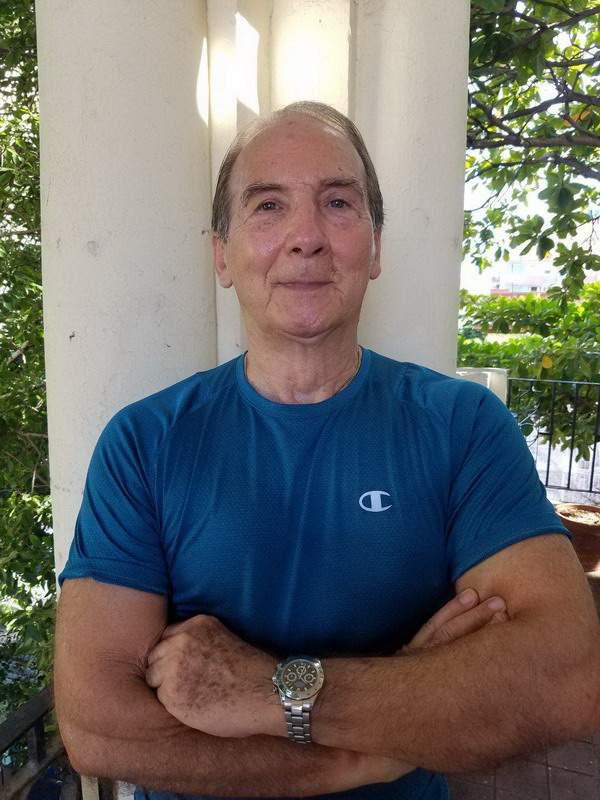
From the simplest piece, to an epic ballet, Cuban choreographer Alberto Méndez lends his admirable good taste to every single creation.
Following an absence of several years, he has been asked to coordinate the always thrilling inaugural show for this year’s 25th International Ballet Festival, bearing the name of the sublime Alicia Alonso.
The National Prize for Dance winner spoke to Granma International about this simple yet magnificent task, which could be seen as a kind of return to his natural environment, in the National Ballet of Cuba’s (BNC) headquarters.
No one doubts that maestro Méndez (San Luis, Pinar del Río province, 1939) will go down in dance history as one of Cuba’s most important choreographers with works which transcend stylistic molds, and move across the contemporary.
With a rich choreographic technique and broad vocabulary, Méndez is the creator of important pieces featured in the repertories of the BNC and ballet companies from Warsaw, Budapest, Rhin, Panama, Spain, Puerto Rico, Venezuela, that of the Teatro Dell'Opera Di Roma, Mexico, Colombia and Santo Domingo.
A brief review of his career as a BNC choreographer – where he began with Plásmasis in 1970 (First prize winner for Modern Choreography at the 5th Varna International Ballet Competition) – must naturally include titles such as Nos Veremos Ayer Noche, Margarita; Tarde en la Siesta; Rara Avis; Suite Géneris; El Río y el Bosque; La Bella Cubana; Paso a Tres; and Muñecos.
Méndez, the BNC’s in-house choreographer for over two decades, has created various works especially for prima ballerina assoluta Alicia Alonso, among them Roberto el Diablo; La Péri; La diva: María Callas in memoriam; La viuda alegre; Ad libitum(featuring Alicia and stellar Spanish dancer Antonio Gades); and Poema del amor y del mar (created for a one-off performance featuring Alonso and one of the most extraordinary dancers of the 20th century, Rudolf Nureyev, accompanied by Spanish soprano Victoria de los Ángeles).
You are organizing the inaugural show again…
They asked me to do it and I’m happily returning to work with the ballet. I’m going to create the inaugural show withballet professors who work here at the BNC headquarters; all the first and second year students from the National School of Ballet on Prado avenue, as well as the company’s entire dance troupe. I consider it to be a tour de force with around 500 people, including children and adolescents.
What’s new?
There’s nothing new exactly. A few changes, adjustments, new ideas. I don’t want it to be a repeat of past shows I’ve done. I was offered the music, a march from the opera Tannhäuserby Wagner, it lasts for about six minutes and I’m going to use it just as it is.
The Gala includes one of your pieces…
We are going to restage Vals, with music by Gounod; a work I created with Maria Elena Llorente and Lázaro Carreño (lead dancers), later I staged a second version with Lorena Feijoo and Rolando Sarabia, and now a third with Gretel Morejón and Rafael Quenedit.

Last year you organized a Gala for the company…
Yes, less than a year ago I did a gala for Alicia’s 95th birthday. I made a few modifications to the original choreographies, using fragments of the classics, La Fille mal gardée, Coppelia, the second act from Swan Lake, Giselle, and some smaller productions, very simple, to bring the whole thing together.
But not a complete work…
I haven’t been with the company for 16 years. Obviously, I haven’t stopped working. I’ve been invited to Mexico, the United States, and have created a few pieces, but essentially I redesign my own works. For example, I’m currently re-working one of my older pieces - Suite Géneris (1988) - for the Arts Ballet Theatre in Florida. I changed the title to Eros Game and changed a few steps, but it’s basically the same. As a preview, I’ll tell you that the ballerina who performed it there, Venezuela’s Mari Carmen Catoya, is set to dance it here during the Festival with two Cuban dancers.
You also created that thrilling piece Tarde en la siesta for her…
Yes, less than a year ago for a program that the director ofArts Ballet, Vladimir Isaaev, called Ballets With Latin Flavor.
Were you pleased with Tarde en la siesta?
Yes, very, because I staged it with various companies atVenezuela’s Teresa Carreño Theater, Poland’s National Dance Company, and also in Puerto Rico. It’s a ballet that has traveled the whole world.
How many works have you produced with music by Ernesto Lecuona?
I think the first was Tarde en la siesta then En la noche azul¸with arrangements by maestro Félix Guerrero, and later I did another with works by Lecuona set to piano called In the middle of the subset, which debuted here, but it was made specifically for United We Dance in San Francisco, California, in honor of the 50th anniversary of the United Nations.

Do pieces by Lecuona work well for dance?
Yes, very well, and I have always insisted on not doing versions with other Cuban pianists who play his works well, such as Huberal Herrera who specializes in Lecuona’smusic, because, themaestro is the maestro. New recordings have been made, and they are very good.
When I created Tarde en la siesta it was with vinyl records, but now new editions of Lecuona’s works - almost all of them piano – have been put to CD. In my opinion Lecuona’s interpretation is unique because, and here’s a nice little fact, he didn’t always play what he had written. It was his work and he did what he liked with it. I found out about this later.
What inspires you to create?
There isn’t anything specific. In the case of Tarde en la siesta it didn’t suddenly just come to me. I was lying down at home listening to Radio Enciclopedia and heard a piece by Lecuona and I saw something in that moment and began to develop it, to explore. That was the start. It doesn’t always happen like that. My works are often commissioned; my second choreography Nos veremos ayer noche Margarita for example, was made specifically for an event, Bordeaux’s theater month in May.
They wanted to pay tribute to Henri Sauguet, the city’s composer. They asked the ballet’s senior officials if we could create a piece with music by Sauguet, and they asked me to do it. Another example is Paso a tres.I discovered the music by Mauri on a CD and I liked it a lot. My friend, the late Mirta Plá (one of the four jewels of Cuban ballet), wanted me to create something for her and Aurora (Bosch, another of the jewels). I thought about a piece I already had at hand and it ended up being a comical work. I created a pas de trios with Mirta, Aurora and Jorge Esquivel.
You create works from your own inspiration and on commission, but what about for specific dancers?
Generally I am the one who chooses the dancer. Obviously I know the dancers, which helps me envision the character.
It’s different when I am with other companies, there I need some guidance. I have to see their technical and interpretive abilities; the two go hand in hand. Ballet is both.
When the time arrives to create a piece an exchange takes place between the choreographer and dancer, you have to give and receive. You have to rely on the performer at all times.
I like to show something. I accept suggestions. In fact throughout my career I have always asked many dancers, some of whom are no longer with us, to approach and look at what I am doing. I’d ask their opinions, if they didn’t like something. That is to say, I like to address things directly, this method works for me.
Any memories of Poema del amor y el mar?
I would have liked to write this experience down, which I did in fact start to do, but everything got deleted from my computer and I said to myself, it’s over. I still think about it a lot. It was a great experience;Alicia, her husband, myself and two or three others, spent time on a Mediterranean island, just off the coast of Amalfitana (Italy). It was incredible in every way, especially the owner (of the island) Rudolf Nureyev, a unique character; I got on really well with him.
Tell us about the inaugural show for this year’s festival…
It’s called La danza imaginada and will take place in the main entrance hall of the Alicia Alonso Grand Theater. One of my dreams was to be a painter. I studied architecture, I liked the artistic part, but mathematics and physics weren’t for me. I jumped over to dance, but I have always painted, it’s a passion. I’ve kept everything, I have around 500 works. I’d never taken the risk, but suddenly I said, I’m going to launch myself.
Ricardo Reymena (BNC designer) has helped to curate and select some 30 works. I want to do it differently because I’m not a painter; I want it to be a performance with dancers which will help to give it another flavor.
Lets got back to choreography; do you have a favorite work?
No, no, no, I don’t fall in love with my dancers or my works, or the music. I like the dancers, the music, the pieces; I like what I’ve created over many years. I put 100% of my physical and mental effort into even the simplest work. I don’t have a favorite piece. I know there are some works that have been more successful than others. That’s how it is.
Alberto Méndez is a seasoned choreographer, with a personal style, and a harmonious and coherent creative language. As such, the many fans of his tasteful and professional works will be looking forward to something more than just an inaugural show.