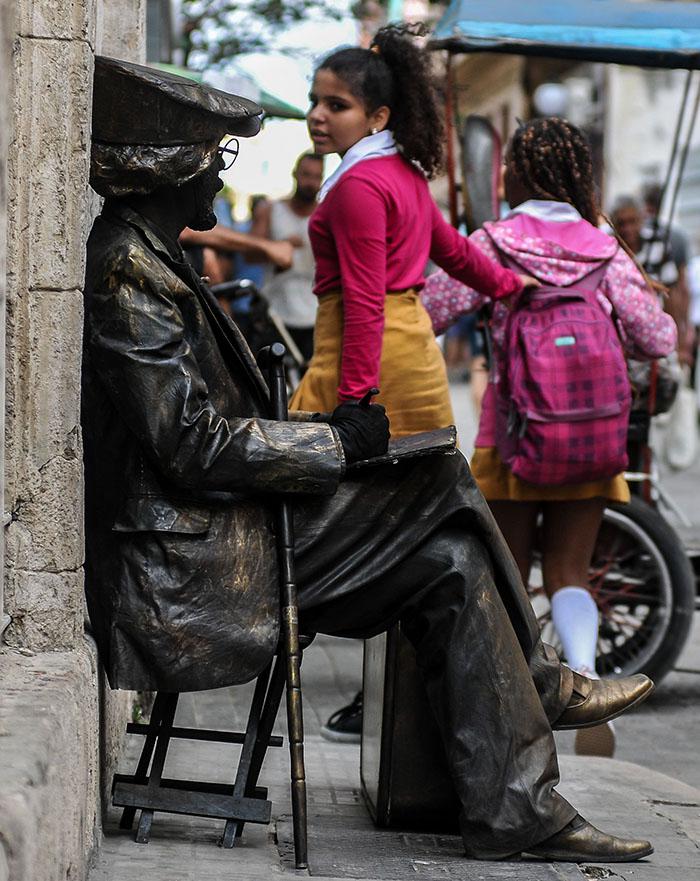
IN the golden kilometer of Havana’s Historic District, which stretches from Cuba Street to Avenida del Puerto, crossing the Cathedral, Armas, San Francisco de Asis, Vieja and Cristo squares, it is common to stumble across fortune tellers, caricaturists, painters, musicians, street vendors, and residents. But among all of them, the area’s living statues are something special.
These figures work in an area that scarcely exceeds two square kilometers, and their performances are both artistic and orderly.
“The living statues had been in public spaces for about 20 years. We wanted to know who they were, and how they were organized,” explains Elpidio Alemán Velázquez, head of the Revenue Department, part of the General Services Budget Unit of the City Historian’s Office.
“We took on the task of ensuring they were working in public spaces according to the legal norms that had been promulgated by the Ministry of Labor and Social Security regarding self-employment. We reached an agreement and established the areas where they were going to work,” he notes.
The Cultural Heritage Directorate is responsible for evaluating and authorizing these self-employed workers. Once their status is legalized, they are given a license, as is the case with other non-state workers.
There have been various campaigns to try to undermine the measures taken by the Cuban government to regulate self-employment, but the truth is that this sector is already a part of everyday life across the country. The oldest area of the capital city is no exception.
“We hold systematic meetings with everyone,” Alemán continues. We have 131 local characters today, and they (living statues) represent eight of that total. Everyone knows them as living statues, and they have been supporting the patrimonial theme of the Office.”
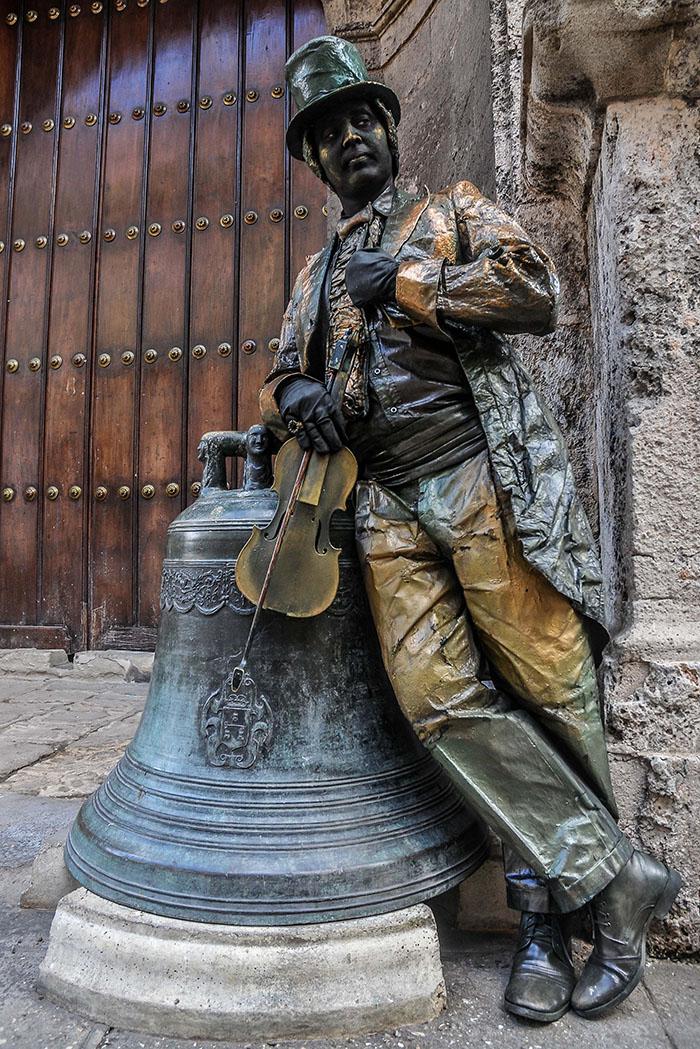
He highlights another essential element in the daily work of these artists: “They are expected to contribute to the maintenance of the Historian’s Office. Here any maintenance is very expensive, but there is no doubt that they make an important contribution through their taxes, and this serves them in the end for their retirement.”
ON THE MOVE
Questions abound when speaking to these self-employed street artists: How do they choose the characters? How much time do they spend on makeup? Why did they choose this profession? But one question is a must: How can they stay in the same position for so long?
Alberto Sánchez, who defines himself as a street artist, reduces the response to a mathematical equation and reveals the secret. “For me it’s a myth, we’re not totally still. The main idea is to be still, but my experience and my own experience told me that wasn’t so. I threw myself in the deep end, and did a sum: poetics of the clown + technique of stillness = performance.
“This means that living statues are 100% communicative. The poetics of the clown allows one to achieve greater communication with the public, in this case with the youngest audience, for whom the illusion that we are statues lasts longest.”
Trained in the world of theater, Olisdrey Isaac Rivera emphasizes an interesting detail: “Our work is hard; we need to have a lot of endurance, a lot of knowledge, even of makeup. Around the world, there are people who do not have resources and use any type of substance.
“We have studied and sought suitable ways to make ourselves up. Make-up is very expensive and we self-manage our materials. We also create our own characters.”
With almost six years experience working in the city’s historic center, he confesses: “Before I looked at statues and said: What would it be like to be inside of that? I abandon my state as a human being and I become a statue, and I see how day and night pass by.
“This is very important to me, as before, when I was doing theater, I worked for a specific audience, I had performance times, training, but in all that I noted that I acted for a specific audience. Here I perform for all kinds of audiences.
“I have had the pleasure of having spectators from infants to others who are almost a hundred years old; people of all social classes. I had the chance to shake hands with the creator of the Internet, to see Madonna in front of me, and millions of others things just because of being located specifically here.”
SERIOUS ART
These living statues are not just a simple attraction of Havana’s historic center. The series of characters portrayed is also a way to let younger generations learn about men and women who existed here in previous eras.
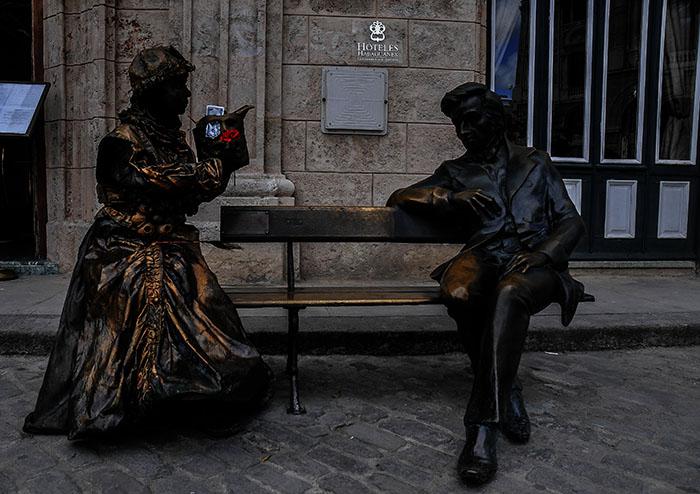
“To create each of these characterizations, we undertake a previous study of the site, the origin, the age in which they existed. We prepare where we are going to position ourselves, the costumes that were used at that time, and how to make the message clear to our audience,” explains Arigneyis Cruz Fernández, a chemical engineer turned “messenger of the angels.”
“About four years ago, I started my career as a living statue. I began to delve into each of the characters I portray. In this case, the character is the Dama de la Buena Ventura (Lady of Good Fortune), the messenger of the angels. It’s a really nice character because she gives messages of love, peace, and people like her.
“Another of the characters is Homenaje a Caridad Suárez, la Venus de Bronce (Tribute to Caridad Suárez, the Bronze Venus), one of the best 19th century singers of Cuban Zarzuela. She is a very beautiful character, very friendly, very Cuban, very Creole; people are very curious about her.
“The biggest audience we have are children,” she notes. “It’s they who most appreciate us, who are most curious to see if you are really a statue or not. It’s they who make us the happiest every day.”
THANKS TO THE THEATER
Some of those who today are living statues in Old Havana have a previous link to the stage, be it studies at the Higher Arts Institute, as a member of the Contemporary Dance company, or working with the Korimakao and Giganterías street theater groups. Others emerge from acting workshops, festivals. Today, they all thank the theater for where they are.
“In 1997, with Vicente Revuelta, we took theater to the streets,” recalls Andrés Pérez, who transforms himself to become El Caballero de París (The Gentleman from Paris). “More than living statues, the street is the theater,” he notes.
It is precisely this daily exchange with the public that has made Beatriz Estévez, a former law student at the University of Havana and today “Silver Fairy” of the city’s historic center, fall in love with street theater, and appreciate the reactions of passersby: “The spectator does not even realize that he is part of what he is looking at, that he is also an actor in everything that happens. People come to thank you for the work you do, and that encourages you to return and continue working.”
David Rouco first worked in an art instructors school, in the supplies area. Later he devoted himself to children’s activities in the squares of Old Havana, and finally chose to portray a cigar roller as a living statue.
“The character has a table with all the instruments with which a cigar is made: the guillotine, the press, the rolling board, the chaveta (broad-bladed knife)... He’s a stationary cigar maker, a depiction of what is used to make a cigar.”
The skill of these artists, the rigor and professionalism with which they assume their work, allows them to transform their appearance in just 30 minutes and exchange with the public for hours, in an apparent state of immobility.
May marks 20 years since the arrival of living statues in Cuba. This team of street actors is preparing to celebrate the Tenth Street Theater Festival in Matanzas, two decades of their art, and the 500th anniversary of the founding of the Cuban capital. Meanwhile, they continue to offer their art to those who visit the oldest streets of this Wonder City.