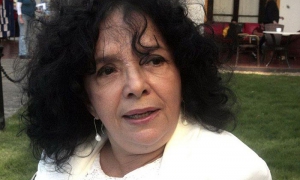
Argentine poet, critic and journalist Jorge Boccanera described the opportunity to deliver the inaugural remarks at the 62nd edition of the Casa de las Americas Literary Prizes, as a great pleasure and an honor, on its opening day January 28, with more than 1,600 works in the categories of poetry, novel and essay on historical and social issues to be reviewed.
Following presentation of the jury, which includes specialists participating in person and others via Internet, Boccanera - winner of a Casa Prize in 1976 for his poetry collection Contraseña - presented an impressive speech that elicited a resounding ovation. He thanked Abel Prieto, president of Casa de las Americas; Alpidio Alonso, Minister of Culture, and Jorge Fornet, director of the Center for Literary Research, attending the event in Che Guevara Hall, and offered praise for the institution, for Cuba and poetry.
He noted that, on this occasion, "the award acquires a special importance since it bears the mark of all that is being resumed even under the adverse conditions of a pandemic," and expressed his admiration, first, of the Casa, "born with the Cuban Revolution," directed by Haydée Santamaría, "a lucid woman… of firm convictions," who was followed by intellectuals Mariano Rodríguez and Roberto Fernández Retamar, and recalled - from comments made in 1961, by Retamar himself - the words of Che Guevara regarding the projected institution that would be devoted to "the cultural heritage of all our America."
Boccanera took time to address the future of poetry, recalling the reasons that led him to the genre, and insisted that despite a certain distancing that some may experience, "Poetry is still here."
"Stretching the thread a bit more, we can even see poetry as a counterweight to the current hegemonic discourse that naturalizes globalized language in technical war talk, advertising and the vacuous entertainment industry; phraseology that expands the language of the deceiver with post-truth and fake news; plus the fallacious jargon of euphemisms that camouflages, falsifies, eludes, conceals and distorts. It occurs to me that, while euphemism masks, poetry amplifies and projects the meaning of its obsessions with an irradiating effect that is redoubled in the practice of multiple readings," he stated.
He quoted within his remarks, among others, Eliseo Diego and César Vallejo, defending poetry "as a jewel of set images, a marriage of real perception and an omen that emerges between a glimpse and the critical eye of an alienated subjectivity, saturated with indifference, consumerist voracity and individualism immersed in fierce competition that perceives the other as the enemy."
He referred to Cuba's solidarity which, "even while suffering the consequences of an obscene, brutal and expanding blockade, has given the world numerous demonstrations, including the Henry Reeve international medical brigade," and recognized as one of "the faces of Cuba" the "Casa de las Américas that has done so much work for the art and human knowledge of our culture, as a laboratory of questioning.” He recalled turning to the Casa since he was very young to access "materials and tools to help me create, reflect, debate and discern. It has been a school for me, especially in times when in Argentina and other Latin American countries thousands of opponents were murdered and tons of books burned."
In closing, and after referring to Julio Cortázar's exhortation to set our eyes on new horizons and reach them, he welcomed the audience to "this house that has been traveling through our America for decades with its cargo of new horizons."