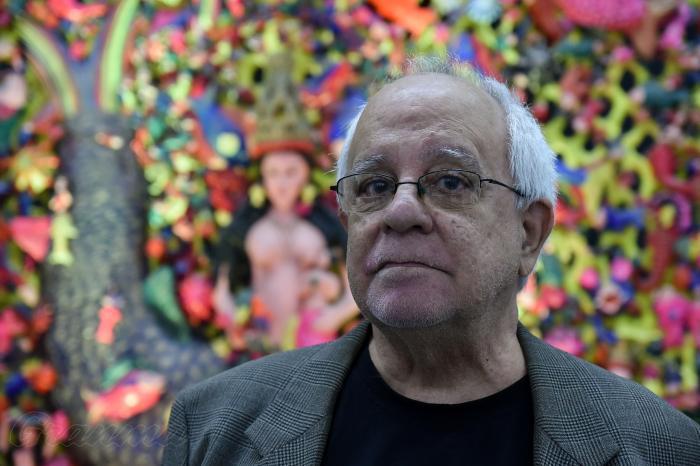
Matanzas-born Luis Lorente won the 2022 Casa de las Americas Prize in the category of Poetry for his work Excepcional belleza del verano (The exceptional beauty of summer).
The news was announced in the institution’s Che Guevara Hall, with Deputy Prime Minister Inés María Chapman Waugh and Abel Prieto Jiménez, president of Casa de las Américas, on hand, among other figures.
Lorente, who won the contest in 2004, commented to Granma that he was totally taken by surprise when he learned he had won, adding that if winning an award like this, just once, is a difficult, doing so twice is even more so. And since accomplishing something difficult is always motivating, doing so again is even more so.
The jury's report explains the decision, stating, "As if on a lampshade, the author projects his visions and memories, which are embodied and evaporate. Thus, the scene is enhanced by the ramifications of profuse symbolism that alludes to an amorous moment, to numerous moments in life, to characters from Cuba's history, even a revisited moment from everyday life. It is a meticulous record recreated by a singular memory, with virtuous language, a well crafted atmosphere and excellent handling of rhythm," also recognizing in Lorente’s collection "the strength and beauty of linked images that meander as a single and forceful poem."
The jury awarded two honorable mentions in this category: to Peruvian Carolina O. Fernández and Bolivia’s Benjamín Chávez for their works Bordando Quilkas and Para alguna vez cuando oscurece, respectively.
The prize in the Novel category went to Argentine Javier Núñez for his work Hija de nadie, which the jury recognized as possessing "good narrative pulse, great command of dialogue,” narrating, “in a cinematographic tone, the dystopian story of two women who resist a harsh, cruel reality."
Spain's Jose Antonio Piqueras Arenas won the Essay Award for Moneda y malestar social en Cuba (1790-1902), a text that, according to the jury, "rigorously describes the place of currency and monetary relations in the historical development of Cuba between the end of the 18th century and the end of the U.S. occupation. The work sheds light on Cuba’s economic history in a convulsive era, highlighting the splendor and the crisis of the colonial model. In the text, the complex relation between capitalism and slavery, the structure of classes on the island and the forms of discontent regarding foreign domination seen in diverse groups are explained with rigor, based on profuse documentary and bibliographic material. We are thus witnessing a substantial contribution to the history of Cuba, one that also offers important lessons for the present."