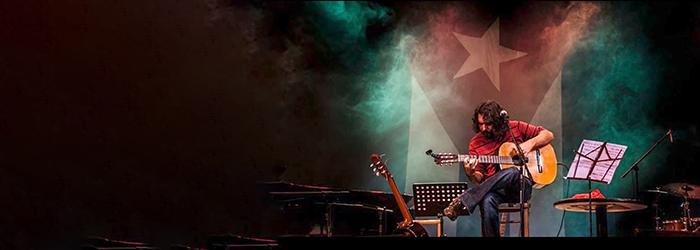
I remember very clearly that summer night in 2005, while being driven back to the hotel the band Yes was staying in, that his legendary keyboardist, Rick Wakeman, was telling his manager about singer-songwriter Santiago Feliú’s performance as one of the musicians who paid tribute to the British artist in the gardens of the Cuban Institute of Music. The impression Santiago left was so great we were even told about the possibility that he would be invited to perform with Yes in England.
It did not take us by surprise. If a classically trained musician like Wakeman was literally in awe by Santiago’s unusual skill to play the guitar so freely and with such mastery, is because he was mind-blown by the confidence of a visceral artist who had the touch of the chosen ones.
He would have shared this opinion if he would have been able to grasp the audacious images of a lyricism as unique as the way he approached music, convinced that effective communication could only be achieved in the same extent he was able to be himself. And with this in mind, Santiago set himself apart from the musicians who follow the laws of the market, by seeing his profession as the maker of songs that require the greatest possible freedom of creation.
As his closest friends say, this singer-songwriter, like his brother Vicente, did not take any decision without previously question it from the honesty of his heart. This explains his stints in countries such as Colombia, from where he was expelled for his links with the M-19 guerrilla group; or in Argentina, where it seemed that the emblematic piece Ansías del alba was a work in homage to the disappeared, while others assume it as a song to our country, when in fact he dedicated it as a gesture of solidarity to the Zapatista Army of National Liberation (EZLN).
His ability to delve into other realities, allowed him a fair and balanced reasoning about the Revolution as a country blockaded and besieged by the government that "only with an anti-imperialist president would change the United States and then he would be a friend of the Cuban people".
Let us remember him on what would be his 60th birthday, with the optimistic verses of his song La isla de Fidel: Revolución querida / sobreviva / vida de tu nación / revoluciona por tu amor / cada vez más / tu corazón.
Translated by ESTI