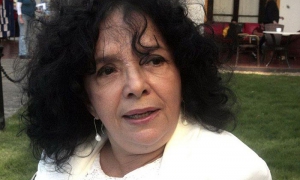
It even competes with the one from novelist Ernest Hemingway himself, celebrating the color of her eyes, a gallantry that must have lasted a lifetime for the young woman who had already published her award-winning volume Al sur de mi garganta (South of My Throat).
It happened on February 15, 1957, during a fleeting stay of the famous novelist in the city of Matanzas, occasion in which Carilda Oliver Labra was designated to deliver the key of the city to the prominent writer.
After finishing his "little speech" in English, by way of welcome, the American writer told her in perfect Spanish: "Baby, to open my heart you didn't need that little key," a phrase that unleashed a whole string of insinuations and public rumors.
Incredible stories are attributed to the ephemeral encounter, such as that it lasted nine hours and that Hemingway, in the style of a Hollywood heartthrob, in the middle of an embrace, lifted her up and with gallantry and respect, put her in a boat for a little trip around the bay.
Carilda always managed to evade the purpose of some investigators to construct the details of the episode, and in this way, she was able to defend the secret of one of the most novel-like incidents of her life.
Today marks a century since the birth of Carilda, poetess with an imperishable work of more than 40 volumes, among them Al Sur de mi garganta and the poem Me desordeno, amor, me desordeno, which was something like her presentation card, and an indisputable proof of her irreverence towards social conventions.
Some of her epic works are also well known, such as Canto a Fidel, and Conversación con Abel Santamaría. Many other patriotic events inspired her words, and the events of Goicuría and the killing of Julián Alemán, Frank País, Franklin Gómez, Miguel Sandarán and José Antonio Echeverría confirm this.
As with other great personalities of world literature, her work and her long life touch the edges of imagination and myth, which is why not a few people, especially young people, sought out this woman whose "verses defend eroticism, sensuality, femininity and freedom of choice."
"They accuse me of more romances than I really had," she once said when referring to exaggerations about her life, but without specifying anything so as not to stop the fable. After all, she enjoyed the things that were said about her existence, the true ones and the invented ones.
Among other "extravagances," this creator used to work in the early hours of the morning, surrounded by dozens of cats, and in the placidity of silence, in her mansion in Calzada de Tirry, in the city of Matanzas.
She knew how to cope with her long life, without pomp and circumstance, "neither miss nor doctor," she once said. A woman who jumped over the conventions of the time, something that perhaps, even nowadays, many would like to imitate.
Carilda, loyal to Commander-in-Chief Fidel Castro, National Literature Prize winner and one of the most important lyrical voices in Latin America, is evoked with particular eloquence in these days, when she reaches her first hundred years, even though she has departed for eternity.
Translated by ESTI