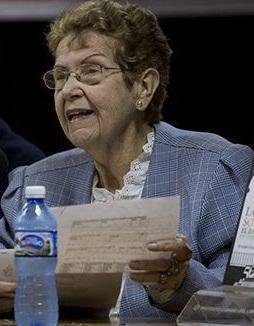
In the 1950s, she saw the building where the José Martí National Library of Cuba is located today. She used to take Sunday walks with her sisters and her father in those parts, and they would stop to admire the beautiful construction that was erected in the then Civic Plaza. The teenager Araceli García Carranza could not have guessed that a few years later this place would become one of the most powerful reasons in her prolific existence.
The outstanding bibliographer, who at 85 years of age continues to discover the mysteries of letters, remembers among her first readings fairy tales and catechism, and with special devotion the Reading Book, by Luis Pérez Espinos.
-Did life give you an early sign that your life would be forever linked to books?
-It is possible that my father's interest in my studies, and my eagerness to please him in everything, led me to books. I never forgot the atmosphere of the National Library when I was at the Castillo de la Fuerza. He would take me there to do my homework at the Secondary School in Havana. My parents instilled in us study and self-improvement and, above all, not to depend on others, to fend for ourselves.
-How long has it been since the National Library opened its doors to you?
-I have been working at the Library since February 1, 1962. Between analytical indexes, bibliographies, department heading, services and collaborations on the profession, in journals, catalogs and other documents, these six decades have passed. I feel embedded in the collections and in the marbles of the Library, I feel part of it.
A long list compiles the most important undertakings of Carranza, a professional who is always seen, in various literary spaces, as a book herself, discussing what others write. "I had the opportunity to help María Lastayo, head of Selection of the center, to move the library of Don Fernando Ortiz to the National Library, and when placing the stationery on the shelves it occurred to me to do his biobibliography. I had previously made analytical indexes of nineteenth century magazines, and I knew about this type of work because in the Revista de la Biblioteca, its founding director, Domingo Figarola Caneda, cultivated it in the years 1909-1913 and, in addition, from 1965 it was very useful as a small section in our Bibliografía Cubana, which we published until 1989. Director Sidroc Ramos immediately approved the project."
"A year before, in 1968, Cintio Vitier founded the Sala Martí and began to publish the Anuario Martiano, and he asked me -starting with Yearbook 2-to compile the bibliography of José Martí, which I published until Yearbook 7. When the Center for Martí Studies was founded, at the request of Roberto Fernández Retamar, I continued publishing it in the Center's Yearbook, up to the present.
"In 1972 Alejo Carpentier donated his collection to the Library. I processed and systematized it until it was deposited in the foundation that bears his name. From that year until today I compile his biobibliography. Later I have compiled the bibliographies of other great figures of Cuban culture such as Carlos Rafael Rodríguez, Elías Entralgo, María Villar Buceta, José Lezama Lima, Cintio Vitier, Roberto Fernández Retamar, Emilio Roig de Leuchsenring, Eusebio Leal and Armando Hart Dávalos, without forgetting my texts in the Revista de la Biblioteca, related to the history and theory of bibliography and the bibliographic-critical essays on some figures such as Alejo Carpentier. Other bibliographies such as those on the wars of independence and other relevant figures, which would make the list too long, I believe have been and are useful to scholars and researchers."
-Those who know you agree that your generosity is a trait that identifies you. What does it mean to you to be, "in the good sense of the word", good?
-My generosity is due to the fact that I am passionate about serving. I feel very satisfied when I give service because, from the internal work or from any position, the librarian should not lose sight of it. Through service, one learns and becomes a better and better professional. It should not be forgotten that the librarian is also a teacher who teaches, who paves the way to knowledge. I don't think I should say that I'm good at it, I just found my vocation.
-When you go through your long and eventful history, which names are inevitable?
-More than colleagues and disciples, I think of that other function of the librarian which is to discover talents among readers and users, and while it is true that we must serve everyone equally, it is a privilege to serve young people who we know have a right future ahead. I have seen Virgilio López Lemus, Luis Toledo Sande, Fernando Rodríguez Sosa, Rafael Acosta de Arriba, Pedro Pablo Rodríguez, just to name a few, be born and grow as intellectuals.
-Someone has called it the "paradigm of the library. What does this institution mean to you?
-For me it is the place where you are so well because, even in the midst of difficulties and problems, the strength of vocation has made me get ahead; and it must be because it is the most beautiful profession in the world, although García Márquez has already said this about journalism.
Equipped with that unsurpassable value that experience brings, Araceli currently continues to "work" Martí, Carpentier, Lezama. She has initiated the bibliography of Dr. Graziella Pogolotti, with Eloísa Carreras she compiles the work of Armando Hart Dávalos, and is head of the Library's Research Department.
Having lived to show the work of others, today the party is for this lady who considers herself "shy, respectful, disciplined and a lover of truth". Together with writer Julio Travieso Serrano, the 31st Havana International Book Fair will be dedicated to her. Meanwhile, Araceli says she is "very aware that I don't know enough, that I lack a lot, because if anyone knows what they don't know, it's the librarian, who in one way or another faces all branches of knowledge, the immense world of knowledge. I always assume that 'I only know that I know nothing'."
Translated by ESTI