

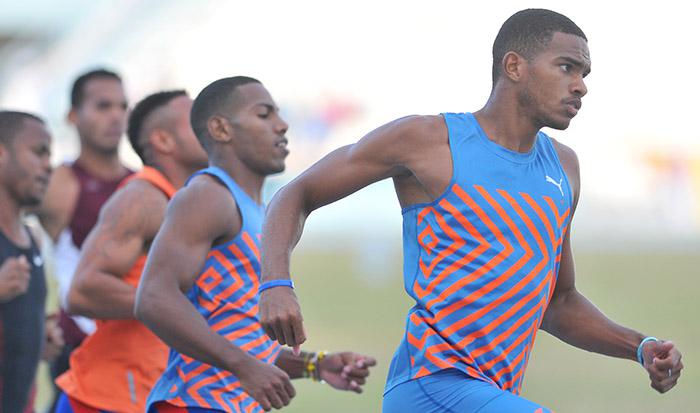
A relentless battle broke out immediately after the International Association of Athletics Federations (IAAF) announced the qualification system for the 2016 Summer Olympics in Río de Janeiro.
Although the system varied from previous, the obligation to comply with specific entry standards dates back to the 1990s, when the struggle against the threat of the “gigantism” of the Games began, and is also intended to ensure the quality level of the Olympic athletics competition.
Most events have set qualifying times or results, and a timeframe in which to achieve these. As such, once an athlete meets or beats these requirements, they can rest assured regarding their Olympic spot. They can then focus on their goals for Río.
In the four different track and field relay races, two for men and two for women (4x100m and 4x400m), there is a more complex variant.
The IAAF ruled that the top eight finishers at the World Relays, Bahamas 2015, would be guaranteed a place at the Río Olympics. Of course, all potential candidates could try their luck.
Cuba sent its male and female 4x400m teams, universally recognized for their Olympic and World medals and finalist positions.
In addition, the men's 4x100m team traveled to the Bahamas. The majority were newcomers, but they had shown their might at the 2014 World Relays, bringing to mind earlier times when our runners impressed individually or as a team.
It was May 2015 and some, among them the Cubans, failed or were unable to secure a spot among the top eight finalists.
Cuba also took a female 4x800m team and they were finalists (fourth place), but that was of little comfort, as this is not an Olympic event. That is not to take away from their effort.
Having lost out on that possibility of qualifying, the Cuban relay teams looked toward their second chance to reach the Olympics – featuring among the best in the world rankings based on the average of their two fastest results between May 1, 2015, and July 11, 2016.
The 4x400m teams quickly demonstrated their ability in July and August, at the Pan American Games in Toronto and Beijing World Championships, respectively. They accumulated important averages of 2:59.82 for the men’s team and 3:29.54 for the women’s team (not included in Beijing), which virtually secured their Olympic spots.
The men’s team is still first place (ninth overall) behind the eight teams already guaranteed to compete in Río. The Cuban women’s team remains in a less comfortable twelfth place, forming part of the large group which according to performance will either shift up or down the rankings up until July 11.
The 4x100m teams did not have the same fortune, and this year have had to fight hard to try and secure a place under the five rings.
The men’s time of 38.44 seconds in May, during the semifinals of the Ibero-American Championships in Athletics, at the same Río venue as will host the Olympics, placed them in the qualification zone (the top 16), given their average from the top score of 38.85 in 2015.
They were then knocked out of this position by Turkey’s relay team (composed of two former Jamaican athletes and one born in Azerbaijan) moving down to 17th place.
The leadership of the island’s national athletics sent the team to Europe to fight for their ticket, despite having to replace starter César Ruiz, injured in Río, with substitute Reidis Ramos.
On Sunday, June 19, Ramos, together with Roberto Skyers, Reynier Mena and Yaniel Carrero, provided a victorious time of 38.70 in the international athletics’ meet in Santo Antonio, Lisbon, Portugal.
Their average, combined with the previous time of 38.44, was reduced to 38.57, meaning the team once again could qualify, returning to 16th place. Just in the lead are the Dominican Republic with 38.56 (15th place) and Turkey with 38.50 (14th place).
Barbados’ team, with an average of 38.60, moved down to 17th place, but will surely not give up their fight. Meanwhile, Portugal failed to benefit from the competition at home, with a time of 38.95 and second place, meaning the team remains in 19th place, with an average of 38.79, based on the times of 38.65 and 38.94.
Cuba's 16th place position is like sitting on top of a volcano. There are many national and continental competitions ahead such as the European Athletics Championships (July 6 - 10), where they could see times that kill off any Olympic hopes.
As such, the Cubans remain in Europe and have announced their participation in various competitions including that of Pamploma, Spain, and surely Turku, Finland, on June 29.
The battle to reach the Olympics promises not to be over until the very end of July 11.


