

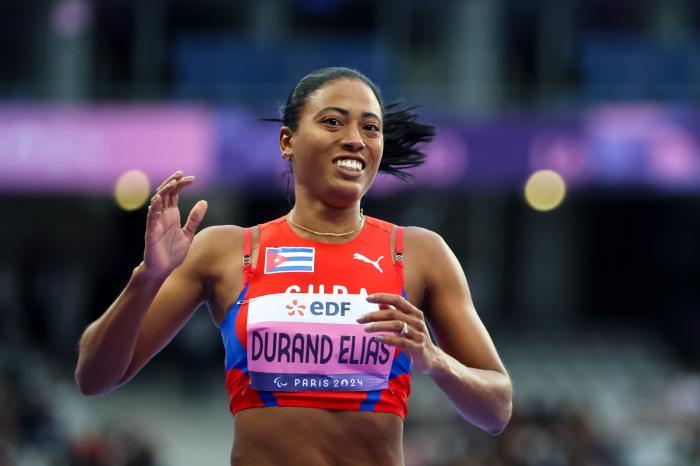
"Every person, with or without a disability, must accept themselves; then, they find their path easier. Otherwise, they create a myth about their inability to move forward, and others either overprotect them or underestimate them."
Omara Durand can offer us this advice because she loved herself so much that she revealed the secrets to making her name the true embodiment of the combination of humility and legend.
“My family is an unconditional support, without being overprotective. I studied on a scholarship until seventh grade at the Antonio Fernández León Special School in the municipality of Boniato, Santiago de Cuba. Beyond the classroom, it prepared me for daily life, as I learned to make my bed, sew, cook, do laundry, and even do carpentry.”
She dabbled in rhythmic gymnastics, but at age seven, thanks to the Physical Education program, her teacher, Reinaldo Cascaré Castillo, recognized her talent for athletics and instilled that passion in her.
Even after finding her calling, several challenging goals awaited her, both on and off the track. “From eighth grade onward, I enrolled in the Provincial Higher School of Athletic Improvement (ESPA), which follows a conventional curriculum. My visual impairment prevented me from seeing the blackboard, but my classmates helped me.”
“In particular, one of them was with me from high school through the University of Sports, and she gladly took on the responsibility of teaching me, even though the other teachers sometimes asked her to be quiet.”
After her discoverer, other coaches “added their own touches to my career and contributed their share.” She mentions Jorge Gonce, Mabel Sosa, Adrián Ferrer, and Manuel López, “whom I consider a father figure; he played a crucial role in my adolescence.”
From 2007 until her retirement, she was guided by the magical hands of Miriam Ferrer on the national team. Her early independence prevented a major trauma when, at a young age, she left home to travel to Havana. However, her mother moved to the capital shortly afterward, and she always shared time with jovial athletes who made her feel at home.
“I never put up barriers for myself, although I was afraid of some exercises. The hurdles terrified me, and I had accidents, but I tried to overcome them and never stopped doing them.”
In her first year on the Cuban team, the 15-year-old, competing in the T13 medical-functional category, debuted at the World Championships for the Blind and Visually Impaired, held in São Paulo, and won the 100 and 200 meters.
“I really didn’t expect it, but it happened, and I loved it; however, I was already setting goals to maintain my status.” Just two weeks later, in another Brazilian city, Rio de Janeiro, host of the Parapan American Games, she again dominated both distances, as well as the 100-meter dash.
“I had high expectations for the 2008 Beijing Paralympic Games; I was considered a favorite. But I suffered previous injuries that prevented me from performing at my best, and I felt the effects of them during the competition. Despite the bitterness of the moment, it became a learning experience.”
From 2011 onward, the avalanche of her astonishing records began. “I always prepared very well; I was characterized by a healthy ambition. You don't foresee records, although training gives you some idea of what might happen, but they are extraordinary achievements.”
During the London Summer Games, she etched her name in the highest echelon and turned the page on the painful four-year drought. “It brought me peace and emotional stability. I settled that debt by winning with Paralympic records in the 100 meters and the 400 meters, although my other event was not included in the program.”
There, she performed for the last time without a guide, but unknowingly, she carried with her a different kind of companion. “I finished the event without receiving any sign of improvement, but after returning to Cuba, the discomforts of a pregnancy began to surface—unplanned, but welcome nonetheless.
“With determination, I decided to have my daughter Erika and return to work. There were differing opinions, but I had the unconditional support of my husband and my mother, who meant everything to me in those circumstances.
“I returned to work three months later, full of uncertainty, but I had more than enough determination and willpower. Miriam found a very good rehabilitation specialist, so much so that, six months into the pregnancy, I went back to the gym, lifted weights, and absolutely nothing happened. In fact, that's when my most remarkable period began.”
Along with the blessing of becoming a mother came a further decline in her eyesight, a reclassification as T12, and the obligation to find a guide.
"I was used to running alone, but I took it all in stride, thanks to Miriam. She brought Yuniol Kindelán because she saw in him the ideal physical condition, as well as similar human characteristics, for example, his seriousness.
"I trusted her, although at first it was incredibly difficult for us to start in sync, but one day we managed it, and then we could spend time apart, and when we came together, we were as one."
“In our first sessions, I asked him, ‘Yuniol, how many sisters do you have?’ He said six, and I replied, ‘From now on, count seven because I’m one more.’ We had to get along really well, be transparent, and clear up any doubts.
“In that conversation, he wasn’t as expressive as I was, but he listened and simply answered, ‘Okay, Oma.’ I think he understood, because we formed an almost perfect partnership. We retired from active sports, but we’re still like siblings, always there for each other.”
She spoke a bit more in that daily interaction, but during races, only his voice was heard. In the short races, he would point out technical aspects, “but on the lap around the oval, which I respect immensely, I would get very nervous, although I never showed it, and he acted as my guide and psychologist, helping me relax.”
Each feat was backed by tremendous sacrifice and demanding preparation led by Miriam, who knows how to combine that rigor with understanding. “I consider her another mother. In Beijing, I wanted to participate, and she never imposed the opposite opinion, even though it was the most sensible one. On the contrary, she tried to comfort me, spending sleepless nights accompanying the medical team.”
Few know this, but the Santiago native considered retiring after the Tokyo Paralympics due to injuries; above all, her heels would swell and limit her performance. Luckily, Yuniol reiterated his confidence in her and convinced her to continue until Paris: “Oma, I think you can keep going.” Breathing the fresh air of a sabbatical year, the first of that final cycle, also helped.
However, no physical ailment caused her as much suffering as her disqualification in the 400 meters at Santiago-2023. “It had never happened to me before, but I really did break a rule, and rules are meant to be followed.” I let go of the guide before stepping on the last line and at the time I didn't realize that mistake, I saw it in a video."
Moreover, it happened on the eve of her birthday and on the seventh anniversary of the death of her beloved Commander-in-Chief, Fidel Castro Ruz. Of course, she wanted to dedicate that victory to him because, despite the proximity in the calendar, she holds him very dear and will never cease to identify as "a Fidel follower, faithful to his ideals."
That day shattered her world, but she knew how to rebuild it and gave him, offered us all, the well-deserved ending under the enchanting backdrop of the Eiffel Tower and the Seine River, in September 2024.
"The 200-meter dash was our farewell, and Yuniol was in pain; there were several tensions at once. Before we started, I gave him positive energy, as he was a little afraid of leaving me behind. In the nine races of the competition, I encouraged him: 'You can do it, and let's go for the next one.' That's how we reached the last one."
“When we finished, emotions flooded in: the sadness of never touching a track again and the joy of winning three titles in the French capital. I took off my spikes, and I meant it; that was it, it was over, after competing with the constant motivation of improving my time. We said goodbye to the fans and to the Paralympic movement, in which we were so beloved.”
After the legitimate tears of those moments, shared by many of her fortunate compatriots, the woman, a resident of the Havana municipality of Arroyo Naranjo, is now focused on self-improvement and showering love on another medal named Liz Allison.
“After retiring, I planned to expand my family, and that happened quickly. I’m enjoying it immensely; she already says ‘mama,’ ‘tata,’ ‘papa,’ she’s also crawling and developing well.”
That innocent joy doesn't diminish her concern: "Taking care of our children feels like an Olympic challenge. Faced with the toxicity of social media, where malicious people want to use young people against the Revolution, we parents have an important educational role to play."
A Prensa Latina poll chose her as the best female athlete in the region two years ago, without any distinctions. However, in that sphere and throughout society, we continue to cling to useless conventions.
"Transforming mindsets is difficult, but not impossible; it requires awareness and professionalism. When we humans learn to see each other as such, and nothing more, doors will open."
Those privileged to know Omara Durand, who is also a member of parliament and the Council of State, will agree that she ran drawn by a light she never saw, not because of poor eyesight, but because that light lives within her.


