

"Paralympic sport is not the adaptation of someone else's dream; it is the achievement of one's own." This conclusion was reached by students in a classroom at the Manuel Fajardo University of Physical Culture and Sports Sciences, according to its rector, Silvano Merced Len.
This phrase is displayed on a wall at the new Cuban Paralympic Committee (CPC) headquarters, inaugurated at the university in the presence of Andrew Parsons, President of the International Paralympic Committee (IPC), and Michele Formonte, Executive Director of the governing body for the Americas.
The event also marked the launch of an Honorary Chair—an academic unit that will have a presence in all Physical Culture faculties across the country. It will be led by Gerdan Fonseca Bernal, the current CPC vice-president and one of the most consistent and decorated figures in track and field throwing events.
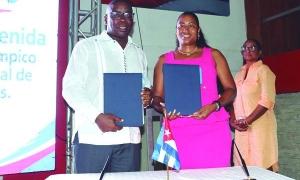
An alliance was signed between the national committee—represented by its president and legendary athlete Omara Durand—and the educational institution. Durand thanked the university authorities for the opportunity to apply scientific knowledge to both elite-level competition and grassroots sports.
Merced Len recalled that, back in May during the CPC’s elective assembly, the winner of 11 global multi-sport titles had expressed her desire to collaborate with the university.
According to First Vice-Rector Mercedes Valdés Pedroso, the initiative is guided by new standards of innovation and inclusion. It will combine academic rigor with the effort and resilience of the athletes. "It is not just about reaching the podium; it is also about the power of science."
Parsons—describing Omara as a "queen, an athlete, and an exemplary person whose leadership can influence the entire planet"—acknowledged the importance of sport as a tool to change perceptions regarding disability, a condition affecting approximately 15% of the global population. Meanwhile, Formonte stated that, as a 34-member continental entity, they seek to foster closer ties with the committees of each state and encourage their engagement with human rights activists in this field. "We coordinate with governments, Unesco, and other organizations because no one can do it alone."
It also serves as a regional liaison through collaboration with networks such as the South American Sports Council, while simultaneously offering training on the complex subject of medical-functional classification, he added.
The organization promotes universal design free of architectural barriers, asks event organizing committees to ensure a percentage of their members are people with disabilities, and raises the profile of sports tourism.
Achievements in the competitive arena increasingly depend on the links between the field of action and academia. Therefore, this center and academic chair—backed by the Olympic Committees of Cuba, the Americas, and the world—hold the promise of future glories, benefiting both those who deserve an opportunity and those of us who share in the joy that arises from it.
Photo


