

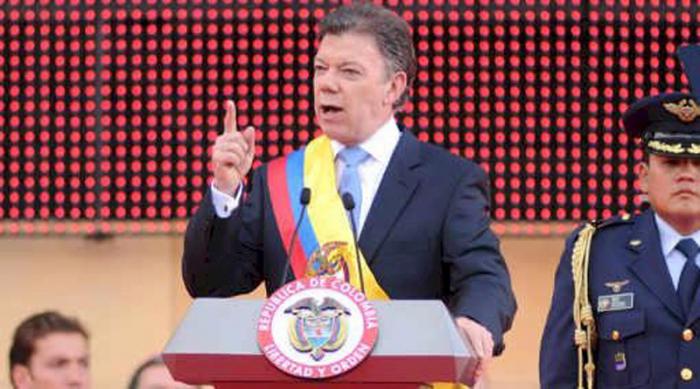
Peace will be the central axis of Colombian President Juan Manuel Santos’ second term, which began August 7, with a commitment to persevere toward the goal of achieving peace as fundamental to the country’s development, via talks underway in Havana between his government and the Revolutionary Colombian Armed Forces-People’s Army (FARC-EP), and the initiation of negotiations with the National Liberation Army (ELN). Colombian President Juan Manuel Santos during the inauguration of his second administration. "Peace" was the most oft-repeated word spoken by Santos during his inaugural address for the 2014-2018 term, and he did so 21 times, reiterating promises made during the election campaign and insisting that he is committed to delivering a peaceful Colombia in four years time, putting an end to a conflict which has lasted 50. The President considers peace the number one priority in his plans for the next four year period, to make possible the construction of a new country on the foundation of total peace, equity and education, a goal which, in his opinion, must be achieved within a decade, by 2025 to be exact. "Peace is the unquestionable programmatic axis," said political analyst Fernando Giraldo, of Javeriana University in Bogota, who believes that while emphasis on peace in the inauguration speech was predictable, the issue is being taken seriously. According to Giraldo, the peace talks Santos initiated during his first term with the FARC-EP are on "a path of no return," despite the difficulties which regularly emerge. "Today I tell you I am going to use all of my energy to fulfill this mandate for peace!" Santos said during the inauguration ceremony, with the conviction that there is no other option. Giraldo commented that Santos needs the new Congress, installed July 20, to legislate for the post-conflict period, that is approve laws to implement the accords, to be reached eventually with the guerilla forces, despite the strong opposition led by former President, current Senator, Álvaro Uribe and his caucus. Delegations from the Colombian government and the FARC-EP, meeting in Havana, have made progress on three partial agreements in the areas of agricultural development, political participation and illicit drugs. They are currently debating issues related to victims of the armed conflict, the fourth of six points which the two parties agreed to include on the agenda. The President also linked the issue of peace with the country’s development, along with two other challenges he considers critical: the achievement of social equity and quality education. All three are interlinked and indispensable to each other. Giraldo commented, "This is not about a speech, but something more concrete," recalling that the promises began to take shape when the 2015 budget was presented, including, for the first time, more resources allocated to education than to defense and security. (Granma International staff)


