

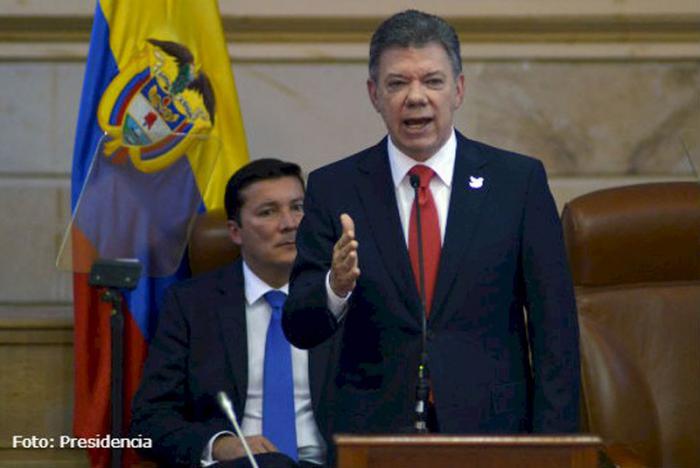
Colombian President, Juan Manuel Santos, will begin a new term in office (2014-2018) in August with majority support in Congress and an opponent – former President Álvaro Uribe - ready to wage strong opposition. President Juan Manuel Santos upon inaugurating the new Colombian Parliament, called on legislators to work for peace. Photo: Presidencia. In the new legislature, elected March 9, Santos will have the majority in the Senate, with 17 seats occupied by the Liberal Party and nine by the Radical Change Party which, along with 21 seats held by the Social National Unity - the party which supported Santos’ candidacy – takes the number of parliamentarians allied with his administration to 47. The same situation exists in the lower house, where the ratio is 92 legislators in support of Santos, to 22 in opposition. The Conservative Party, which received the third most votes in the March 9 elections, will have 18 senators, the majority of whom are also allied with Santos, the Green Alliance will have six, the Alternative Democratic Pole with five and Citizens’ Option with three. In this context it is worth highlighting the return of two political heavy weights, former governors and presidential candidates Horacio Serpa (Liberal Party) and Antonio Navarro Wolff (Green Alliance), both participants in the ratification of the 1991 Constitution. In addition to Serpa and Wolff there are other new figures such as political expert Claudia López from the Green Alliance, who in 2010 (during Uribe’s term in office) exposed the ‘para-politics’ scandal, brining to light links between politicians and paramilitaries, which led to the indictment of 97 parliamentarians. In total the new Congress will have 268 members, including 21 women, and one in every three senators new to the current legislature. According to analysts, all of this, without forgetting the Democratic Center’s motivations and the presence of Uribe - which will heat up or polarize future legislative debates - and the majority Santos holds in the upper and lower houses, will afford him control over proposed legislation. The new congress will face the challenge of advancing important reforms for the country, but above all the laws which will establish a judicial framework for the political participation of FARC-EP, in the wake of agreements to establish an end to the country’s internal conflict currently being addressed in talks held in Havana. After inaugurating Congress, President Juan Manuel Santos invited all political parties to work together to achieve peace, stating that he will have "the enormous responsibility of supporting the implementation of the agreements, and creating legislation for a new nation: the post-conflict nation," in his hands. He continued, stating "I do not believe that those who did not support my candidacy are opposed to peace. There is not a single rational Colombian who does not want peace," this is an issue "which must unite instead of divide us," he commented.


