

More than four months ago, 43 students from the Ayotnizapa Rural Teachers School, in the Mexican state of Guerrero, disappeared after being arrested by police arriving in the town of Iguala to participate in a peaceful protest against the policies of the municipal mayor. They have yet to reappear, and thus Mexico cannot close the wound caused by their disappearance, another case in the wave of violence which exists in the country.
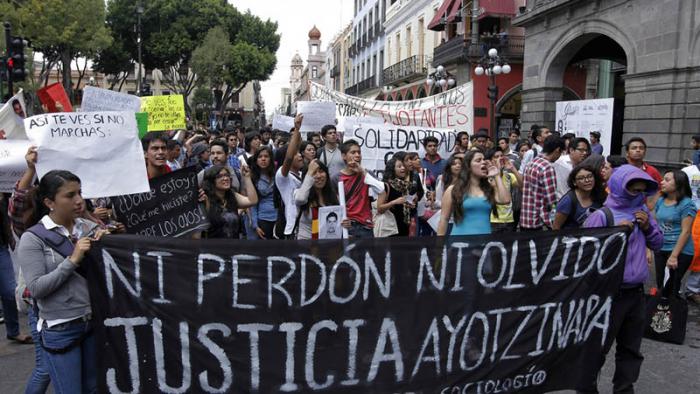
Exact figures of the number people killed as a result of the violence generated by drug trafficking and paramilitary groups is unknown, as during the search for the students dozens of human remains were found in common graves in Guerrero, a tragedy which extends to other Mexican states, as a result of drug cartels working in collaboration with territorial authorities, according to human rights organizations.
A report published recently by the Citizens Council for Public Security and Penal Justice, a Mexican non-governmental organization, revealed that nine of the most violent cities in the world are located in Mexico.
The most dangerous city in the county, and second most dangerous in the world, is Acapulco, with an average of 142.88 murders per 100,000 inhabitants, followed by Torreón, Nuevo Laredo, Culiacán, Cuernavaca, Ciudad Juárez, Chihuahua, Victoria and Monterrey.
Despite the high number of kidnappings and disappearances carried out in this nation, few cases are reported for fear of reprisal, and the discovery of common graves in Guerrero during the search for the missing students, once again demonstrated the impunity with which criminals operate, despite the promises and measures adapted by successive governments over many years.
An example of why there exists such collective fear of assassination in the country, was the brutal beating and beheading of the Revolutionary Popular Front leader (FPR), Gustavo Alejandro Salgado Delgado, in Morelos this month, 24 hours after being reported missing.
Salgado Delgado was one of the main promoters of the initial protests against the disappearance of the Ayotzinapa students in the center of the country.
A NATION STANDING UP TO VIOLENCE
The situation that occurred in Ayotnizapa - which involved, according to the Attorney General of the Republic (PGR), officials from the Iguala Mayor’s Office, where the youth were abducted, members of the provincial police force and hired killers from the Guerreros Unidos cartel, some of whom have been arrested - has mobilized various sectors of Mexican society and international organizations, who have, since then accompanied the student’s family members, in pursuit of justice, in small and large scale protests.
On September 26, 2014, the police were awaiting the bus on which the students were traveling, who were shot at on arrival. Six people – three of whom were students – were killed instantly, while 43 were arrested on the order of the Mayor of Iguala, José Luis Abarca.
The case, which the PGR is trying to close, has generated a series of protests which has upset the political stability of the federal, state and municipal authorities of the most violent territories.
Representatives of the families of the 43 disappeared students – who the PGR claims were killed and their bodies burnt by Guerreros Unidos – traveled to Geneva at the end of January, 2015, to present a formal charge before the UN Committee on Enforced Disappearances and oblige the Mexican government to take measures in order to avoid any further tragedies.
The official Mexican delegation which traveled to the UN promised that in June, at the latest, the country will have a general law to combat this problem, and that they will work to improve a series of deficiencies exposed during the case,” stated deputy secretary of Multilateral Affairs, Juan Manuel Gómez Robledo.
AN OPEN WOUND
The parents of the 43 disappeared students, who were training to become teachers to work in poor Guerrero communities, have rejected the response of authorities, given that only the remains of one of the students have been identified. Much less now, after the Argentine Forensic Anthropology Team (EAFF), which worked on identifying the remains, contested the so-called “true story” offered by the PGR in order to close the case.
The EAAF cast doubt on the theory of the PGR, due to a number of facts, and released a statement disputing the rigor of the official investigation, which repeats that the students were arrested by police, handed over on the orders of Mayor Abarca to Guerreros Unidos, who murdered and burnt them in the town of Cocula, after which their remains were thrown into the San Juan River.
According to the Argentine experts, the area where the PGR believed the bodies were burnt – in a garbage dump in Cocula – was in fact used in previous burnings, since at least 2010.
In addition the EAAF found evidence from the bone remains recovered from the Cocula dump still undergoing analysis, which strongly suggests the existence of remains which do not belong to the students.
“The Ayotzinapa investigation – stated the EAAF – can not be definitively closed as there is still a significant amount of evidence to process, both by the PGR and the EAAF. More time is needed to analyze the remains and all related evidence. This will take several months.”
The national director of the Mexican Labor Party (PT), and member of the Federal Parliament, Alberto Anaya, commented in a public statement, “The case can not be closed when what happened - and who the true authors of the crime are - has not been clearly established.”
It is absurd, he stated, that the federal authorities continue to push the issue aside, as if nothing had happened, covering up the impunity and corruption existent in their own institutions.
Similarly, the President of the National Human Rights Commission, Luis Raúl González, stated, “There can be no talk of closing the case,” and emphasized, “We are still awaiting decisions from judges, part of the results requested from abroad, a conclusion can not be considered, and the National Human Rights Commission must remain open.”
THE VIOLENCE CONTINUES
A few days ago, the Mexican newspaper La Jornada reported that at least 11 people were kidnapped in the municipality of Cocula, where the students were allegedly murdered, according to workers at the Canadian Media Luna mine, located in the area.
La Jornada reported that the kidnapping was carried out by some 30 individuals with rifles, who intercepted the public transport on which the miners were traveling after finishing their work.
Meanwhile, Mexican society, through its political and student organizations have insisted that they will continue public protests in order to stop the PGR from closing the investigation into the Ayotzinapa case, an open wound for the entire.


