

Six months after the forced disappearance of 43 Ayotzinapa student teachers, the Mexican population refuses to let impunity for their murderers prevail while these young people fade into mere memories, given the now certain impossibility of finding them alive.
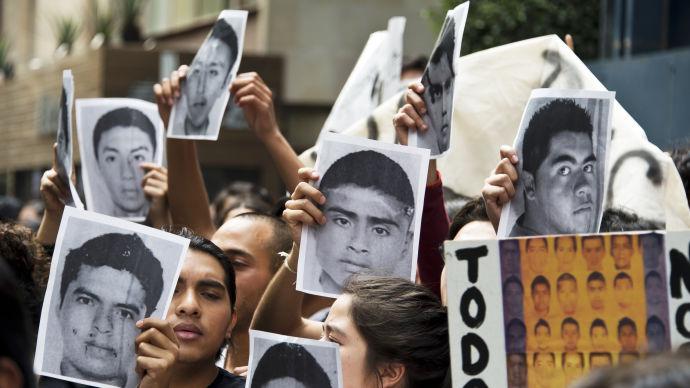
Demonstrations inside and outside of the country continue to ensure the case does not sink into oblivion.
The youths, who were studying to become primary school teachers at the Raúl Isidro Burgos Rural Teachers College of Ayotzinapa, were kidnapped on September 26 last year by police in Iguala, a municipality close to Ayotzinapa, where they were participating in a peaceful protest against measures implemented by the local authorities.
However, the police prevented them from getting off the bus in which they were traveling. Instead, they received them with bullets, and six people - including three students – were killed on the spot while a further 25 were wounded.
Forty-three students were arrested, and according to the mayor of Iguala, later handed over to hitmen from the local Guerreros Unidos (United Warriors) gang in a coordinated action.
Guerreros Unidos members who participated in the murders and were arrested together with the mayor and his wife, admitted that they had killed, burned and thrown the remains of the students arrested hours earlier into the San Juan River.
Since then, there has been no end to the popular mobilizations across Mexico demanding that the students be returned alive and the government of President Enrique Peña Nieto take responsibility for the forced disappearances in Iguala and thousands of similar cases, which have come to light during the ongoing search for the kidnapped, with the discovery of dozens of mass graves and human remains.
Six months after the events, a group of parents and representatives of the 43 students are touring the United States, speaking at public meetings to denounce impunity and violence in Mexico.
As part of their continuing struggle to bring what they consider the truth to light, they held a vigil outside the State Department in Washington on March 23, demanding justice before the international community.
“The reason for our visit to this country is to inform the world community that the Ayotzinapa case (where the students were from) can not be closed until there is a real, scientific answer to the whereabouts of our 43 young disappeared students,” explained Felipe de la Cruz, spokesman for the “Caravana 43.”
The spokesman, who teaches at the Raúl Isidro Burgos Rural Teachers College of Ayotzinapa and whose son survived the police attack, participated in a conference held at the University of the District of Columbia Law School, in the U.S. capital.
The relatives of the disappeared plan to visit at least 43 major U.S. cities, including New York, as part of the “Caravan of the 43.”
De la Cruz noted, “As Mexicans we can not sit still and let this go unpunished. If we allow it, we are dooming ourselves and future generations in our country, who will be condemned to live the same suffering.”
Spokespeople for the families have called on the federal government to open new lines of inquiry, as they are unhappy with statements made by authorities in Iguala, in the state of Guerrero, and those of members of the mafia operating in the area, implicated in the deaths.
The Ayotzinapa 43 Caravan set off from San Antonio, McAllen, and El Paso (Texas) in mid March, traveling over three different routes to publicize the case in U.S. society and the Latino community.
While in the United States, the relatives will speak with local media about their experiences in the search for their kidnapped children, and the violations of civil liberties in Mexico, just as they did before the United Nations Commission for Human Rights in Geneva, Switzerland.
The families of the students reject the official version claiming that the Guerreros Unidos murdered the students mistaking them for members of rival gang Los Rojos (The Reds), which they say is unfounded since there are eyewitnesses to the presence of the Iguala police and the arrests, as well as the students’ subsequent transfer to nearby Cocula, where it is assumed they met their tragic end.
The National Coordinator of Education Workers (CNTE) organized a series of actions last March 20 outside embassies located in Mexico City, to internationalize the demand that the students reappear alive.
On March 26, six months after the disappearances, the CNTE held the tenth Global Day of Action for Ayotzinapa and Mexico, with rallies outside the National Electoral Institute (INE) in Mexico City, and simultaneous demonstrations at offices of this body across all states of the country.
The National Meeting of the Resistance Movements was also held in Mexico City, attended by representatives of various student, worker, peasant and civil society organizations.
On March 27, an international meeting for Ayotzinapa was held in Chilpancingo, Guerrero, and the next day at the school where the missing students studied.
As evidenced by the protests, Mexico will not let its students die.


