

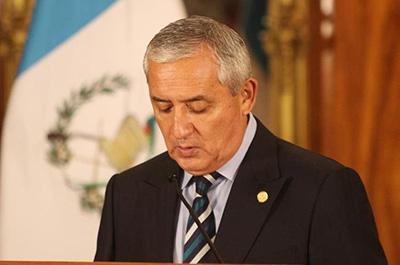
Although political situations can change overnight, Guatemalan President Otto Pérez Molina, with a full military career behind him at 54 years of age, continues to enjoy the support of big business, which would like to prop up his controversial administration until the next scheduled elections, September 7.
Pérez Molina retired from the Army in 2000 as a General, after three decades of service, including counter-insurgency combat missions and heading up two military bodies, the Intelligence Directorate (D-2) and the Presidential General Staff.
With the elections three months off, the Agricultural, Commercial, Industrial and Financial Associations Coordinating Committee (Cacif), the largest business grouping of its kind in the country, has decided to stand behind the leader of the conservative Patriot Party, since they are concerned about salvaging national institutions, severely eroded over three decades of civil war.
This support keeps Pérez Molina in place. He has the backing of ministers like Sergio de la Torre (Economy, previously head of the Chamber of Industry) Carlos Contreras (Labor, former Cacif lawyer), Cynthia del Águila (Education) and Juan Carlos Paiz (competitivity commissioner and head of the Alliance for Prosperity with United States.)
Big business cannot, however, avoid reality altogether, since it is obliged to represent its economic interests internationally and cannot turn a blind eye to the eminent crisis. The citizenry has been in the streets for seven weeks now, protesting corruption and the President, who has taken no responsibility whatsoever and no on believes.
Guatemala has 17 million inhabitants, 50% of whom are indigenous peoples with a poverty rate of 90% and no voice in the country’s decision-making. To the surprise of Guatemala’s right wing, this time the indigenous have joined the demonstrations, demanding the President’s resignation and a serious investigation of corruption.
Quiché leader Rigoberta Menchú, winner of the Nobel Peace Prize, was among the first to demand that Pérez Molina resign, “for questions of dignity.”
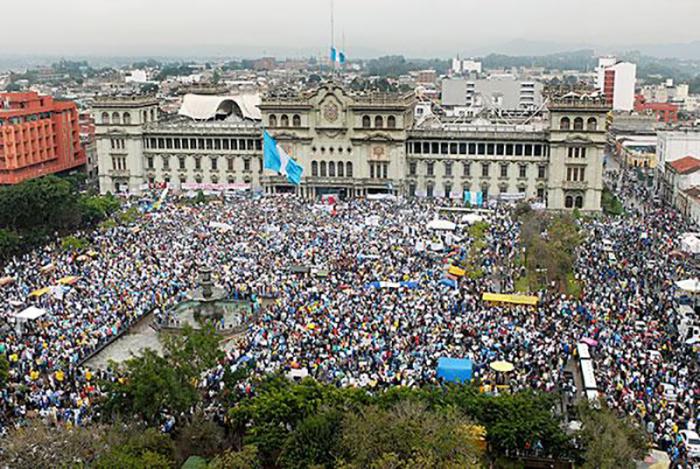
Photo: http://www.elperiodico.com.gt
There is a possibility that a change may take place, since the previously united business sector is wavering. The Chamber of Commerce has already taken some measures against corruption, and other groups want a new President before the next elections.
The urban movement is returning to the streets June 13, while the Social Popular Assembly, which includes independent campesino, religious and student organizations, has called a national strike, two days later, with a special invitation to Cacif.
Among those also making demands are the Center for the Defense of the Constitution (Cedecon) and the College of Attorneys and Notaries of Guatemala (CANG).
In Quetzaltenango, Cobán, Chiquimula, Huehuetenango, Petén, San Marcos, Totonicapán, Sololá and Escuintla, thousands of Guatemalans have taken to central plazas and parks to denounce authorities in local governments, considered entirely corrupt.
At least 12 authorities have been detained for ties to corruption, in a scandal which emerged this past April 16, when a customs fraud network called La Línea was exposed. Vice President Roxana Baldetti resigned May 8, and her private secretary, presumably the head of the corrupt group, Juan Carlos Monzón, has disappeared, a fugitive from justice.
Also arrested were high-ranking officials at the Guatemalan Social Security Institute (IGSS), headed by Pérez Molina’s former secretary and military man, Juan de Dios Rodríguez, accused of irregularities in dealings with a dialysis company; as well as Central Bank President Julio Roberto Suárez; and the head the country’s tax authority; among others.
After the resignations had begun, on June 2, Ivanova Ancheta left her position as deputy for sustainable development at the Ministry of Energy and Mining, as did Pérez Molina’s son-in-law and Presidential secretary, Gustavo Martínez, who, according to local media, has been linked to other cases of fraud. Also on the list is former Minister of the Interior Mauricio López.
The International Commission against Impunity in Guatemala (CICIG), led by Colombian Iván Velásquez, and co-sponsored by the United Nations, was responsible for exposing the tax fraud network La Línea, which has to date stolen some 15.18 million dollars, according to the Commission. The CICIG carried out a year-long investigation to compile evidence of corruption and fraud.
This is the political environment in Guatemala today: a President with questionable authority; an indignant population, disillusioned with party politics; and a big business class which removes and installs those in the country’s highest positions at will. Nothing, however, is sure. More surprises may be in store.


