

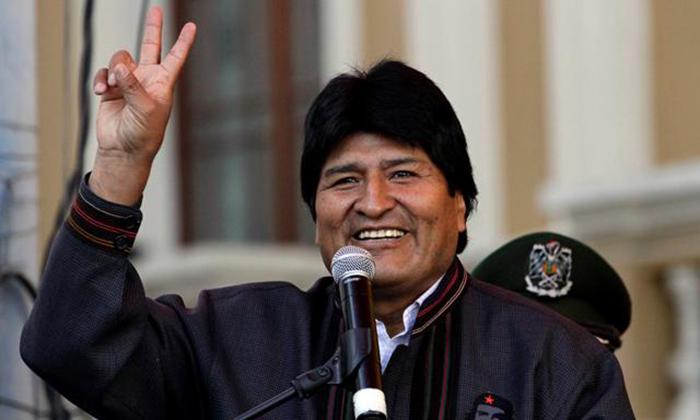
The possibility that President Evo Morales will stand as a candidate in Bolivia’s next presidential elections in 2019 has the country’s right wing on edge.
According to the Vice Minister of Coordination with Social Movements, Alfredo Rada, opposition leaders lack the necessary expertise to enter into a debate regarding Morales’ and Vice President Álvaro García Linera’s possible run for re-election.
After the National Coordinator for Change (CONALCAM) and the Bolivian Workers' Federation (COB), allies of Morales and the Movement Toward Socialism (MAS), announced to the press that they would propose a reform of the constitution to allow the President to run for another term, the opposition leadership launched a disproportionate campaign, lacking in solid arguments, Rada asserted.
The vice minister noted, for example, that former Bolivian president Jorge Tuto Quiroga (2001-2002), attacked Morales with arguments devoid of foundation, showing complete ignorance regarding political systems, as he compared what is occurring in Bolivia to an absolute monarchy.
“I think Tuto Quiroga needs to read a political science handbook or at least a political education handbook as there he will discover the difference between a monarchy and a democracy,” Rada stated.
At the same time, he explained that, in a monarchy, kings or queens rule, and they are not subject to popular vote, but in a democracy leaders are elected by majority vote, as has occurred in Bolivia since 2005.
He warned that these assertions alone by the former presidential candidate of the Christian Democratic Party demonstrate that the right wing is not prepared for adebate on Morales’ possible run for re-election in 2019, which on winning would see him serve through 2025.
The COB and CONALCAM initiative took everyone by surprise and various accusations, completely out of tune with reality, have appeared in the media, the vice minister stressed.
Furthermore, he referred to the leader of the Democratic Unity party, Samuel Doria Medina, the big loser in the general elections held last year, who downplayed the importance of the position assumed by CONALCAM and the COB.
“Voicing this opinion, Doria Medina also demonstrates that he is unprepared for this debate. Apparently the CONALCAM initiative caught him by surprise, he wasn’t expecting it, and he is now improvising things to try to discredit the initiative of the social movements,” Rada emphasized.
Rada noted that the opposition’s huge error over the last decade has been to underestimate the political process and consider CONALCAM as equivalent to MAS, without realizing that the former has a much larger structure than that of the political party.
“While the MAS is present within social movements, it has no monopoly over the political representation of the popular trade union, agricultural, and urban organizations,” he said, and explained that the 38 organizations that make up CONALCAM make the body a “seed of popular and community power.”
Evo Morales became President of the Republic of Bolivia in January 2006, and in January 2010, after the enacting of the new Political Constitution of the State, he was sworn in as the first President of the Plurinational State of Bolivia, eligible for one immediate re-election, which occurred last October, when he won with 61 percent of the vote.
To run as a candidate in the 2019 elections, the Constitution will need to be amended, a task which social organizations, led by CONALCAM, are currently undertaking, since the Constitution in effect since 2009 only allows for one consecutive re-election.
A poll by Ipsos Apoyo, Opinión y Mercado, revealed that 54% of Bolivians support the re-election option for Evo Morales, reported Prensa Latina.
The survey was conducted among residents of the cities of the so-called economic backbone of the country: La Paz, Santa Cruz and Cochabamba, where the majority of the population lives.
According to the poll, released by the private ATB national television network, only 38% are opposed to a possible re-election of Morales, who first took office in January 2006 and was re-elected last October for a second term.
The survey also revealed that 53% would vote for Morales if he were to run in the next election, while 37% said they would never back him. Only 10% remain undecided.


