

Although Western media prefer to ignore this simple historical fact, the Iranian nuclear program began 50 years ago, following a proposal from the United States.
When the nation was still ruled by the Shah, in the 1960s, Iran obtained its first reactor for research purposes, thanks to its ties with the United States.
Currently, when the Iranian nuclear issue is a constant in debates within the U.S. Congress, and Republican lawmakers attempt to obstruct the agreement reached in Vienna by the G5+1 (members of the UN Security Council plus Germany), very few seem to remember that it stemmed from a U.S. initiative.
After the triumph of the Islamic revolution in Iran in 1979, the U.S. switched to demonizing the nation, attacking its right to develop such technology for peaceful purposes.
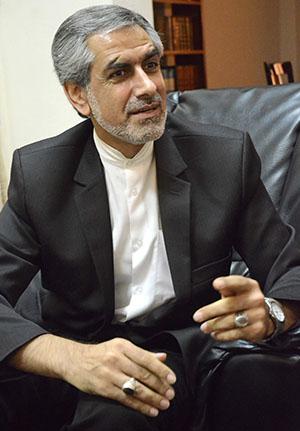
To learn more about these events and the near future of this country, Granma spoke with the Ambassador of the Islamic Republic of Iran in Havana, Kambiz Sheikh-Hassani.
During the reign of the Shah, a puppet imposed by Washington, the United States had guaranteed profits of millions of dollars from Iranian oil exploitation, hence its interest in further developing this industry, the ambassador began.
He added that, according to the original proposal, by 1994 Iran would be capable of producing 20,000 megawatts of nuclear electricity and thus significantly raise its oil exporting capacity.
“With the Islamic revolution in 1979 an independent government was established in Iran which answered to national interests, so the U.S. began to obstruct the development of our nuclear research, and, using their political influence and media empire, they turned our program into a crisis,” he explained.
The Iranian official, who has almost 30 years experience in the diplomatic service, believes this strategy was intended to restrict and hamper Iran’s ability to develop in this scientific field.
He stressed that Western countries, which over ten years ago imposed sanctions on Iran due to is nuclear program, disregarded the fact that the country is a signatory member of the Treaty on the Non-Proliferation of Nuclear Weapons (NPT) and that the program was constantly monitored by the International Atomic Energy Agency (IAEA).
Nuclear power is highly beneficial, Sheikh-Hassani continued, not only for sustainable electricity production but also due to its possible applications in areas such as health and food security.
“Our objective in using this energy was always clear. Fossil fuels are not eternal and in order to met the energy needs of a developing country we needed to have our own understanding of such a useful energy source,” he added.
At present the country is completely self-sufficient and independent in terms of the production of radioisotopes, used in the production of drugs to treat cancer. “In Iran close to a million people use these services,” the diplomat reported.
On entering into negotiations with the G5+1, four main objectives have been pursued.
Sheikh-Hassani specified that these aims include maintaining the capacity and development of nuclear activities within the country, the elimination of the unjust sanctions and resolutions adopted by the Security Council, and removing the Iranian nuclear program from chapter seven of the United Nations Charter (Action with Respect to Threats to the Peace, Breaches of the Peace and Acts of Aggression).
“We believe that with the adoption of this agreement and its proper implementation, we have achieved these goals which will contribute to the stability of Iran, the region and the world,” he concluded.
Through the nuclear program, the Iranian people have full access to nuclear power, he insisted, explaining that proof of this was the opening of the Bushehr nuclear power plant, capable of producing 1,000 megawatts of electricity a day, a huge achievement for the country.
Furthermore, “the signatory countries of the Vienna Agreement committed to working with us in developing this field,” the ambassador noted.
AN ECONOMY BASED ON SELF-SUFFIENCY
Bilateral sanctions, although having harmed the Iranian people and economy, have not prevented the country from developing and advancing.
“We are a peaceful and stable nation, which boasts important scientific, economic and social achievements,” the ambassador stated.
“Our strategy is based on self-sufficiency and a resistive economy, coupled with constructive interaction with the world,” he said.
This is to enhance domestic resources and the talent of young people, in addition to strengthening the economy based on the creation of added value, he explained.
“In the two years of President Hassan Rohani’s government, we have recorded significant progress. From 2014 the economy boomed and saw growth of 3%, oil production increased to 2.9 million barrels per day, exports of non-oil products reached a record 50 billion dollars, representing growth of 19% compared to the same period last year,” the diplomat revealed.
He added that budget dependence on oil and its derivatives dropped from 50% to 36%, the lowest of the past four decades. In addition, inflation fell from 40% to 15.6%.
Iran is leading the Middle East in terms of economic development. The country is currently ranked first in steel production, at 16 million tons, as well as in motor vehicle production, at one million one hundred thousand. The nation also dominates the field of scientific research with the publication of 39,918 articles in 2014, representing 1.5% of the world's total scientific output.
SOUTH-SOUTH COOPERATION FOR DEVELOPMENT
Despite being a continent rich in natural and human resources, Latin America has faced intervention by great powers for many years, the Iranian diplomat commented.
With the coming to power of progressive governments, the political atmosphere in the region has changed and regional integration has been strengthened, as seen with the emergence of organizations such as ALBA-TCP and CELAC, he said.
Both regions, Latin America and the Middle East, face common challenges related to climate change, terrorism, violence, drug and people trafficking. Putting these issues on the international agenda in order to find solutions based on consensus has resulted in bodies such as the Group of 77 and the Non-Aligned Movement (NAM), he added.
In this respect, the ambassador highlighted the relevance of NAM as “a legacy of the great leaders of all our countries since the decade of the 60s, including Fidel Castro.”
Iran has been a member of NAM since the triumph of the Islamic revolution. Along with Cuba, the country has been one of the most active members of this group, which has made very important independent decisions, including support for the Palestinian cause, rejection of the blockade imposed on Cuba by the United States and defending the right of the Iranian people to make peaceful use of nuclear power, he said.
As pro tempore chair of NAM, Iran strives to strengthen its structure and assist the peoples of its member states. “We are confident that this movement can play an essential role in achieving progress in the nations of the south,” Sheikh-Hassani argued. “South-South cooperation in the framework of these same organizations will be very helpful,” he added.
AN ALLIANCE TO EXCHANGE EXPERIENCES
With extensive experience in the Iranian foreign service, Kambiz Sheikh-Hassani arrived in Cuba with high expectations.
“Iranian intellectual circles, since the very beginning of the guerrilla struggle of Fidel Castro, supported the Cuban revolutionary process. Immediately after the victory of the Islamic revolution, we established diplomatic relations with Cuba,” he noted.
In the last three decades of friendship between Cuba and Iran the political sphere has been one of the main areas of collaboration and since coming to office in 2013, Dr. Rohani has insisted on the strengthening of our relations in such fields as the economy and sciences, he added.
“Our exchanges with Cuba have always been positive, we have benefited in areas such as the training of medical professionals, the family doctor system, the development of medicines and vaccines, among others.”
In turn, Iran has experiences that could prove useful to the island, such as the subsidy policy, the development of science and its products, nanotechnology, biotechnology, the defense industry and infrastructure development, he emphasized.
“Just as Cuba collaborated with my country in the past with regard to technology transfer for the manufacture of vaccines, we are ready to help not only with the supply of consumer goods but also with the necessary machinery to develop your industry.”
Ambassador Sheikh-Hassani also commented on new opportunities for trade. The process of updating the Cuban economic model, he explained, provides a hopeful horizon for the materialization of the country’s economic objectives.
“We are a country with many opportunities for investment here. Cuba could take advantage of the strengths of my country in sectors such as oil and petrochemicals, the production of industrial machinery, road or railway transportation, the supply and manufacture of building materials, massive housing construction, shipbuilding, spare parts industry,” he outlined.
“We could also collaborate on joint production and development of drugs and medicines.”
The diplomat stated that he was very happy that the beginning of his mission on the island had coincided with the onset of the transformation in the relations between Cuba and the United States.
“I have witnessed historical events. The era in which they could rule over the people through pressure and sanctions has ended, it is time to hold a dialogue and constructive interaction between governments based on respect and mutual interest,” he said.
U.S. policymakers recognized that their policy in this regard had failed, and that is thanks to Cuba’s resolve, he noted.
“From Iran we support this process and hope to see the total elimination of the blockade against the Cuban people and that this process can overcome any difficulties,” Ambassador Sheikh-Hassani concluded


