

EL PALMAR, Amazonas, Venezuela.—Not everything in the rainforest is humidity and fertile land. Very near to the big rivers there are also dry areas that complicate the lives of those living here in two ways: firstly, in regards to the cultivation of the food, and secondly, in regards to education.
In the south of Venezuela, where the Orinoco River widens with the waters of the Meta River and marks the meeting point of three states of the same name, in Venezuela, Colombia and Brazil, is one of the entrances to the huge Amazon rainforest, the largest in the world.
But in the first miles of the road into the forest, which after crossing the river on a barge, continues to Puerto Ayacucho – the capital city of the country's southernmost state – the landscape is still not the dense and impassable stretch of rainforest of films; but an exquisite setting of isolated and rounded mountains, bare rocks, sometimes crowned by smaller ones, forming strange shapes.
They appear as if purposely placed there, as if to give texture to the flat lowlands, set among the scattered bushes or hills of large trees, where you can come across anacondas, giant anteaters or predatory cats; but where human beings also live. “The land here is very hot, bad for farming,” explains Edilberto, an indigenous local, “but for many years it has been ours; the land of the Jivis people, and of friends such as the Cubans.”
A CLASS UNDER A MORICHE PALM
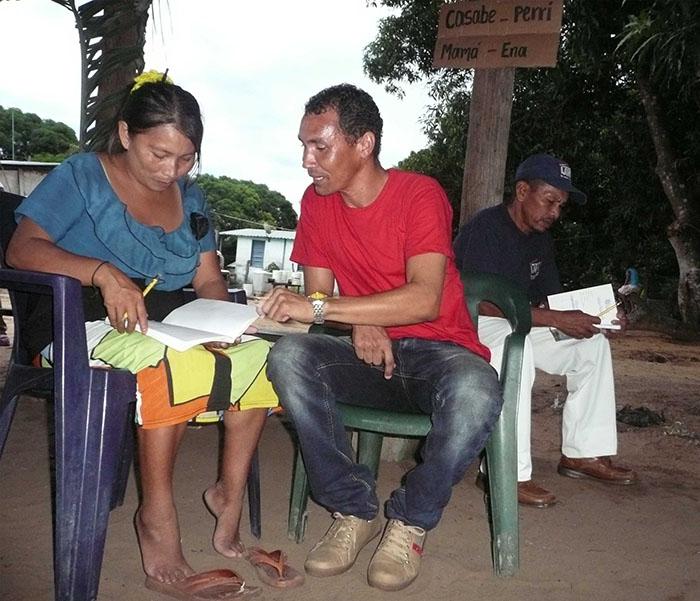
The temple of the community is, now, the classroom for literacy classes: a simple structure made of wooden posts and leaves from the moriche palm, under which the teacher, a blackboard, and a dozen adult students of the El Palmar indigenous settlement gather.
They start at four in the afternoon and for three hours every day; after a long day during which they have tended to their cassava or pineapple – the only crops that grow in the area – or made a good batch of cassava bread, flour or catara (a traditional spicy sauce), or woven a large amount of moriche bags and hats, to sell in the city.
In six groups such as this (known as circles) 80% of the members of the community learn – under the auspices of the Mission Robinson program, and through the Cuban “Yo sí puedo” method – to read, write, and even speak better Spanish; as the Guahibos (people of the Jivis ethnicity) have their own dialect.
“They need Spanish to communicate in the city, get documents, better insert themselves into society, and they take this on with tremendous enthusiasm; although undoubtedly it makes the learning process a little longer and more difficult,” explains Dairi Castillo, a Venezuelan reseracher of the mission.
But they learn well and enjoy it. The attention, interest, and satisfaction of gaining new knowledge are visible on their faces, and the relaxed atmosphere with jokes in both languages and typical songs stands out.
“At my age, I didn’t think I would have the opportunity. I am a grandmother who can not read, or couldn’t, because I have already started. The best thing is that class is next to the house, at a time that does not affect the family, the work in the fields, and you do not have to pay anything, just come and that’s it,” Luz Marina, sitting in the last row, explains.
“For me it has even done away with my shame, because when you know something it makes you braver. As soon as I graduate, I will be one of the teachers,” Mireya Rodríguez reveals enthusiastically.
The entire group of adults pays attention to the teacher, proud on watching their relative, much younger than all of them, teaching them the letters. Alexander Rodríguez is a son of El Palmar, and also a product of the social missions that have made him a teacher. “First the Robinson (mission), then high school in the Ribas (mission), and now as a facilitator trained by the Cuban consultants,” the young man notes, pointing to Emilio, the Cuban educator who is supervising the class today, and who takes the opportunity to demonstrate some of his years in front of a classroom.
A CUBAN IN THE COMMUNITY
Although only having been in the country for a short time, Emilio Barbán from Mantanzas has learnt about Venezuela from the humble people of the Amazon; both those attending his methodology workshops, to go on to teach literacy in their own communities, and those who take classes from the community in which he resides.
“The most exciting aspect of the workshops is the challenge of teaching the same thing in 23 different languages, including three from Colombia. There is a native speaker from each ethnic group who translates, but something always sticks.
“But best of all are the educational consultancy visits to these indigenous villages. This is where you really feel like you are in a 'magical land', as they say. They survive the harshness of the area, but they love, protect and take refuge in it.
“Their generosity and sense of respect is admirable. For them, we Cubans are not teachers, but rather doctors. They call us doctor and everything. Perhaps because they feel that education also heals them.
“It's definitely a place you come to once and want to visit again, due to the fidelity and warmth they offer. It’s not your culture, but you appropriate it fast, motivated by their huge interest in learning.
“I had only found stories of the rainforest in books and movies, but I never imagined that I would come to know it in this way, serving the people and being useful within it, using my profession,” Emilio concludes.
At the end of the day, as night falls, the same gratitude shown at the beginning concludes the class; when a wave of local mosquitoes reminds visitors that they are in a foreign place.
But Edilberto is not disturbed by the bites. A mosquito will not make him miss the last notes given by the teacher. He has been here 58 years, he says, and his advanced age causes the reporter to ask a question which he answers in his dialect: “Cae epa ata apocuene rrowinae woja yapü toeneja.”
As in his multilingual workshops, Emilio and the young Jivis man translate.
Edilberto’s concluding sentence is ultimately a lesson, and a clear concept of the significance of the educational mission that Cuba assists in Venezuela: “No, it's never too late to learn.”


