

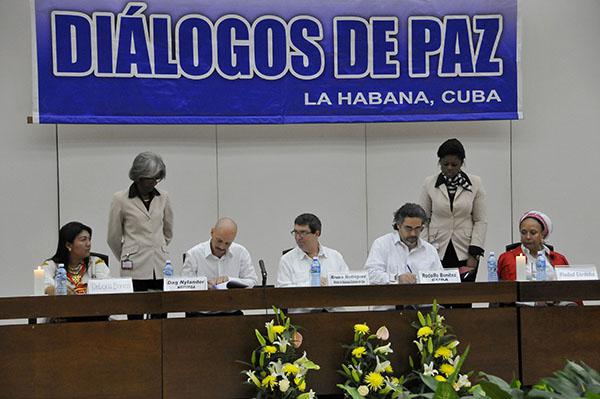
On December 14, the government of President Juan Manuel Santos and the Revolutionary Armed Forces of Colombia-People's Army (FARC-EP) reached an agreement on reparations and justice for the victims of over half a century of armed conflict.
The heads of the delegations of the Colombian government, Humberto de la Calle, and the FARC-EP, Iván Márquez, symbolically presented the agreement to Bruno Rodríguez Parrilla, Cuba’s minister of Foreign Affairs.
The documents, which confirm agreement on one of the most complex issues of the talks started in November 2012, will be kept under the safeguard of the guarantor countries, Cuba and Norway.
Representatives of the accompanying countries, Chile and Venezuela, were also present at the ceremony.
The agreement is entitled “Agreement on the Victims of Conflict. Integrated System of Truth, Justice, Reparations, and Non Repetition,” and also includes the Special Jurisdiction for Peace, an instrument designed during the talks to deliver post-conflict justice, as well as a Commitment on Human Rights.
Both sides emphasized the role of the guarantor countries in reaching this deal, together with the role of Cuba as host of the talks.
Humberto de la Calle, head of the Colombian government delegation, said the signing of this agreement was good news for the world.
“For the first time in the world, by common accord and amid an ongoing conflict, on agreement between the parties, a Jurisdiction has been created based on the acknowledgment of responsibility, of truth and the commitment to reparations,” he said.
“It's a system that applies to all. It is not a door to impunity. After six million victims, discussions about who started the war are not relevant to the just end of hostilities, but neither do the violations of one side justify the violations the other. There is no room for impunity,” he added.
Humberto de la Calle also explained that there is no place for amnesty regarding serious crimes committed by both sides, such as genocide, war crimes, hostage-taking or other deprivations of liberty, torture, extrajudicial killings, forced disappearances, sexual violence, forced displacement and abduction and recruitment of minors.
Meanwhile, Iván Márquez, head of the FARC-EP delegation, argued that this process demonstrated that restorative justice is the best way to recover social morality, cleanse political practices and sow the possibility of general wellbeing.
“The process that is underway in Havana is unique in that it has been agreed upon an integrated system that gathers and connects all the elements that international humanitarian law (IHL) states as inalienable rights of victims: the right to truth, justice, reparation and non-repetition,” he added.
AGREEMENT ON THE VICTIMS OF CONFLICT
The core element of the commitment between the Colombian government and the FARC-EP is to compensate the victims of the conflict.
The two essential parts of this section of the agreement, the Human Rights of Victims and Truth, attempt to address the demands of those affected by such a long conflict.
Since the beginning of the process, the parties have stressed that victims are at the center of any final agreement.
Over the past year, several delegations attended the talks, where numerous victims and organizations participated in forums and presented their proposals.
Among the commitments that stem from the signing of the accord on victims are agreements for the creation of the Commission for the Investigation of the Truth, Coexistence and Non-Repetition, the Special Unit for the Search for Disappeared Persons, the Special Jurisdiction for Peace, and specific measures of reparation.
It was also reported that during the discussions that led to the signing of this understanding, the Historical Commission on the Conflict and its Victims was launched, which yielded important findings regarding the origins and multiple causes of the conflict.
As part of these discussions, it was decided to establish protocols to advance programs to detect and remove landmines and other explosive devices dispersed across the territory. In addition, an order to commence an immediate humanitarian search to locate, identify and return the remains of missing persons was issued.
The Colombians who have suffered due to the widespread conflict number in the millions. Victims converged in Havana to testify regarding forced displacements and sexual and psychological violence, together with relatives of those disappeared and killed.
While just 60 people traveled to Havana to state their case during the peace talks, in the interests of bringing together the largest number of possible opinions, participation mechanisms were widened and more than 3,000 people formed part of four forums organized by the UN and the National University of Colombia.
Speaking on behalf of those affected by the conflict, Jineth Bedoya expressed her joy at having found the path to peace after so many decades of impunity.
”Our support for the peace process does not mean that we renounce justice, reparation and above all, the truth.
Colombia must understand that only through dialogue and reconciliation will it be possible to reach the realization of the word which we pronounce so much yet know so little of: peace.”
“We believe in you and we want our country to believe in the peace accord, but if you fail it will not be with us, the victims, but with the history of Colombia,” she concluded.
INTEGRATED SYSTEM OF TRUTH, JUSTICE, REPARATIONS AND NON-REPETITION
The end of the conflict should help to ensure the end of violations and abuses. It is also an opportunity to satisfy the rights of those affected.
The Integrated System of Truth, Justice, Reparations and Non-Repetition, which emerged as part of this important stage in the talks, involves recognizing the victims as citizens with rights and the need for the complete truth about what has happened to be uncovered.
It is intended to be comprehensive in order that measures achieve a maximum level of justice and accountability for human rights abuses and IHL violations. Furthermore, it will contribute to the clarification of the causes and conditions of the conflict and the construction of a historical memory.
According to reports, it has a differential and gendered approach that adjusts and responds to the particular characteristics of victimization in each territory, especially the needs of women and children.
It should also ensure the legal security of those seeking justice, as an essential element of the transition to peace.
Compliance with these conditions will be verified by the Special Jurisdiction for Peace, while according to the agreement, no one mechanism takes precedence over another, but rather they will all be interconnected.
It is hoped that with the implementation of this and all agreements regarding the victims, justice will be done and the foundations will be laid to ensure that the violence of the conflict in Colombia finally comes to an end.
EXTRA
A new and important step forward for peace
Press statement by Rodolfo Benítez Verson, guarantor representing Cuba at the Peace Talks between the government of Colombia and the FARC-EP.
Havana, December 15, 2015
We welcome the important agreements reached by the government of Colombia and the Revolutionary Armed Forces of Colombia-People's Army (FARC-EP) on item 5, related to the Victims, of the Agenda for the Peace Talks taking place in Havana.
Since the beginning of the process, the parties have stressed that victims are at the center of the final agreement. Several delegations of victims attended the table of talks. Many victims and victims' organizations participated in various forums and submitted proposals to the Table which were instrumental in achieving these understandings.
The agreements announced today represent a new and important step forward in efforts to achieve peace in Colombia and add to that already achieved regarding Item 1 “Integral Agrarian Development Policy”, Item 2 “Political Participation“ and Item 4 ”Solution to Illicit Drug Problem”. Likewise, discussions continue to advance on Item 3 “End of the Conflict”.
Cuba, in its capacity as host and guarantor country at the Talks, in conjunction with Norway, will continue to contribute, as much as possible, to the achievement of a final agreement ending the conflict and building a stable and lasting peace in Colombia.


