

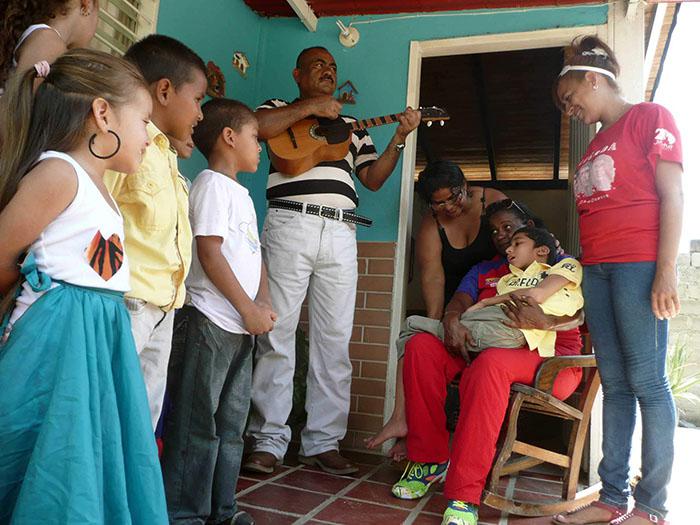
Colinas de San Lorenzo, Cojedes, Venezuela.— In this dusty town of simple homes, poverty and humility, the hills aren’t much, but the heights of human virtue are scaled everyday, by three Cubans living and working here.
There are three of them, but they are never alone. Wherever they go, they attract a large group of children from the neighborhood, often with their parents in tow, and at every house they visit, the doors are opened and they are welcomed into families.
Located in Colinas de San Lorenzo is the only Mission Base in the municipality of Tinaco. The center ensures that this poor settlement has full access to health, cultural and sports services, as provided by three young Cuban internationalists.
With them, residents say, the Bolivarian Revolution has made San Lorenzo a better place, and the community has changed so much that, unless you visit and listen to the people’s testimony, you won’t believe it.
ELIÉCER’S SECOND MOTHER
Omairai’s house, for example, is always open, especially to María Milagros, the community sports specialist, who has become a second mother to her son, Eliécer. One of Maria’s first rehabilitation patients, he now begins to laugh as soon as he hears her voice, when she enters the small living room, without knocking.
Eliécer Quiñones is 14 years old, but cerebral palsy complicated by kyphosis severely limits his mobility, and obliges him to spend long hours in bed or in his wheel chair, except when he is in María’s arms.
“He is my life,” is all the athlete from Cienfuegos can say with a knot in her throat. She holds him in her lap after a session of therapeutic exercise, and today tells me the story.
“I arrived to the community like anyone here to do a job, but very quickly it became a reward in itself, and Eliécer’s case was essential to that.
“Meeting him and his mother is the best thing that has happened to me in Venezuela, feeling that I could help. After the therapy, I’ll do whatever is needed here - cook, give the boy his medicine, his food, even bathe him. I feel like I’m in my own home, and I can give all that I have as a friend and a mother, because I have two little ones waiting for me in Cuba.”
Eliécer’s home is the family expression, on a small scale, of what María Milagros has achieved in the community. Her charisma and generosity are contagious, captivating the previously cold, apathetic neighborhood with physical activity, be it in an elders circle, a school, day care center, or dance therapy in the town square.
“Our greatest accomplishment has been the people’s integration into the Missions Base. Today, we are the community’s center, and our work has greatly improved the environment, the security, the very relations between neighbors.
“People join projects on their own, spontaneously ask questions, express interest – the youth above all. This happened when we constructed the outdoor gym, and with everyone’s contribution, it turned out to be an excellent job.
“The impact of the center has grown like a child, who is born, carried, caressed and cared for, until he or she grows up. This is how we wanted to do it, and definitely, we have made a mark, a before and after.”
MATERNAL ART
“We have made a mark…” María emphasized, because throughout Colinas de San Lorenzo, the signature of the three is visible.
We could say that the coordinated assistance represented by the Missions Base also has a distinctive musical tone: the grace of a cultural instructor from Mayajigua. She came from the Sancti Spiritus municipality of Yaguajay to rural Tinaco, to plant the seeds of art and harvest the fruit.
At 27 years of age, Jhoamna López also shares her maternal side, walking through the town like a hen followed by her chicks. “When someone is looking for me, they don’t ask for the culture teacher; they ask for the mother of the children here. That’s who I am.”
Her story, like that of Ahmed, the doctor - a Havana native - begins with the Missions Base, even before the building was finished.
“I started with six children, now I have 34,” she explained. When I noted her Venezuelan Spanish, she added, “Well, if you live with them all the time, of course things are going to stick, their way of speaking. This is an ongoing source of jokes between the children and me. They correct my terms and I polish their Cuban. It’s a party.
“It was the children I first sought out when I arrived here, and today, it’s practically a company in which everyone does everything, because they don’t want to miss anything, and moreover, they have the talent to do it all well: dance, sing, act, paint …
“I put together a kind of Colmenita, (a well known Cuban children’s theater group) called Avalancha en las Colinas. (Avalanche of the Hills) Municipal specialists come to present workshops on theater, visual arts, music, handicrafts, literature, and you need to see how much attention they pay. They spend as much time as possible here, in the Base.”
Jhoamna explains the threesome’s close collaboration using the example of their popular dance therapy sessions. “While the mothers exercise, the children are with me, rehearsing, drawing, putting the performances together. But for some time now the level of confidence is even greater. They leave them at my house when there is a show, and if their parents aren’t there to take them, we even go to the Mercal, to buy food or walk around town.
“Once, before I went on vacation to Cuba, they proposed a slumber party. Imagine all these children! The three of us - Ahmed, María and I – agreed, just to please them, and it turned out to be a lovely celebration.
“I told them to come at seven, and at six o’clock they were on the porch with their pillows, until the next day. It was crazy with the house full of all those children, games, stories, until they fell asleep. That night, looking at them worn out, I understood why they see me as a mother, and the Missions Base as a big house for all of them.
“I thought about the social miracles that culture can achieve, if you struggle against marginalization and ignorance. I thought about what this Revolution is seeking to do, to meet the needs of the poor; but I thought about Cuba, too, about Cubans, I saw myself there, and felt proud.”
A BLESSING
With so much walking door to door, Ahmed Hernández has won the town’s appreciation,too, by stopping a pain with just the right medication or simply arriving to ask about the sick and those who are well, with a stethoscope around his neck and a joke up his sleeve.
Resident of Colinas have become accustomed to him crossing fields and trudging along dusty roads, giving no indication that he was born and raised a city boy in Cuba’s capital. Perhaps that is why he describes his expeditions as his best experiences, “Walking to the houses, getting to all the places wherever someone might need me.”
“It’s that medical attention was not available here. People had to travel to the CDI (Comprehensive Diagnostic Center) or a distant hospital, after trying to find transportation. This was the need we came to meet, while we help train doctors here. We must do it well.”
When he came to Venezuela, Ahmed had 15 years of work experience, but with María and Jhoamna, he completes the trio of first-timers on an international mission. With the enthusiasm of beginners, they have created an almost perfect line-up, an excellent team.
“It’s all the same, if I’m doing dance therapy or putting on a theater performance, but likewise, I have them as my best nurses. That’s what it’s all about, the three of us are one,” he insists.
The three collaborators meet up at Eliécer’s house, and after a song performed by the neighborhood children, Omaira Quiñones synthesizes what these young Cubans have become for the poor town.
She speaks of them one by one, “With María’s affection, my son is recovering, very slowly, but happy. All of his happy feelings come out when she is here. She is his other mother and my sister.
“The lovely surprises Jhoamna always brings make Eliécer smile, and his mother is excited. And thanks to the doctor, to his presence, I don’t have to run to the highway with the boy in my arms, looking for help.
“I know doctors who separate the poor for having scabies, and bad people who have coldly told me: sister, put the child in God’s hands, don’t be cruel, look how you have him living in this world.
“But with my Cubans I learned that there are opportunities for all people, that there is no insurmountable problem when there is love, this great love they offer us, with solidarity, respectful, disinterested and sincere.
“This is who you are, a great love, a blessing for my family and this people.”


