

San Carlos de Rio Negro, Venezuela.— This town seems even smaller alongside the colossal river it borders. It has a long overlook with a strong railing to lean on and appreciate the broad waters of the Amazon tributary, which serves as the border here between Venezuela and Colombia.
The severe drought which the region and the entire country are facing has lowered the water level, so the Río Negro's course is now dotted with rocks poking through the surface, although the river still appears mighty.
This is the coolest spot in town, under the equatorial midday sun, a good excuse to take a rest in the shade of a tree at one end of the overlook, where two young Cuban women have caught the attention of the national guards watching over the port and the owner of an adjacent business.
"I don't know about here, but in Cuba, dominoes are not just for men. Let's go, two more, let's see if some one can beat us! We have to go back to work soon," the two doctors call out playfully, joking with the typical rivalry the game generates in their native country.
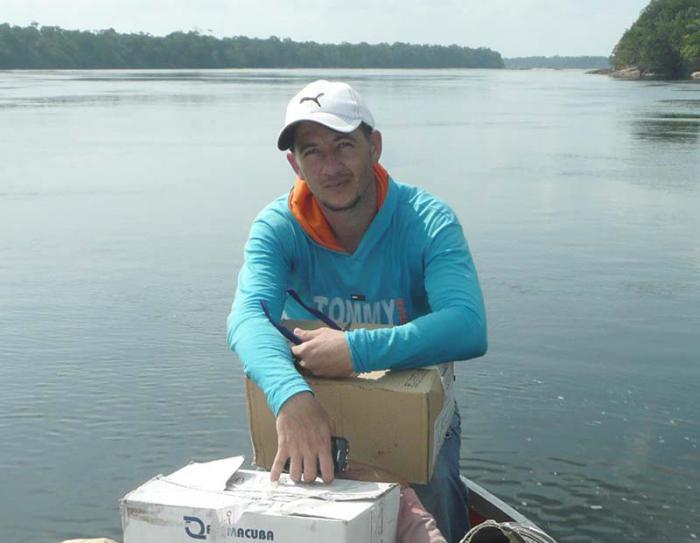
Another doctor, a man, and a pair of male nurses have already made three trips from the Comprehensive Diagnostic Center (CDI) to the river's edge, with the same wheelchairs they carried earlier this morning from the plane, now being used to move a number of boxes.
"It's the medicine we use in Maroa. We have everything that's needed: tablets, injectables, saline solution, even the film for my work… and it's all free of charge for the people," emphasized the young man, Nicdael Borges, from the Las Tunas municipality of Amancio, the town's X-ray technician. But clearly he is much more than that.
In just a short time, he has shown himself to be classically hyperkinetic, motivated by the desire to help, to collaborate in every way possible, to take charge of anything. Even though it's almost 3:00pm, and the boat being loaded can hardly be seen beneath all the boxes, he comes around the corner with a group of boys carrying a couple tanks of gas, "one of oxygen, and another to cook… we've been using charcoal," he explained.
"Yes, this is the boat right here, we'll see how we squeeze in. Maybe something will have to come off, but however we go, we're going. Are you scared?" he says, leaving no time for a response. He talks as fast as he works.
The boat, a voladora, has the same dimensions as a traditional river canoe, but with a motor at back, and seems even smaller now that it is loaded with so much medicine, two patients returning to their homes in Maroa, the gas canisters, three doctors, the skipper, and a reporter added at the last minute.
"I think it's too much weight," the skipper says as he starts the motor, adding, "With luck, we'll arrive in five hours." The passengers begin making metal calculations, wondering if we'll be navigating through the Amazon jungle in the middle of the night.
The overloaded boat hits bottom, and Niky - the radiologist - takes charge, jumping into the knee high water to free the boat with a push.
Seeking more insight into his nature, this reporter asks Niky a first question. He responds, "Just imagine, I spent almost a year in La Esmeralda, the principal settlement in the municipality of Alto Orinoco, where the famous river is born. I went with the indigenous people there to their conucos, (food plots) deep in the jungle, to help them, and, by and by, arrange some food for the CDI mission," he says with a wink.
"I always came back loaded with plantains, cassava, fruit, a bit of everything that was available. The thing is that I need to have something to do, to feel useful. Life gave me this energy, and, believe me, it's needed here."
A detail interrupts the conversation, as Niky speaks with the skipper and the boat accelerates, leaving a wake now, weaving between the rocks in the black water.
"That's why they call it the Black River. It has lots of minerals, iron, gold, quite a bit of gold, although it doesn't look like it," he says before a dull thud shakes the boat, sending us sprawling and scattering the boxes.
The motor bounced up, with the propeller in the air, and hits the skipper's leg, but he quickly recovers and turns the motor off, yelling, "Yikes, I didn't see that rock," while checking on the boat's condition.
At first, no one notices the water beginning to leak into the boat, until it fills the bottom.
"The stopper came loose," the skipper shouts, attempting to cover the drain hole below the motor with his foot.
"There it is!" says one of the patients, pointing toward the wooden stopper being carried away from the boat by the current, which is also moving us downstream now. We are in the very middle of the river, far from both shores.
"We have to reach it. If not…" the skipper says, as the roar of the motor drowns out his comment, and the menacing forecast.
In the spot where just seconds ago the able Niky stood, we see only a watch and a cell phone …. to be continued.


