

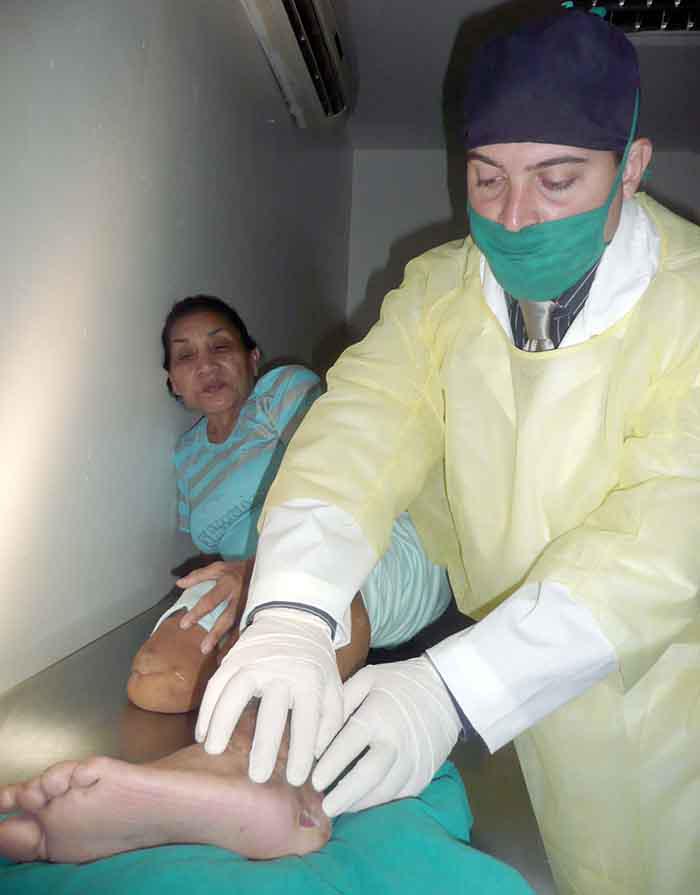
San Juan de los Morros, Venezuela.—“Our very own José Gregorio has arrived,” says a man with crutches sitting closest to the door, and as Yanurys enters the waiting area, a chorus of hopeful voices welcome him with considerable excitement: “Good morning, doctor!”
“Yes, good morning, but there’s no need to mention the saint,” the Cuban doctor responds with a smile, in reference to the comparison with the most revered figure of Venezuelan popular imagination: the miraculous “doctor of the poor,” José Gregorio Hernández.
He greets his patients one by one who, despite each having bandaged feet, attempt to lift themselves to offer a warmer greeting: a hug in the case of men, a kiss on the cheek for the women.
“It’s always the case, he is very loved,” the receptionist notes, who witnesses this welcome three times a week at the Tulio Pineda rehabilitation center in San Juan, the capital city of Guárico state.
A year ago, Dr. Yanurys Ramírez Herrera, from Sancti Spíritus, first introduced the exclusive Cuban treatment for diabetic foot ulcers, known on the island as Heberprot-P, to this region. The treatment, which is applied directly to wounds, is now also produced in Venezuela under the registered name Espronepider.
Since then, not even the first of the beneficiaries has yet to overcome his surprise, on witnessing how this young doctor suddenly arrived and healed open wounds which for many months had immobilized dozens of people.
“Manuel is one of the patients that I remember most fondly,” says Yanurys. “He came from Calabozo, another city, when he learned of this option; but he arrived scared and with lots of doubts, given the diagnosis of amputation at all the clinics he had previously visited. He has an auto repair shop. His family depends on the business and his efforts, and without his foot, he said sadly, this would all come to an end.
“He had a deep wound, but only two toes were incurable. We removed them and saved the rest. He returned to his business, he is now active, and even long after he still finds no way of thanking us.” But to confirm this, there is no need to resort to memories; just spending some time here with the doctor and his team is sufficient, as the examination room provides a flood of testimonies.
“I still can’t believe it. No one who sees the scar can imagine that I had a wound of six centimeters that came down to the bone,” explains Cándido Rodríguez, aged 79, who first traveled from Cagua accompanied by his daughter.
“In just six weeks it already looks like a simple graze, and I compare this to the six months I was in a private clinic, applying dressing after dressing and nothing. For the last few sessions I have come alone and driven.”
He is followed by Pedro Paredes, leaning on crutches and the shoulder of his mother, María. “It's his second time and he is already smiling. Just one dose and it’s as if they injected my son with all the hope in the world.”
Pedro doesn’t speak while they attend to his wound; he appears to be praying; but the jokes that the nurse throws his way help him relax. After the final bandage is applied, he lowers himself from the stretcher smiling: “I no longer need help to stand up. I’ll be back without fail,” and he says goodbye with a loud “thank you” to the entire team.
In a wheelchair, having had one leg amputated at the knee, Ana González enters. “It’s never too late, never too late,” she repeats. “I will not lose both now. I was about to, but I came in time and here I am, saving the foot that still allows me to stand up. This Cuban kid is a blessing.”
Yanurys only manages a shy smile. With each statement of this kind, he humbly insists that it is not him, but the whole team, that is to thank, and he emphasizes the “venezolanidad” of the two nurses and the young doctor he is training.
Yasmila Mijares is his right-hand woman. She has 22 years experience as a diabetic foot nurse; “In traditional cures, of course, as this wonder treatment didn’t exist here.” She even presented her research in the field at an International Nursing Congress and earned the support to establish the first clinic in San Juan.
“But with Cuban medicine and the arrival of Yanurys everything changed. What once took three months is now achieved in three applied doses. The response to treatment is very fast and the wound is completely healed. I am so moved and enjoy it so much that I have not taken a vacation.”
With just four months working at the clinic, Eucaris Vázquez, the second nurse, states that she is happy, “It’s what I want to do, definitely,” while Jessica García, the young surgeon, says she was fortunate to discover this occupation.
“It is very rewarding seeing so many patients cured so quickly. They arrive here after going all over the place, being admitted for long and expensive periods in private clinics, amputations, despair, until suddenly they come through that door and find all the answers. It’s wonderful.”
The three form the team accompanying Dr. Yanurys. Venezuelans working together with a Cuban, in an effort that encapsulates the potential for collaboration. While the Cuban doctor insists whenever he can that patients appreciate the rest of the team, “It’s your people, look, from the same land,” he is nonetheless filled with a national pride.
The angiologist and vascular surgeon has seven years experience in this field, but his time in Venezuela has changed some of his perspectives.
“Here you have the opportunity to compare and see the high human value of our medicine in its proper perspective. What for us in Cuba is very normal, to them appears a miracle. They quickly add it all up and do not understand how something so effective can possibly be free of charge.”
“I myself, a retired military man,” Juan Fernández notes, “paid two million bolivars for a lengthy admittance, using traditional remedies and facing possible amputation. I opposed them cutting off my foot and then I came here, without paying a penny and my foot is saved, with the wound already 90% healed.”
“In just one year, 168 people have been cured, and in the same period we have provided more than 2,000 consultations and an equal number of applications. The result? Ever since then, no one who has come here has required amputation and no one has had a negative biological reaction to the treatment. It couldn’t be any better,” Dr. Yanurys explains.
Outside, in the waiting area, those coming out of the consultation room tell those about to enter what they can expect to see on removing their bandages. On some faces, signs of satisfaction, on others, eager anticipation.
They are aware of the magnificent qualities of the treatment, but they prefer to applaud the expertise, the consideration of the Cuban doctor “who attends to us with a familiar warmth, as if one were a suffering relative he wants to heal. José Gregorio was like that, yes indeed.”
With his eye on some paperwork, Yanurys crosses the room. All eyes follow him. As he retraces his steps, a hand grasps his and he stops. He smiles, with a questioning look.
Without lifting herself from her wheelchair, Ana responds after a long silence: “Thank you, doctor, thank you very much!”


