

Since the process of English colonization of North America began almost four centuries ago, the U.S. political creed has been in formation. In 1630, during a speech given aboard the Arabella, anchored in Massachusetts Bay, before disembarking John Winthrop stated that the colonists would found "a city on the hill," that the entire world would consider an example to follow.
These arguments have been used and manipulated throughout U.S. history, from the displacement of native peoples and the independence of the thirteen colonies, to the present. In a document known as the Declaration of Independence, signed July 4, 1776, some fundamental principles for the country were established, including "all men are created equal, that they are endowed by their creator with certain unalienable rights, that among these are life, liberty and the pursuit of happiness."
Nonetheless, the new nation could not achieve the proclaimed equality of its citizens, delaying the abolition of slavery almost a century. A rich elite composed of 1% of the population has always ruled, making an attempt to keep the middle and working classes satisfied, while the poor population grew.
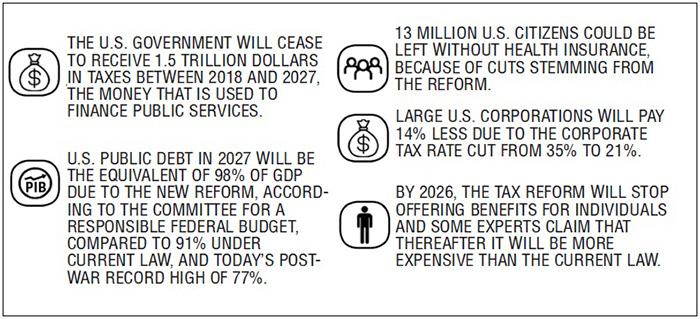
In 2018, the bad news began for the U.S. people with the approval of a tax reform, the most extensive in three decades and Donald Trump's first political victory as President, having been in office more than a year. The tax cut will amount to 1.5 trillion dollars over the next decade, affording corporations and the richest individuals generous rate reductions.
To justify such large tax cuts benefiting a favored few, the government argues that the changes will generate more jobs and bring back U.S. capital invested abroad. These measures will, however, mean cutting social programs that help the most needy, leaving some 13 million citizens without health insurance, for example. The financial package will increase inequality and widen the gap between the rich and the poor.
Nobel Prize winner, U.S. economist Paul Krugman, analyzed the impact the reform will have on the United States, and paraphrased Abraham Lincoln's famous speech about a government "of the people, by the people, and for the people" to describe the essence of Trump's plan, saying, "We are talking about a government of the people, not by the people or for the people, but rather by rich donors and for rich donors."
This is the reality that the majority of the U.S. population must face, and that persons who immigrate - in search of "the land of opportunity" and the "American dream" which has become a veritable nightmare - will find.
According to the U.S. Census office, more than 40 million people (more than one in eight of U.S. citizens) live in poverty, and among these, 18.5 million in extreme poverty.
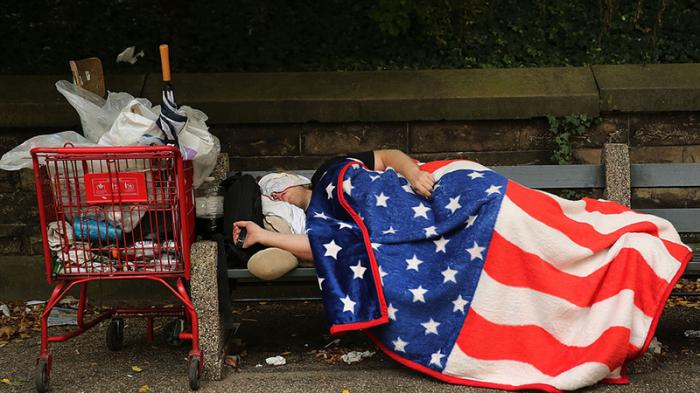
The number of people sleeping on the streets has also grown. According to the last report issued by the U.S. Department of Housing and Urban Development, in December of 2017, there are 553,742 homeless in the country. One of every five of whom live in New York City or Los Angeles.
It is evident that the United States is experiencing a difficult social situation, caused, in the first place, by the structural crisis of the capitalist system, with its neoliberal model reaching a dead end. Thus the establishment is attempting to readjust the system, well aware that all U.S. citizens are not "created equal," nor do they enjoy certain "inalienable rights." They continue to be concerned that fewer people every day see their "city on the "hill" as an example to follow in 2018, much less in coming years.


