

The voices of “hard power” are less inhibited when making recommendations regarding the role of the United States in the world, as compared to their colleagues inclined toward so-called “smart power.”
Irving Kristol, theorist of the most belligerent conservatism and prominent disciple of Leo Strauss, took for granted an "American Imperium" and didn’t hide proclaiming it.
“One of these days, the American people are going to awaken to the fact that we have become an imperial nation.” 1.
According to Kristol, the difference between the U.S. empire and the European was that, "Our missionaries are in Hollywood."
Leo Strauss arrived in the United States fleeing the Nazis. Disciple of Heidegger, admirer and student of Plato, Maimonides, Nietzsche, and Carl Schmitt, he taught his students that within society some are fit to lead and others to be led. 2.
He believed that natural human aggressiveness could be controlled by a powerful state and recommended: "If there is no external threat, one has to be invented… a political order can only be stable if it is united by an external threat." 3
Followers of Strauss expanded their role from their faculty positions at the University of Chicago. Allan Bloom, founder of the John M. Olin Foundation think tank in 1984, exerted great influence during the Ronald Reagan administration.
The first generation of this group, with Allan Bloom in the lead, reformatted conservative thinking, endowing it with arguments that go beyond adhering to traditional values and defending the free market.
The Closing of the American Mind (1987), a best seller written by Bloom, offered, through an analysis of U.S. university culture, a diagnosis of the country and a method to solve the serious problems it faced.
After September 11, 2001, neoconservatives (neocons) practiced a policy of terrorizing the U.S. population, via media manipulation of messages and promotion of a paranoid vision of reality.
Neocon warriors were however discredited during the George W. Bush administration. The U.S. image was seriously damaged, and the "real power" decided to remove them from the scene. A change was needed.
From hard power to smart power: What’s the difference?
The Barack Obama administration, as noted by prominent U.S. figures like James Petras and Noam Chomsky, more than anyone, used extraterritorial tools to exercise power and knew how to use fear with great skill.
The contradictions between neocons and their government were only cosmetic, a public relations issue, nothing more. The goal was to simply change the image, to achieve a new consensus.
Intelligent power, also born of Straussian circles - with their genesis in Chicago’s academic and political world - functions on the basis of "consensus engineering" to further limit thinking in the U.S. to a narrow range of ideas.
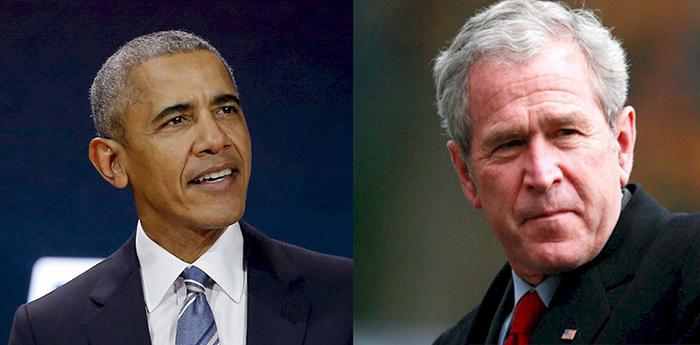
What difference is there between George Bush preparing the attack on Iraq, executing the operation as "emperor" of the rich and powerful, white Anglo-Saxon Protestant super-multimillionaires, and Barack Obama, the first Black President of the United States, carefully creating the necessary setting to invade Syria, or Donald Trump, whose erratic behavior includes threats, blockades, economic sanctions, bombings, and indiscriminate missile attacks.
When he was President, George W. Bush announced that he would take military action if Iraq refused to destroy its weapons of mass destruction, describing the Baghdad regime as "a threat to the United States."
On March 20, 2003, the United States and the United Kingdom began the invasion of Iraq by land, after U.S. forces attempted to kill Saddam and his staff in a selective attack with Tomahawk missiles fired from several ships.
Obama declared on August 28, 2013 that he had not wanted to get involved militarily in the Syrian civil conflict, underway for more than two years, but went ahead to announce that if Assad used chemical weapons against his own people, "That would change my calculations significantly.”
The Pentagon and NATO hawks did not wait long to fire Tomahawk missiles on Syria from ships and submarines, after the theatrical fabrication of a false chemical attack on the civilian population.
Donald Trump says that, in the case of Venezuela, "All options are on the table," and threatens the use of force against Cuba and Nicaragua, as well.
In a televised speech on the aircraft carrier USS Abraham Lincoln, George W. Bush announced in 2003, "The main combat operations in Iraq are over." Will we be seeing President Donald Trump, decked out in a pilot suit on an aircraft carrier, announcing victory in another "dark corner of the planet?"
The "Project for a New American Century," the flagship document outlining the neoconservative plan to extend the U.S. empire across the planet, is based on the doctrine of "preventive war with a global and permanent character." The project brazenly states, "If the 20th century was the American Century, the 21st century should be, too."
Thus, new wars must be launched with overwhelming technological superiority against countries that are weak, but extremely valuable from the U.S. strategic point of view.
The plan exists, the real power implements it, no matter which of its facades the current government is using, the mission is to advance the goal of global domination. The same pretexts, the same interests, the same actions. What has changed?
1. Irving Kristol. “The Emerging American Imperium,” Wall Street Journal, August 18, 1997.
2. Leo Strauss. What is Political Philosophy? and Other Studies. The Free Press, Glencoe, IL,1959.
3. Idem.


