

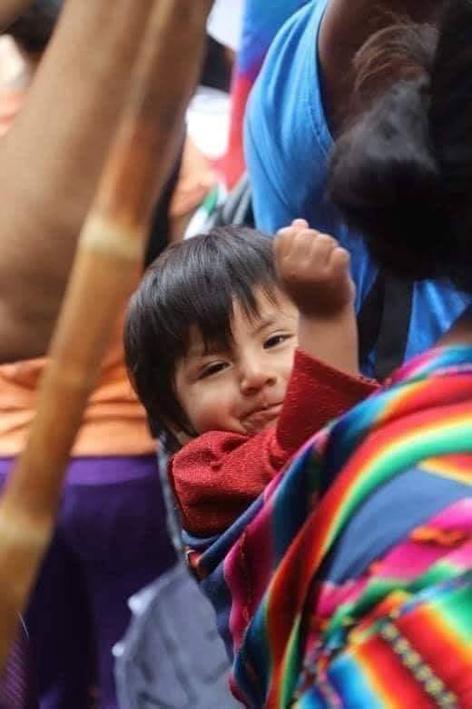
“These sons of our America, which must save herself through her Indians and is on the rise; these deserters, who ask to take up arms with the forces of North America, which drowns its Indians in blood and is on the wane!.”
José Martí
The history of coups d'état in Latin America is long and sobering in that, after a process of change that has affected US interests in the region has been overthrown, the immediately subsequent election never returns the government to the forces displaced from it.
However, this all changed on October 18, 2020, when the candidacy of the Movement to Socialism (MAS), formed by Luis Arce and David Choquehuanca, obtained 55.10% of the votes, exceeding by 8% the results of a year ago, when the coup took place, and leading by more than 26% the second most voted option.
The Bolivian people demonstrated with their vote, and in a convincing manner, the falsity of the accusations of fraud launched by the Organization of American States (OAS) on the results of the elections of November 2019. These accusations led to a coup d’état that gave way to the emergence of a de facto government based on repression, the spilling of indigenous blood and a substantial economic and social setback that coincided with the COVID-19 pandemic and placed the country in a dramatic situation.
Before that, the process of change in Bolivia had to defeat, successively, the historic alliance of the white and racist national oligarchy with Washington: the anti-constituent coup (2006-2007), a civic-prefectural coup (2008), a separatist coup (2009), another one against social organizations (Tipnis 2011 and 2012), and a media operation known as the Zapata Case, just three weeks before the referendum on presidential reelection on February 21, 2016. In the latter, a woman, managed from the US embassy, claimed to have birthed a child of President Evo Morales, a child who would later be proven never to have existed (1). The message to the voters of the referendum was clear: "if Evo cannot take care of a child, how will he take care of a country?” This scandal secured a narrow victory for the US-affiliated forces (51.30% No vs. 48.70% Yes) that would later be annulled by the Constitutional Court of Bolivia, a decision Washington did not object to later when the same Article 23 of the American Convention on Human Rights was used to allow the reelection of Oscar Arias in Costa Rica and Juan Orlando Hernandez in Honduras.
Bolivia is a very particular country, with a plurinational and multicultural condition, where about 40% of the population does not have Spanish as their native language, social movements and neighborhood councils are structured in a long tradition of resistance and struggle, with an ancestral social organization that has resisted five centuries of violence and discrimination until one of its own became the country's top political figure. If the elections of this October 18 prove anything, it is that this social composition has said enough and has begun to walk, and will never stop after five-hundred years of brutal exclusion.
For the right-wing press, MAS voters are people who don't know what a cell phone is, don't know what the Internet is, and mentally have absolutely no idea about practically anything (2), but what their vote shows in successive elections is that they are better informed and have more sense of history than European and American voters, induced to vote against their own interests by fake news and artificial intelligence.
Once again, Caliban has taught Prospero a lesson that has baffled him to the point of silence, regardless if he is an academic or a coup-plotter, if he is from the OAS or a US university. The upstart admirer of American Rome, who despises the other, is in fact for North America a despicable intruder who never made it to understand his own. Now, what they superficially believed to be his victory is his defeat, not only ideological, but cultural, since they are unable to recognize that the US-made democracy they are raising for Latin America no longer works, not even in that country.
Our America will never accommodate to what Obama repeatedly called "universal values" in his allusions to Cuba, but they are nothing more than systems of domination that the United States imposes on the world. Our most lucid intellectuals, from Carpentier to Wifredo Lam, from García Márquez to Galeano, and even the early Vargas Llosa, before he became the spokesperson for the most fundamentalist neoliberalism, realized this. But the colonized who wants to serve the colonizer never learns.
All racism is related. The Bolivian coup leaders turned to Israel for advice on repression. "We have invited you to help us. They are used to dealing with terrorists. They know how to handle them," (3) said a minister of the de facto government to Reuters agency. Meanwhile, the US-funded private press in Cuba, in an exercise of a certain Eurocentric school of bending reality to fit its schemes, were looking for cool references of Zionism, well seen by the centers of power, from the dogmas that divide Latin America into an "authoritarian right" and a "totalitarian left," Evo was accused of being a "leader" affiliated with the latter. (4)
The totalitarian "leader" then said a truth unpronounceable by the Zionist "democrat": "There are similar practices in the de facto government of Bolivia in an analogy with the Israeli regime, talking about what is happening with Palestine, like the murder of people, repression of the population, censorship of the press and even the expulsion of journalists who try to show what is happening.”
It is not surprising that the tropical Zionism has been denouncing Evo and calling him a totalitarian ever since, following the route of those who had previously called him a terrorist. As I wrote then: "Evo Morales is not a traditional politician, nor is he a military man; he was forged as a leader in the unions and social movements that had faced repression and endured dictatorships for a long time in the country that has perhaps suffered more coups d'état worldwide. Anyone who knows how unions and neighborhood councils work in Bolivia, knows about their internal democracy, how they submit all matters to assembly in their long history of mobilizations, resistances and strikes where not a few of their members have lost their lives.”
Nothing differentiates Zionism's fascist view of the Arab people from those who scornfully accuse the indigenous people of ignoring democracy as conceived by their colonial view. It is a question of the same imperialist ideology tempered to different geographies. Martí rightly called runts those in our America who do not have faith in their land, and “wish to govern unique populaces, singularly and violently composed, by laws inherited from four centuries of free practice in the United States and nineteen centuries of monarchy in France.” (5)
The MAS has obtained a historic victory, although those who only talk about what has happened in Latin America in order to dogmatically label the Cuban revolutionaries and their comrades in the region as totalitarians, have not told their readers yet. The reality is that the Bolivian indigenous peoples have made it possible for the overthrown to return to government for the first time after a coup d'état, something that was not achieved by the US-built "democratic transitions" in Latin America, nor in Southern Europe.
It is true that lessons will have to be drawn so that Washington and the local oligarchic forces do not have the army and police at their service once again. It is understood that it is not enough for the economy to go well and for even the rich to benefit, for the process of change to be irreversible. However, it will not be the colonial dogma of the newcomer in the North who, like all converts, seeks to deny his own to the extreme, the right vision to analyze a reality that does not fit in the mind of those who, in Martí's words, live "in corrupted lands, sporting a worm for a necktie and a sign that says ‘traitor’ on the back of his paper jacket." A land to where Jeanine Añez is already heading after requesting 350 visas for her ministers and families from the United States.
Perhaps the best description of these disconcerting events is the one by US writer Ernest Hemingway, who put his skin in danger for the good causes of his time and chose to live among us, and learn from our humble fishermen: "Man is not made for defeat. A man can be destroyed, but not defeated".


