

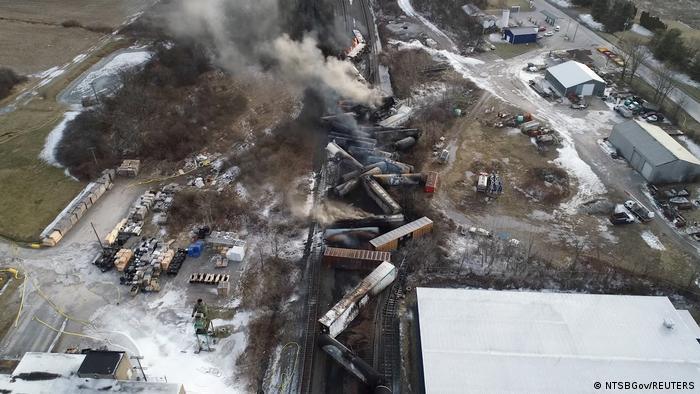
The news, in spite of the efforts to hide it, to mimic its essence or to distort its content, always makes its way: in East Palestine, Ohio, there was a chemical accident.
Washington tried to prevent the information about what happened from going beyond the borders of East Palestine; even, as denounced by the former president of Bolivia, Evo Morales, they tried to hide it by arresting journalists such as Evan Lambert. Yes, this is how the heralds of freedom of the press act.
Evo demanded that U.S. President Joe Biden explain to the world everything related to the environmental disaster that began on February 3, when the Norfolk Southern Railroad train, loaded with chemicals and traveling from Illinois to Pennsylvania, derailed in East Palestine and caused a huge fire.
Days later, specialists carried out a controlled combustion of the overturned cars to prevent a possible explosion. During the operation, hydrogen chloride and phosgene were released into the air, a toxic gas that was used as a weapon in World War I, responsible for the largest number of deaths caused by gases in that war.
The presence of these substances was only revealed after the cars were burned. Trent Conaway, mayor of the town, declared a state of emergency in the area and explained that the wagons involved in the accident were carrying dangerous toxic substances.
The U.S. Environmental Protection Agency reported that other compounds such as ethylene glycol monobutyl ether, ethylhexyl acrylate and isobutylene were also present in the affected cars.
Specialists in the field, from the Centers for Disease Control and Prevention of that country, warned that ethylhexyl acrylate is a carcinogenic substance, isobutylene causes dizziness and drowsiness when inhaled, and exposure to monobutyl ether can cause blood in the urine, vomiting and nervous system depression.
Two weeks later, evidence of the contamination is still being presented, increasing the uncertainty of people living in Ohio, and not only there, but across the country and in various parts of the world, to the point that some have named the accident "the little chemical Chernobyl."
The director of the Ohio Department of Natural Resources, Mary Mertz, reported that a river near the disaster area was contaminated, causing the death of some 3,500 fish.
One hundred thousand liters of vinyl chloride burned in Ohio. The size of the cloud that formed after the train explosion indicates that the problem is much larger than first reported. Predicted acid rain may cover a much larger radius and affect populations far removed from the incident.
According to Andrew Whelton, an environmental engineer who investigates chemical risks during disasters, it is not clear how much of it was diluted in the air, in the water or fell to the ground, and explained that these compounds can remain active for years if adequate measures are not taken, reported BBC News Mundo.
As if that were not enough, on February 14, a tanker truck had an accident on a highway in Tucson, in the southern United States, which caused a leak of nitric acid, a substance that is considered highly hazardous to health, the Arizona Department of Public Safety reported in a statement.


