

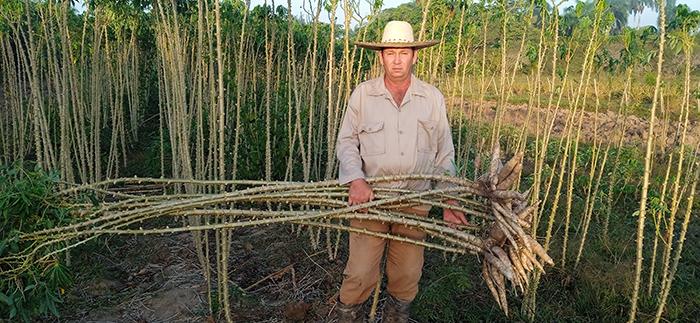
MINAG-FAO-Green Climate Fund (GCF) project eradicates invasive weed to restore farms and landscapes, building climate resilience and transforming lives.
In the Corralillo town, in Villa Clara province, in the central part of Cuba, Mariano Quintero Almeida works eight hours a day in the hot sun on the farm he calls El Despertar (or “The Awakening”). He’s not complaining. In fact, he is pleased.
When Mariano was given the land three years ago, the thought of scratching anything more than a bare living from this 67.5-hectare property seemed unattainable.
El Despertar farm was covered almost completely by an invasive weed (Dichrostachyscinerea) called “marabú” or “sicklebush”. A fast-growing, woody bush covered by thorns, sicklebush forms dense thickets, making cultivation almost impossible.
“Specialized machinery is essential for cutting sicklebush because it’s a very strong plant with many thorns,” Mariano explains. “If the work is not done correctly, the sicklebush will sprout again from its roots and return even stronger than before. In six months, it will have overtaken double the land it occupied previously.”
Mariano says decades of unsustainable cattle ranching in Corralillo had led to overgrazing, soil degradation and erosion, making the land susceptible to infestation by sicklebush. Over the years, property after property had been over-run, displacing livestock and agriculture and transforming the community.
“Jobs disappeared, and people migrated to other towns or cities,” Mariano remembers. “All of my neighbors had to get rid of their cattle and started making charcoal and selling firewood, because they couldn’t work the land.”
“There are very few farms here that are not infested,” he explains. “Only a very few people know how to work the sicklebush. Others chose to use chemical herbicides, which later caused them problems for their livestock or agriculture.”
The problem is not only in Corralillo. Sicklebushes covers vast tracts of once-productive land around Cuba. In 2020, the Cuban government and the Food and Agriculture Organization of the United Nations (FAO) began implementing a project, financed by the Green Climate Fund (GCF), to help manage the situation.
The overall aim of the USD 120 million project is to develop more sustainable and climate change-resilient agrifood systems in areas covered mostly by sicklebush and degraded pastureland. Cuba, a Small Island Developing State, is particularly vulnerable to the effects of climate change. The provinces of Villa Clara, Matanzas and Las Tunas have experienced recurring droughts, soil degradation and salinity.
Under the project, smallholder farmers in these three provinces received machinery, including tractors, brush cutters, rotavators and ploughs. More than 4,500 farmers, including 900 women, have received training. Mariano says that the project staff explained to them how the machine worked and what it could do, but to see it working on sicklebushes was incredible.
“These are impressive machines,” he says. “We were overjoyed to see the light at the end of the tunnel.”
Mariano explains that the farmers are now able to clear the same amount of sicklebush in one day that would have taken them a month to clear on their own. And the work itself is more efficient, because the sicklebush biomass is plowed into the soil, so the soil benefits.
“Before we worked from sunrise to sunset with axes and machetes, the sicklebush thorns tearing our arms and clothes,” Mariano says. “We could plant small plots that gave us just enough for our family’s use. Now we can farm larger tracts of land and help the community with the crops we are planting. It has made a big difference.”
Across the three provinces in Cuba, farmers have so far succeeded in eradicating more than 5,100 hectares of sicklebush. They are in the process of establishing forestry, agroforestry and silvopastoral systems on over 6,500 hectares of land, cultivating trees, shrubs and agricultural crops, as well as livestock on the same plots. These practices help boost soil fertility, as well as remove greenhouse gases from the atmosphere, contributing to climate change mitigation and adaptation.
Farmers are now producing meat, milk, vegetables, fruit and grains in an environmentally sustainable manner. Mariano himself is now growing a variety of crops on El Despertar farm, including cassava, corn, squash, sorghum, sunflower, sesame, peanuts and beans. And he has other plans too. He hopes to grow fruit trees and introduce jersey and zebu dairy cattle that can withstand the heat and drought conditions in Corralillo well into the future.
“The project has already had tangible results, which for us have been a miracle that I hope will multiply and never end,” Mariano says. “Before this, we had dreams, but this project has taught us to make our dreams come true.”
This FAO project is the first of its kind funded by the GCF in Cuba and one of 20 high-impact initiatives in FAO's $1.2 billion GCF-funded project portfolio. By 2027, the project aims to introduce agroforestry practices on 36,000 hectares of land, while mitigating 2.7 million tons of greenhouse gas emissions and helping 52,000 family farmers in Cuba improve their food security, nutrition and livelihoods.


