

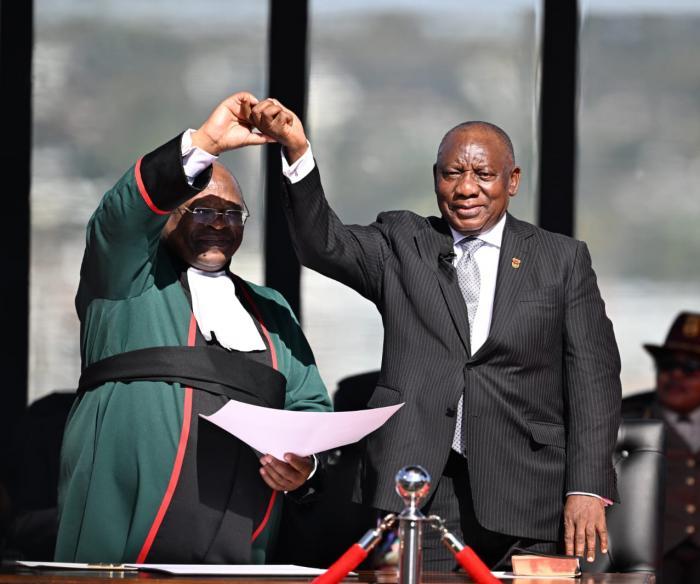
Pretoria, South Africa.— President Cyril Ramaphosa took office on Wednesday morning for his second and last five-year term at the helm of South Africa, in a solemn ceremony attended, among other dignitaries, by the member of the Political Bureau of the Central Committee of the Communist Party of Cuba and Vice President of the Republic, Salvador Valdés Mesa.
The inauguration ceremony, which took place between 11:50 a.m. and 1:30 p.m., was held, as is tradition, in the amphitheater of the Union Buildings, seat of the Government, where the President of the southernmost African country was sworn in before the President of the Supreme Court, Raymond Zondo.
At the end of the ceremony, guided at all times by the extraordinary South African culture, Ramaphosa greeted heads of state, heads of government, vice presidents and other heads of delegations, including Valdés Mesa, with whom he spoke briefly, and who was also greeted warmly by Tshepo Motsepe, wife of the host leader.
The ceremony was attended by some 3,000 people, including 18 heads of state and government, former leaders, official delegations from numerous countries, South African traditional chiefs and other national and international personalities.
The official Cuban delegation to the inauguration of Cyril Ramaphosa, headed by Valdés Mesa, is composed of Tania Margarita Cruz Hernández, First Deputy Minister of Public Health; Anayansi Rodríguez Camejo, Deputy Minister of Foreign Affairs; Enrique Orta González, Cuban Ambassador to South Africa, and Luis Alberto Amorós Núñez, Director of the Sub-Saharan Africa Directorate of the Ministry of Foreign Affairs.
Among the leaders who participated in Ramaphosa's inauguration were João Lourenço, from Angola; Filipe Nyusi, from Mozambique; Emmerson Mnangagwa, from Zimbabwe; Bola Tinubu, from Nigeria; Felix Tshisekedi, from the Democratic Republic of Congo; Samia Suluhu Hassan, from Tanzania; Denis Sassou-Nguesso, from the Republic of Congo, and the King of Esuatini, Mswati III.
Also in attendance were high-level delegations from China, Palestine, Namibia, Lesotho, Uganda, Burundi, South Sudan, Egypt, as well as representatives of international organizations.
"NEW ERA"
"A new era" begins for our country, asserted in his inauguration speech President Cyril Ramaphosa, who heads a coalition Government, after the African National Congress (ANC) lost the majority of the Parliament in the elections of last May 29, despite having won the elections with just over 40% of the votes.
After 30 years of maintaining its hegemony in the National Assembly, the ANC now had to agree on what it has defined as "a Government of national unity", together with its traditional opponent, the Democratic Alliance, whose majority base is the white population. The Inkatha Freedom Party, of the Zulu ethnic group, the social democrat Good, and the Patriotic Alliance, of the extreme right, also joined the bloc.
"The formation of a government of national unity is a moment of profound importance. It is the beginning of a new era," Ramaphosa said at the inauguration of his second term.
"It is a moment when we must choose between moving forward together or risk losing all that we have built," he emphasized.
Among the goals of the new government, according to a declaration of intent agreed between the parties that form it, are, among others, to achieve rapid, inclusive and sustainable economic growth, as well as the defense of workers' rights and the reduction of poverty, informed the South African President.
"We affirm our determination to build a more egalitarian and caring society. We affirm our determined quest to build a growing and inclusive economy that provides opportunities and livelihoods for all people," he stressed.
Ramaphosa further stated that the ANC will convene "a national dialogue on the critical challenges facing the nation," for which he invited other political parties, civil society, labor, business and other stakeholders in society to participate.
"We must be brave and we must be bold. This is a new current that augurs progress, transformation and a deep and fundamental change", said, at the end of his speech, the fifth President of the South Africa founded by the leader Nelson Mandela, in 1994, after hundreds of years of exploitation and exclusion of the black population.


