

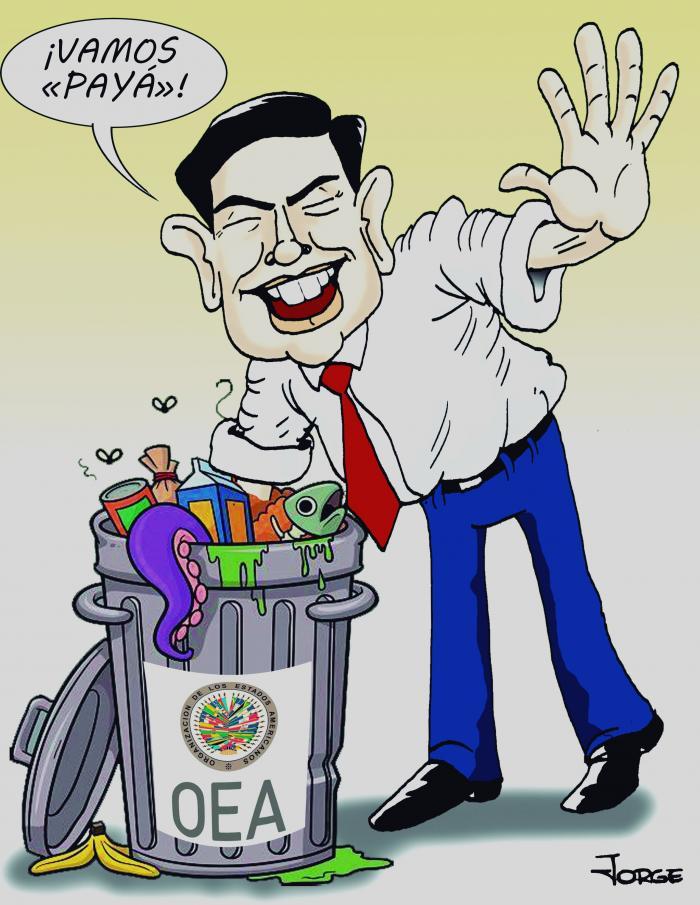
The election of Rosa María Payá Acevedo as head of the Inter-American Commission on Human Rights (IACHR) is a maneuver by Washington to strain Cuba's relations with its regional allies, and to position her figure in the continental scenario in the run-up to 2026.
The U.S. Secretary of State, Marco Rubio, repeatedly pressured the members of the Organization of American States (OAS) to support this candidacy. One day before the OAS General Assembly, held in Antigua and Barbuda, Rubio even publicly urged them to vote for his proposal
At the end of May, the government of Donald Trump made official the proposal of Rosa María Payá for the IACHR, for the period 2026-2029. Washington spared no praise, presenting her as "a democracy advocate, human rights leader and Latin American policy expert of international prestige".
Such assessment seems to be supported, among other things, by Payá's recognized admiration for Jeanine Áñez, the former de facto president of Bolivia, convicted of genocide, terrorism, sedition and conspiracy after the events of November 2019, during and after the coup d'état against Evo Morales.
Various anti-Cuban organizations such as Center For a Free Cuba, Juventud LAC, Pan American Foundation for Democracy (Fupad), Foundation for Pan American Democracy (FDP), National Endowment for Democracy (NED), Victims of Communism Memorial Foundation, Foundation for Human Rights in Cuba and Democratic Initiative of Spain were articulated to support the candidacy.
There was also support from terrorist organizations such as the Cuban Democratic Directorate and the Cuban American National Foundation (CANF).
The new head of the IACHR lacks political capital and followers both in Cuba and abroad, beyond the backing of the White House and its allies.
On the other hand, several opposition groups in exile have denounced Payá for alleged embezzlement of funds since 2021, pointing out that she has diverted resources from the OAS, the State Department and USAID, originally intended to promote protest actions and unrest in Cuba.
It should be noted that Rosa María Payá is one of the main promoters of the campaign against the Cuban medical brigades, one of the axes of the U.S. government's strategy of subversion against the island.
A figure fabricated and financed by Washington, Payá is also famous for her insistence on calling for a tightening of the blockade and requesting U.S. military intervention in Cuba. What a "pearl" has been chosen for a responsibility that, by size and nature, is alien to him.


