

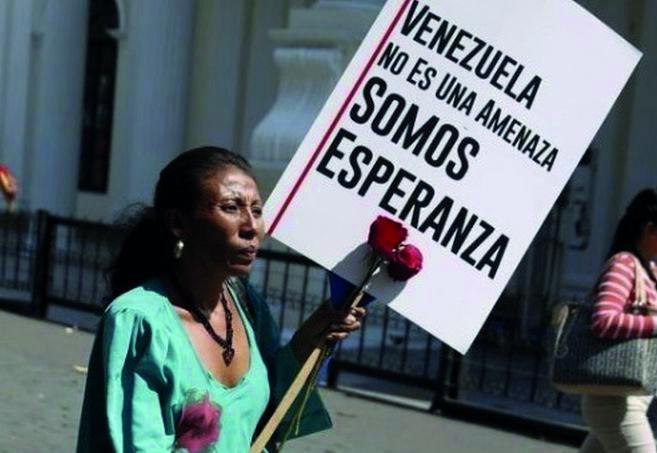
It was heard throughout the chamber yesterday. At the UN, Venezuela's permanent representative to that body, Samuel Moncada, denounced "a gigantic crime of aggression in progress, beyond all rational parameters, all legal logic and historical precedent" on the part of the U.S. government.
This action includes, he alleged, a declared naval blockade, the theft of 4 million barrels of Venezuelan oil, and electronic warfare in the airspace, which, he asserted, constitutes a violation of international law and a threat to regional peace.
At the Security Council meeting, he stated that the intention is to "fabricate a provocation that will allow them to falsely invoke Article 51 of the United Nations Charter," and insisted that Venezuela is only the "first target of a larger plan" that seeks to divide and conquer the continent "piece by piece."
For his part, Washington's representative to the UN, Mike Waltz, issued an open threat: "The United States will impose and enforce maximum sanctions to deprive Maduro of the resources he uses to finance the Soles cartel, which the United States has designated as a foreign terrorist organization, along with the Aragua Train. The sanctioned oil tankers are the main economic lifeline for Maduro and his illegitimate regime," he shouted.
This is not the first time that the issue of direct military escalation against Venezuela has been brought before the multilateral body. Last October, Samuel Moncada questioned the US's right to militarize the Caribbean region, execute civilians, and deny them due process. He also denounced that, in this way, the White House intends to turn that country into a U.S. "colony."
On this occasion, Russia's permanent representative, Vasili Nebenzia, accused Washington of being "responsible for the catastrophic consequences that this cowboy behavior has for the inhabitants of the blockaded country." Previously, Russian Foreign Minister Sergey Lavrov had reiterated to his Venezuelan counterpart, Yván Gil, his country's willingness to provide all necessary support to counter the blockade against the South American nation. Likewise, Maduro and Putin insisted on the Strategic Partnership and Cooperation Agreement, which establishes mutual respect in the face of the northern nation's sanctions architecture.
Other nations have shown their support for Venezuela, such as China, which, through its Foreign Minister, Wang Yi, reiterated that both countries are strategic partners and that mutual trust and support are a tradition in bilateral ties.
For her part, Mexican President Claudia Sheinbaum has emphasized that her administration's foreign policy will remain firm under the constitutional principles of non-intervention, "non-interference, and peaceful resolution of conflicts."
Meanwhile, extrajudicial executions continue in Caribbean and Eastern Pacific waters as part of a regional strategy to neutralize transnational criminal networks linked to drug trafficking, according to the Southern Command, despite the fact that no details or verifiable evidence have been reported in this regard.


