

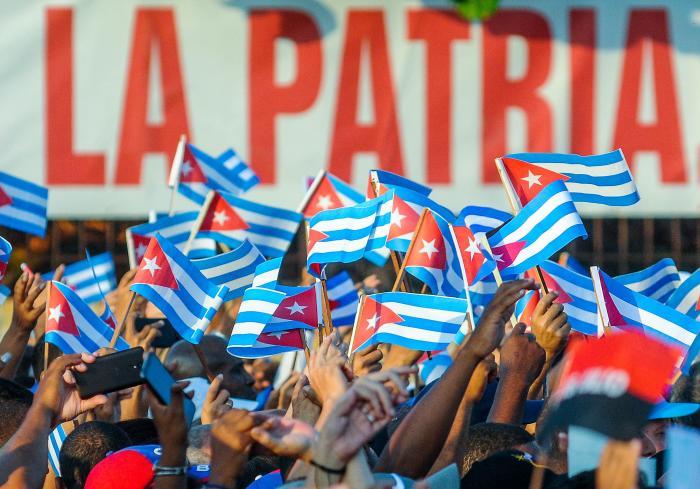
"Sick with rage over the sovereign decision of this people to choose their political model," after their "invade and destroy" Cuba—one of the most recent threats—the occupant of the Oval Office and his death squad issued a kind of Sunday ultimatum against the largest of the Antilles yesterday.
The island, as a "free, independent, and sovereign nation" that "does not attack, has been attacked by the United States for 66 years, and does not threaten, is preparing, ready to defend the homeland to the last drop of blood," has said: "No one dictates what we do."
This was stated by the First Secretary of the Central Committee of the Party and President of the Republic, Miguel Díaz-Canel Bermúdez, following the statements by U.S. President Donald Trump, with which he sought to intimidate the people, claiming that "there will be no more oil or money for Cuba. Zero! I strongly recommend that you reach an agreement before it is too late."
Rejecting the anti-Cuban rhetoric, the island's leader remarked: "Those who turn everything into a business, even human lives, have no moral authority to point the finger at Cuba in any way, shape, or form (...) Those who blame the Revolution for the severe economic hardships we are suffering should be ashamed of themselves. Because they know and acknowledge that these shortages are the result of the draconian measures of extreme suffocation that the US has been applying to us for six decades and now threatens to intensify."
The people of the Caribbean nation, "dignified, brave, and heroic," said Esteban Lazo Hernández, member of the Political Bureau and president of the National Assembly of People's Power and the Council of State, "will not give in to threats or blackmail. We will defend our homeland until victory, always."
In the face of this new aggression, which disregards sovereignty and self-determination, Manuel Marrero Cruz, member of the Party's Political Bureau and prime minister, reiterated on the same social network "the deep conviction of being an eternal Baraguá" and urged a response like Maceo's: "Anyone who tries to take over Cuba will only gather the dust of its blood-soaked soil, if they do not perish in the struggle."
To the Washington government, which presents itself as pacifist while supporting genocide in Gaza and Lebanon, providing weapons for the continuation of armed conflicts, responsible for extrajudicial killings in the Caribbean and the Pacific, having kidnapped the president of a sovereign country, and spreading its imperial poison across all continents, Roberto Morales Ojeda, member of the Political Bureau and secretary of organization of the Central Committee, reminded it that "Cuba stands firm. The Revolution knows no defeat."
"Those who today launch furious attacks against the nation lack any moral authority to point fingers." Regarding "the serious economic shortages we are suffering," he emphasized that they are part of "an economic war that seeks to break what they could not defeat."
Trump seems to have forgotten that from Africa, Latin America, and other parts of the world where Cuba has been an internationalist in liberation struggles, it has only brought back martyrs and heroes.
In this regard, Bruno Rodríguez Parrilla, member of the Political Bureau and Minister of Foreign Affairs, stated that "Cuba does not receive and has never received monetary or material compensation for the security services it has provided to any country. Unlike the US, we do not have a government that lends itself to mercenary activities, blackmail, or military coercion against other states."
He insisted on Cuba's absolute right to import fuel from markets willing to export it and that exercise their own right to develop their commercial relations without interference or subordination to the unilateral coercive measures of the US.
He stated: "Right and justice are on Cuba's side. The US behaves like a criminal and uncontrolled hegemon that threatens the peace and security" of the entire world.
For its part, the government of the Bolivarian Republic of Venezuela ratified, through a communiqué, its historical position in the framework of relations with the island, in accordance with the Charter of the United Nations and international law.
Regarding the binational relationship, it emphasized that it has been built "on brotherhood, solidarity, cooperation, and complementarity." It reaffirmed that international relations must be governed by the principles of international law, non-intervention, the sovereign equality of states, and the self-determination of peoples.
They reiterated that political and diplomatic dialogue is the only way to peacefully resolve disputes of any kind.


