

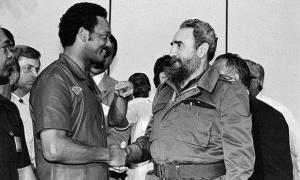
Reverend Jesse Louis Jackson, the last great figure standing in the civil rights movement in the United States and the first African American to lead a campaign for the presidency of the country, died Tuesday at the age of 84, closing a fundamental chapter in the struggle for social justice in the 20th century.
The news, confirmed by his entourage in a statement posted on social media, said that Jackson "passed away on Tuesday morning, surrounded by his family." With him goes the voice of a man who knew how to turn the pulpit into a trench to defend fundamental human values.
Born in 1941 in the segregated southern town of Greenville, South Carolina, Jackson grew up amid the harshness of the discriminatory laws that marked life in the United States. Ordained as a Baptist minister, his destiny was sealed when he became a close associate of Dr. Martin Luther King Jr.
When an assassin's bullet took the life of his mentor on April 4, 1968, far from being daunted, Jackson founded Operation Push (People United to Save Humanity) in 1971, and later the National Rainbow Coalition, organizations that he merged in 1996 to create the Rainbow Push Coalition, a tireless machine in the defense of civil and economic rights and social justice.
Jackson burst onto the national political scene with two bids for the Democratic Party's presidential nomination, in 1984 and 1988. Although he did not win the nomination, his campaigns were historic.
His speech at the 1988 Democratic National Convention, in which he proclaimed that "America is not a quilt woven with a single thread, a single color, a single fabric," remains one of the most memorable pieces of political oratory in the country.
Beyond the borders of the United States, Jackson engaged in intense unofficial diplomatic work. In 1984, he met Commander-in-Chief Fidel Castro Ruz in Havana.
Following that meeting, 48 prisoners were released, people who had been tried and convicted for actions against the Cuban Revolution. Upon his return, Jackson urged the Reagan administration to resume dialogue: "The policy of ostracism does not work," he declared.
He always maintained that connection with the island; he was a constant critic of the economic blockade imposed by the United States against Cuba, calling it an "obsolete Cold War policy" and a "historic embarrassment" that isolated Washington in the region.
It is therefore no coincidence that the Cuban people and government have expressed their heartfelt sorrow: "Cuba will not forget his friendship." Jesse Jackson never let down those who believed in him, leaving behind an indelible legacy: his faith in a more just world.


