


The multicolored array of flags from around the world painted Cuba with the arrival at Havana’s José Martí International Airport of the Convoy Nuestra América a Cuba, an international movement aimed at breaking the blockade of the largest of the Antilles by sending solidarity aid.
In the first shipment, the European Convoy, originating from Italy and arriving on the island on March 17th, brought approximately five tons of medical supplies. The second shipment, coming from New York, was the result of a collection drive by young human rights activists and allies of the Cuban Revolution; it brought not only sanitary materials but also personal hygiene and school supplies; all will be distributed in coordination with Cuban institutions.
The first donation was made possible thanks to Italy’s Agency for Cultural and Economic Exchange with Cuba and the Progressive International. Both were part of a campaign carried out in various countries by Let Cuba Breathe and Let Cuba Live, to which solidarity groups and several individuals contributed.
In this regard, Rodrigo Zarza, director for Europe of the Cuban Institute of Friendship with the Peoples (ICAP, in Spanish), emphasized that this aid—and the fact that Cuba’s friends make the defense of our country an additional motivation in their lives—is of great importance, particularly during the difficult times we are experiencing, he said.
He emphasized that this is not just about material support, but rather evidence that there is a strong awareness within the solidarity movement of the unique situation we are facing from an energy perspective, due to the Executive Order in which the U.S. government declared Cuba an "unusual and extraordinary threat," as the shipment also includes solar panels and photovoltaic systems that will assist some of our health institutions.
Accompanying the convoy were more than a hundred passengers, representatives of various solidarity organizations, labor collectives, workers, and political organizations from more than a dozen European countries, as well as Algeria, Morocco, and the United States.
VOICES IN DEFENSE OF JUST CAUSES
As soon as they landed, men and women—workers, trade unionists, social and political leaders—took the opportunity to address the people of this Caribbean land, to whom they have come not only to offer material aid in the form of medical supplies and basic necessities, but also to reaffirm their conviction that the largest of the Antilles represents a moral example from any geographical perspective.
French MEP Emma Fourreau stated that for her it is "very important to be here with the Cuban people, who have always shown solidarity with peoples around the world." She also acknowledged that, although the island is currently under U.S. siege, the blockade that has hindered this nation’s development has been in place for over 60 years, which is why it is urgent to "show that a large part of the world stands with Cuba."
"What we’re bringing today is symbolic," she noted, "it won’t solve the needs, but it’s a first step toward expanding and attracting more people to the international solidarity movement with Cuba."
The MEP knows that, upon her return, speaking about the daily reality she will witness on this visit—which delegations from other continents are already joining—is also urgent, "because the press abroad does not report the truth. We will be an international spokesperson for the cause of the Cuban people," she affirmed. To that end, they will be able to "hear and see what the Cuban people have to tell us."
Marc Botanga, a Belgian MEP, highlighted the importance of traveling to the island to offer assistance to the people who "are being suffocated by the criminal policies of the U.S." A witness to "Cuba’s solidarity with Europe—especially Italy—and other countries during the COVID-19 crisis," where specialists from the island came to provide support at the most critical moments, he is happy to be part of the Convoy, as solidarity is not only material aid but also a feeling of gratitude for what the largest of the Antilles has done for decades in diverse corners of the international community.
Lucano Doménico, an Italian MEP, acknowledged that the Caribbean island stands as a symbol of the struggle against imperialism, and that it is not alone in the midst of the complex situation it faces today due to the intensification of the blockade, which he and his people condemn.
He also explained that not everyone who supports Cuba is here today; however, this is only the beginning of the aid that Italy and the world are offering.
MEP Ilaria Salís noted that this five-ton shipment brought by the European segment of the Convoy is a sincere contribution from all those organizations and individuals who have offered a helping hand to support the people of the Greater Antilles, in the face of the persistence—she argued—of the criminal and genocidal blockade that seeks to suffocate them.
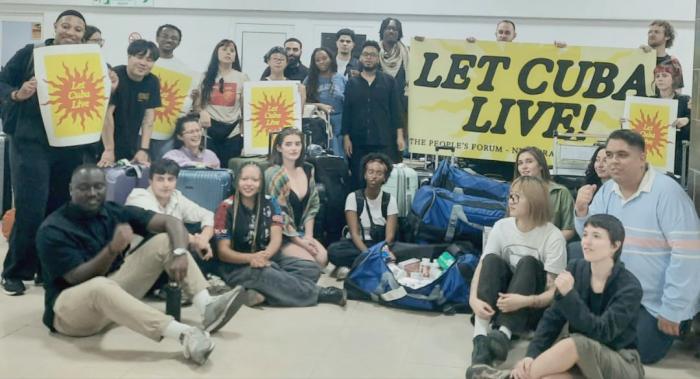
FROM NEW YORK: LET CUBA LIVE
"The Cuban people have made immense sacrifices for humanity, for the dignity of all the peoples of the world, including the people of the United States," emphasized Manolo De los Santos, coordinator of The People’s Forum, who, after recalling the events caused by Hurricane Katrina in the U.S. –"when no American doctor dared to treat Black communities"– expressed his gratitude toward the doctors from Cuba, "who were willing, with the little they had, to help everyone."
That is why, he added, we want to return to the largest of the Antilles to demonstrate our love and friendship and, "above all, a militant solidarity that says ‘No’ to the genocidal attempt to crush the Cuban people."
Regarding the donation, which includes medications for children with cancer, painkillers, and other supplies, he noted that "a shipment of solar panels is also on its way to be distributed to Cuban hospitals, valued at over half a million dollars."
These solar energy modules will operate autonomously so that operating rooms in Cuba can continue to function despite the difficulties.
Meanwhile, Puerto Rican Niki Franco, a member of the Let Cuba Live and Nuestra América projects, emphasized that it is important to remember that Cuba is not alone.
"We will be interacting with students and artists and learning a little more about how people have reinvented themselves and built community despite the situation caused by the sanctions imposed by the Washington administration," she said.
Similarly, Vivian Lesmick, also part of the project, noted that all the activists arriving in Cuba want nothing more than to show the world that the blockade is causing the Cuban people to suffer.
"Cuba is a country that has given so much—so many medical donations—and now, when it needs us, here we are," she declared.


