

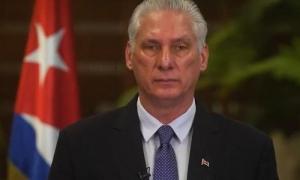
"Despite the current adverse context, Cuba trusts in and relies on multilateralism and diplomacy as the only effective tools for maintaining peace, civilized coexistence, and sustainable development," stated the First Secretary of the Central Committee of the Communist Party and President of the Republic, Miguel Díaz-Canel Bermúdez, in his message to the Second International Conference on Unilateral Coercive Measures, which is taking place in Geneva until April 10.
"From this small nation that resists with dignity the harassment of the blockade in all its aggressive forms, I deeply appreciate the expressions of international solidarity and the support we have received in these difficult times," the Cuban president emphasized, referring to the impact of the intensification of the blockade and the energy embargo.
"A few days ago, the arrival of a Russian oil tanker in a Cuban port made headlines around the world. Hundreds of media outlets followed the tanker's route with unusual interest. The energy blockade against Cuba had been in place for more than three months; that is, the threat of applying coercive measures to any country that, in the exercise of its sovereign prerogatives, exports fuel to Cuba."
“Faced with the criminal aim of suffocating our economy, the 100,000 tons of fuel from the Anatoly Kolodkin became an absolutely extraordinary event that the Cuban people celebrated in every way possible. Why? When does such a common act among sovereign nations become such an extraordinary event? The answer is very simple: when an entire people is punished by being deprived of resources and means essential for their sustenance with the criminal aim of destroying their economy,” Díaz-Canel noted.
Cuba is the victim of a prolonged collective punishment that seeks to bring its people to their knees through hunger, disease, and severe shortages of basic supplies, denounced the Cuban president, who recalled that, by preventing the arrival of fuel to the Island, the United States government flagrantly, deliberately, and unjustifiably violates the human rights of an entire people, as well as the freedom of trade of third countries.
"Cuba is experiencing prolonged daily power outages, shortages of water and liquefied gas, making household chores extremely difficult," he emphasized.
He also stated that more than 96,000 Cubans, including 11,000 children, are waiting for surgeries due to the lack of electricity, despite the efforts of health institutions to find solutions. Meanwhile, more than 16,000 patients requiring radiotherapy and another 2,888 who depend on hemodialysis are affected by the disruption of services that rely on a stable power supply.
Furthermore, he added, schools and universities have had to readjust their study programs and resort to blended learning modalities to ensure the continuity of the teaching and learning process; state and private transportation is practically paralyzed; and the business system and food production have been severely impacted, preventing them from guaranteeing basic supplies.
"Beyond these figures," Díaz-Canel pointed out, "it is impossible to quantify the physical and psychological exhaustion, the daily hardships, the postponement of dreams, and the media war to which a noble, resilient, and compassionate people like ours are subjected, purely out of malice."
"What country can live and develop under this pressure? What right does the world’s leading economic power have to commit such an abuse against a small developing country? Will the United Nations and sovereign states allow international law to be violated and an attempt to return to times of subjugation, barbarism, colonization, and slavery?" he asked.
"International institutions must do much more to denounce and confront the unilateral coercive measures that are being imposed and reinforced not only against Cuba, but also against numerous developing countries," he urged.
"This international conference is an opportunity to highlight their impact and put forward action-oriented proposals. From Cuba, we are promoting the creation of a Human Rights Council working group, composed of various experts, to provide broader and more specialized attention to this issue. We also advocate for the adoption of a legally binding international instrument that demands the immediate lifting of these measures and the accountability of those responsible."
Likewise, the Cuban President expressed his gratitude for the international support shown in the firm opposition to the blockade against Cuba and the systematic denunciation of its legality and its incalculable impact on the human rights of its people. "I assure you that the Cuban people will not forget those who, faced with abuse and blackmail, stood on the side of justice and raised their hands and voices without fear to defend the right of this heroic people to live and to sovereignly choose their destiny. Similarly, I assure you that the Cuban people will defend every inch of their homeland against the voracious appetite of the empire that attacks us. The determination of Cuban men and women to defend our absolute sovereignty is unwavering," he concluded.


