

Seventy-seven years is a lifetime. A long lifetime, a pipe dream for many. Much or little—for oneself or for others—can be accomplished in 77 years. Seven decades, roughly three generations, two numbers… how much time passes?
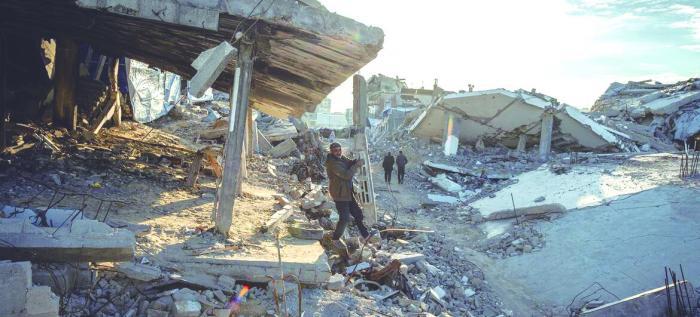
Seventy-seven years have passed since the clock turned back in Gaza. This is the estimate of a report by the UN, the European Union, and the World Bank, which also indicates that, after two years of escalating conflict with Israel, the sectors most severely affected are housing, health, education, commerce, and agriculture.
According to the document, reviewed by the United Nations website on April 20th, nearly 372,000 homes have been destroyed or damaged; more than half of the hospitals are out of service; virtually all of the schools have been destroyed or damaged; and Gaza's economy has contracted by 85%. These numbers alone paint a picture of devastation in which the population of the coastal enclave is barely surviving.
In this regard, the report provided data on the reconstruction needs of these sectors. For example, housing is estimated to require approximately $16.2 billion, while agriculture and the food system are estimated to require around $10.5 billion.
Regarding health, the figures amount to $10 billion, and for trade and industry, the estimated $9 billion. “These sectors together represent almost two-thirds of the total reconstruction needs and constitute the most urgent priorities.”
Furthermore, the document highlights that around 1.9 million people have been displaced, often multiple times, and more than 60% of the population has lost their homes. Meanwhile, the employment rate is only 9.3%. “This situation, combined with job losses in the West Bank, has led to a 13-percentage-point drop in the combined rate for the West Bank and Gaza, placing it among the lowest in the World Bank database.”
“The bill is staggering,” the text states, “$71.4 billion will be needed over ten years to rebuild the Palestinian enclave.” It further warns that $26.3 billion is required to restore vital services, rebuild devastated infrastructure, and revive a paralyzed economy. “A colossal task, commensurate with the scale of the destruction and the humanitarian crisis.”
The document records numbers on economic losses, material goods, rubble that will take years to clear… Other texts reveal the dead, the wounded, the displaced. Food insecurity, famine, unemployment, the collapse of health and education systems, the catastrophic cumulative effects on physical and mental health are reduced to statistics, going from disaster to numbers, like a final blow.
While this is happening, the world looks away, focuses on other wars, perpetuates conflicts, or reopens wounds with threats and cannons.
This is where human ambition and misery are leading us. Is this the future we are building? Time must move forward.


