

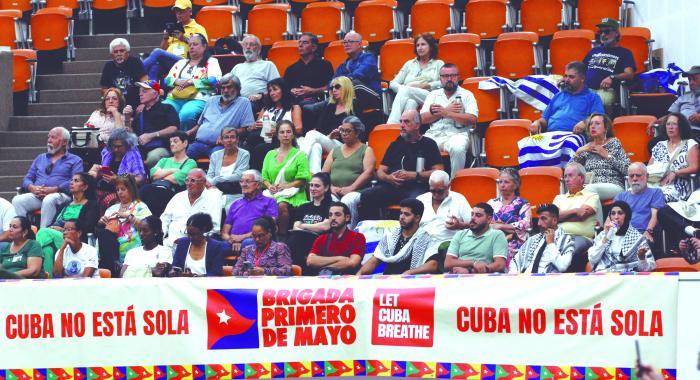
In the face of threats and aggression against Cuba, against a Revolution that has made its principles its shield—and the world knows this well—numerous voices, coming from the most diverse corners of the globe, are rising in support of the island’s determination to defend its sovereignty.
Thus, as Political Bureau member Roberto Morales Ojeda, Secretary of Organization of the Party’s Central Committee, recently stated on X, “every show of international support, every expression of solidarity, is a seed that strengthens our conviction.”
On the same social media platform, Colombian President Gustavo Petro declared: “I do not agree with a military aggression against Cuba because that is a military aggression against Latin America. We said that the Caribbean is a zone of peace and that must be respected. The Cuban people are the sole masters of their country.
“The American continent will live in peace if no one seeks to impose themselves on others. This continent is the continent of Freedom, not of invasions. Honor to José Martí and to the free and sovereign republics of Latin America and the Caribbean,” he emphasized.
Ariadna Montiel Reyes, in her speech after being elected president of the Mexican Morena party, raised her voice—“as in other moments in history”—“against any attempt at intervention against the people of Cuba, because their struggle for dignity and the right to decide their own destiny is also part of our own struggle.”
In that regard, she joined the call previously made in Barcelona by President Claudia Sheinbaum “to put an end to all economic blockades against the island (…) Our solidarity will always be with the people of Cuba!” she affirmed.
In an official statement, Uruguay’s Frente Amplio condemned any attempt at military intervention or deployment against Cuba. It also urged the U.S. government to abandon confrontational actions and establish a respectful dialogue on an equal footing. It also called on its people to mobilize in defense of peace and to remain vigilant in the face of this escalation, which once again threatens the stability of Latin America and the Caribbean as a zone of peace.
The Communist Party of India (CPI) strongly condemned the United States’ actions and threats against Cuba. In a statement signed by its General Secretary D. Raja, the organization noted that this represents a dangerous continuation of the decades-long policy of economic blockade, coercion, and intervention aimed at undermining Cuba’s sovereignty and its socialist path. It expressed its unwavering solidarity with the Cuban Communist Party and the Cuban people in their struggle to defend their sovereignty and socialist achievements.
For its part, the Guatemalan National Revolutionary Unity Party (URNG) emphasized that the historic May 1st, in the year of Fidel’s centennial, strikes a blow against U.S. imperialism, which believes—and seeks to make others believe—that Cuba is willing to surrender to its threats of military aggression.
Similarly, it expressed its confidence that the Cuban people, under the leadership of the Communist Party; its historic leaders, such as Army General Raúl Castro Ruz; its President, Miguel Díaz-Canel Bermúdez; and guided by an immense creative, resilient, and combative spirit, will continue to resist and overcome any form of aggression, including direct military aggression.
The URNG emphasized its deepest support for the people and government of Cuba; furthermore, it categorically condemned all aggression and called for the development of a Multipolar Front of International Solidarity.
The Bolivarian Alliance for the Peoples of Our America-Peoples’ Trade Treaty (ALBA-TCP) expressed its deep concern and firm rejection of the escalation of statements by the U.S. government that “threaten the use of force against the sister Republic of Cuba,” in a regional context marked by tensions that jeopardize peace and stability in Latin America and the Caribbean.
Similarly, it urged the U.S. government to prioritize the path of “respectful dialogue, on an equal footing, without threats or conditions,” in full compliance with the UN Charter and with respect for Cuba’s sovereignty and independence.
For its part, the American Association of Jurists, in an official statement, denounced the escalation of aggression and asserted that the measures taken by the U.S. administration—"of an imperialist nature—evoke the Monroe Doctrine and constitute a further tightening of the 67-year-old economic, commercial, and financial blockade against the Cuban people."
It also reiterated its demand for the closure of the illegal Naval Base in Guantánamo and its return to Cuba, and called on the UN and the international community to demand respect for the island and to urgently convene the United Nations Security Council.
The Network of Intellectuals, Artists, and Social Movements in Defense of Humanity emphasized that, while humanity cries out for peace, cooperation, and respect for international law, the U.S. responds with the logic of state terrorism. It also expressed its support for the government and people of Cuba. It denounced that attempts to break a country’s will through hunger and economic suffocation are not only immoral but “doomed to failure in the face of the dignity, resistance, and legacy of struggle of its heroes and martyrs.”
THE WORLD BECOMES A TRENCH OF SOLIDARITY
For its part, Vietnam reaffirmed its firm solidarity in the face of the challenges facing the island and noted that it has offered concrete support in sectors such as agriculture and energy. During the regular meeting of ambassadors of the Non-Aligned Movement, held at UN headquarters, the head of the Vietnamese mission, Do Hung Viet, urged member states to continue supporting the Caribbean nation.
Likewise, the Uruguayan labor movement expressed its support for the Caribbean nation and condemned the criminal and genocidal blockade. At the same time, it highlighted the resistance of the Cuban people in the face of constant aggression and renewed its commitment to stand with the Greater Antilles in all international forums where the end of this hostile policy is debated.
Meanwhile, the Latin American and Caribbean Reflection Group (Gralyc) categorically rejected, in a statement released in Mexico, the recent threats against the land of Martí, “which is an example of resistance, dignity, and ethical and moral values for the entire world. Cuba does not pose a threat to U.S. national security,” it stated.
Milagros Rivera, president of the Committee for Solidarity with Cuba in Puerto Rico, warned that: “The Cuban people
stand firm and are ready to defend their political and social project, as well as their sovereignty and dignity; it is up to other governments to earn respect.” She also insisted that the U.S. government wants to defeat the Caribbean nation and, to that end, criminalizes solidarity.
Meanwhile, the chapters of the Solidarity with Cuba movement in the province of Panama and the Azuero region asserted that any military adventure, direct aggression, or escalation of hostilities against the island would pose a threat to regional peace.
The All-India Peace and Solidarity Organization (Aipso) called on the international community, peace movements, and democratic forces worldwide to demand an immediate end to the blockade and all forms of intimidation against Cuba.
Likewise, the Venezuela-Cuba Friendship and Mutual Solidarity Movement denounced that the U.S. administration persists in using coercive mechanisms, economic suffocation, and the inclusion of Cuba on spurious and unilateral lists that seek only to justify a criminal blockade that has lasted for more than six decades.
The Colombian Movement of Solidarity with Cuba (MCSC), regarding the blockade, stated that it is a “shame for humanity that this collective punishment is permitted, as it causes distress, suffering, and limitations on access to healthcare, education, and food.”
“We hope that every place in the world that has received Cuba’s solidarity and looks to that island as a beacon will become a bastion of support, defend it, and show that it is not alone,” the statement concluded.
Similarly, the Tzuk Kim-pop Movement—an organization representing five Mayan communities in the western highlands of Guatemala—emphasized that Cuba is not isolated and reaffirmed that the only path forward for the Largest of the Antilles is the full exercise of its sovereignty and self-determination.
The Uruguay Chapter of the Network of Intellectuals and Artists in Defense of Humanity, in a statement, described the recent sanctions against Cuba as a crime against humanity and a flagrant violation of the sovereignty of the Cuban people, while highlighting their strength and unity in the face of the imperialist siege.
Support also came from Brazilian intellectuals, political leaders, and activists through a solidarity manifesto signed by, among others, the Secretary of International Relations of the Communist Party of Brazil, Ana Prestes; journalist Breno Altman; writer Fernando Morais; and intellectual and Dominican friar Frei Betto.
The Máximo Gómez Association of Cubans Residing in the Dominican Republic joined “in the defense of the homeland. We Cubans will not be intimidated. We also know that Cuba has the overwhelming support of the international community, of dignified and grateful Cubans wherever we may be, and of the peoples who today and always demonstrate that the Island is not alone.”
Photo


